Results by title
106 books match the query 'Customs & Traditions' and 8 start with c

Cajun Women and Mardi Gras
Reading the Rules BackwardCarolyn E. Ware
University of Illinois Press, 2006
Cajun Women and Mardi Gras is the first book to explore the importance of women’s contributions to the country Cajun Mardi Gras tradition, or Mardi Gras “run.” Most Mardi Gras runs--masked begging processions through the countryside, led by unmasked capitaines--have customarily excluded women. Male organizers explain that this rule protects not only the tradition’s integrity but also women themselves from the event’s rowdy, often drunken, play.
Throughout the past twentieth century, and especially in the past fifty years, women in some prairie communities have insisted on taking more active and public roles in the festivities. Carolyn E. Ware traces the history of women’s participation as it has expanded from supportive roles as cooks and costume makers to increasingly public performances as Mardi Gras clowns and (in at least one community) capitaines. Drawing on more than a decade of fieldwork interviews and observation in Mardi Gras communities, Ware focuses on the festive actions in Tee Mamou and Basile to reveal how women are reshaping the celebration as creative artists and innovative performers.

Carnival Theater
Uruguay’s Popular Performers and National CultureGustavo Remedi
University of Minnesota Press, 2004
Offers a new model for interpreting popular national culture through Uruguay’s carnival theater troupes
The murgas are troupes of performers, musicians, writers, and creators who, during Montevideo’s Carnival, perform on the tablados, temporary stages built in the neighborhoods of Uruguay’s capital city each year. Throughout the period of Uruguay’s subjection to a brutal dictatorship and in the following era of “democratization,” the murgas, envisioned originally as popular theater, were transformed into a symbol of social resistance, celebrated by many and perceived by others as menacing and subversive.
Focusing on the cultural practices of the lower classes and more specifically on the processes and productions of the murgas, Gustavo Remedi’s Carnival Theater is a deeply thoughtful consideration of Uruguayan society’s identity crisis and subsequent redefinition in the wake of the authoritarian-bureaucratic-technocratic regimes of the 1970s. A revealing work of cultural criticism, the book proposes a new set of criteria for the interpretation and critique of national culture.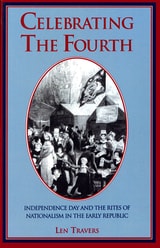
Celebrating the Fourth
Independence Day and the Rites of Nationalism in the Early RepublicLen Travers
University of Massachusetts Press, 1997
A CHOICE Outstanding Academic Book
Public rituals have always held a vital place in American culture. By far the noisiest and most popular of these to emerge in the nation's early years was Independence Day. After a decade of fitful starts, the Fourth of July eclipsed local and regional patriotic observances to become the premier “American Jubilee.” Celebrating the Fourth provides a history of this holiday and explores its role in shaping a national identity and consciousness in three cities—Boston, Charleston, and Philadelphia—during the first fifty years of the American republic. Independence Day celebrations justified, validated, and helped maintain nationalism among people unused to offering political allegiance beyond their own state borders. As the observances became increasingly popular and symbolically important, political partisans competed hotly for the right to control the meaning of the festivals.

Civilization and Monsters
Spirits of Modernity in Meiji JapanGerald Figal
Duke University Press, 2000
After discussing the role of the fantastic in everyday Japan at the eve of the Meiji period, Figal draws new connections between folklorists, writers, educators, state ideologues, and policymakers, all of whom crossed paths in a contest over supernatural terrain. He shows the ways in which a determined Meiji state was engaged in a battle to suppress, denigrate, manipulate, or reincorporate folk belief as part of an effort toward the consolidation of a modern national culture. Modern medicine and education, functioning as a means for the state to exercise its power, redefined folk practices as a source of evil. Diverse local spirits were supplanted by a new Japanese Spirit, embodied by the newly constituted emperor, the supernatural source of the nation’s strength. The monsters of folklore were identified, catalogued, and characterized according to a new regime of modern reason. But whether engaged to support state power and forge a national citizenry or to critique the arbitrary nature of that power, the fantastic, as Figal maintains, is the constant condition of Japanese modernity in all its contradictions. Furthermore, he argues, modernity in general is born of fantasy in ways that have scarcely been recognized.
Bringing unexplored and provocative new ideas to the Japan specialist, Civilization and Monsters will also appeal to readers concerned with issues of modernity in general.
Community Action and Organizational Change
Image, Narrative, IdentityBrenton D. Faber
Southern Illinois University Press, 2002
Brenton D. Faber’s spirited account of an academic consultant’s journey through banks, ghost towns, cemeteries, schools, and political campaigns explores the tenuous relationships between cultural narratives and organizational change.
Blending Faber’s firsthand experiences in the study and implementation of change with theoretical discussions of identity, agency, structure, and resistance within contexts of change, this innovative bookis among the first such communications studies to profile a scholar who is also a full participant in the projects. Drawing on theories of Michel Foucault, Anthony Giddens, and Pierre Bourdieu, Faber notes that change takes place in the realm of narrative, in the stories people tell.
Faber argues that an organization’s identity is created through internal stories. When the organization’s internal stories are consistent with its external stories, the organization’s identity is consistent and productive. When internal stories contradict the external stories, however, the organization’s identity becomes discordant. Change is the process of realigning an organization’s discordant narratives.
Faber discusses the case studies of a change management plan he wrote for a city-owned cemetery, a cultural change project he created for a downtown trade school, and a political campaign he assisted that focused on creating social change. He also includes detailed reflections on practical ways academics can become more involved in their communities as agents of progressive social change. Featuring six illustrations, Faber’s unique study demonstrates in both style and substance how stories work as agents of change.

Courting Desire
Litigating for Love in North IndiaRama Srinivasan
Rutgers University Press, 2020

Cultural Transfers in Dispute
Representations in Asia, Europe and the Arab World since the Middle AgesEdited by Jörg Feuchter, Friedhelm Hoffmann, and Bee Yun
Campus Verlag, 2011
Our conception of cultures and cultural change has altered dramatically in recent decades: no longer do we understand cultures as isolated units; rather, we see them as hybrid formations constantly engaged in a multidirectional process of exchange and influence with other cultures. Yet the very process by which we represent these cultural transfers is itself subject to cultural, political, and ideological conditions that affect our understanding, acknowledgment, and representation of them. Built around concrete examples of controversial representations of cultural transfer from Asia, the Arab world, and Europe, Cultural Transfers in Dispute presents a critical self-reflection on the scholarly practices that underpin our attempts to study and describe other cultures.

Customs and Culture in Poland under the Last Saxon King
Selections from Opis obyczajów za panowania Augusta III by father Jedrzej Kitowicz, 1728-1804Translated and with a preface and commentary by Oscar E. Swan
Central European University Press, 2019