Results by title
176 books match the query 'Deaf' and 7 start with c
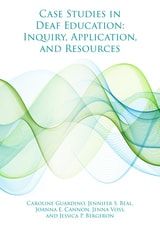
Case Studies in Deaf Education
Inquiry, Application, and ResourcesCaroline Guardino
Gallaudet University Press, 2018
The authors address the diversity of d/Dhh students by examining a multitude of learner characteristics that influence communication and educational services. These characteristics and their interactions include a student’s background experiences, language and communication mode (sign and/or listening and spoken language), language and academic proficiency levels, use of assistive hearing devices (hearing aids or cochlear implants), and family dynamics. The case studies are supported with authentic supplemental materials, such as audiograms and Individualized Educational Plans, and are accompanied by discussion questions, activities, resource lists, and a glossary of essential terms. Case Studies in Deaf Education will help teachers and allied professionals develop the knowledge and skills to use a collaborative, problem-solving process that leads to the provision of quality, effective services for students who are d/Dhh.
The accompanying Instructor’s Manual contains key information for each case study and provides PowerPoint slides that can be displayed during in-class or online discussions. Find it at the GU Press website as a downloadable file.

Change and Promise
Bilingual Deaf Education and Deaf Culture in Latin AmericaBarbara Gerner Gerner de Garcia
Gallaudet University Press, 2016
Change and Promise describes the historical, cultural, and political contexts for providing bilingual deaf education in Latin America. Bilingual deaf education uses students’ sign language, while simultaneously giving them access to and teaching them the majority spoken/written language. This book describes current bilingual deaf education programs in the region that have increased society’s understandings of Deaf culture and sign languages. This cause, as well as others, have been championed by successful social movements including the push for official recognition of Libras, the sign language of Brazil. Change and Promise covers this expanding empowerment of Deaf communities as they fight for bilingual deaf education, sign language rights, and deaf civil rights.
Despite the vast political and cultural differences throughout Latin America, an epistemological shift has occurred regarding how Deaf people are treated and their stories narrated, from labeling “deaf as handicapped” to being recognized as a linguistic minority. This panoramic study of these challenges and triumphs will provide an invaluable resource for improving outcomes in deaf education and help to secure the rights of deaf children and adults in all societies.
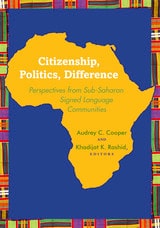
Citizenship, Politics, Difference
Perspectives from Sub-Saharan Signed Language CommunitiesAudrey C. Cooper
Gallaudet University Press, 2015
This collection centers upon two interrelated purposes: to examine sub-Saharan African deaf people’s perspectives on citizenship, politics, and difference in relation to SSSL practices, and to analyze SSSL practices in relation to sociopolitical histories and social change interests (including addressing aspects of culture, gender, language usage, race, ethnicity, sexuality, and ability). The editors have organized these themes under three main sections, Sub-Saharan Signed Languages and Deaf Communities, The Politics of Mobilizing Difference, and Citizenship. Such wide-ranging subjects as the ethics of studying Kenyan signed language, sign language and Deaf communities in Eritrea, and overcoming cultural and linguistic barriers to HIV/AIDS education drive home the importance of the unique and varied research in this collection.
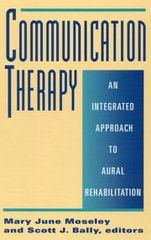
Communication Therapy
An Integrated Approach to Aural RehabilitationMary June Moseley
Gallaudet University Press, 1996
This new book for students and professionals emphasizes a functional approach to aural rehabilitation refined during the past several years. It details the use of an integrated therapy strategy designed to meet a variety of needs for each client while simultaneously working on multiple communication skill areas. Particular care has been taken to address the different requirements of deaf and hard of hearing adolescents and adults, including information about the unique needs of the culturally Deaf population. Throughout this practical text, clinicians receive encouragement to learn American Sign Language to enhance communication with Deaf clients.
Communication Therapy calls upon the expertise of various authorities well-versed in integrated therapy. They explain fully the state-of-the-art practices for all therapy areas, from global areas in communication therapy, to technology for aural rehabilitation, auditory skills, speechreading, speech and voice, pronunciation, and language skills, and telephone communication training. Case studies demonstrate the effectiveness of the integrated approach, making this book a significant advancement in communication therapy.
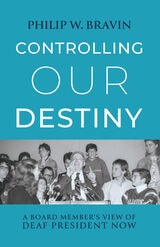
Controlling Our Destiny
A Board Member’s View of Deaf President NowPhilip W. Bravin
Gallaudet University Press, 2020
Bravin recounts the discussions and decision-making that happened behind the scenes leading up to and following the ill-fated announcement. He reflects on the integrity of the process and the internal conflict he experienced as a deaf person who supported a deaf president yet felt compelled to abide by his duties as a board member. After the protests, his leadership was recognized when he was selected as the first deaf chair of the board. Photographs and documents add depth to Bravin’s account, many of which will be seen by the public for the first time. I. King Jordan, the first deaf president of Gallaudet, provides a foreword in which he shares his own unique insight into these events.
Controlling Our Destiny captures the energy and the urgency of DPN. Readers will understand the complexities of the presidential search process and the cultural and historical contexts that triggered the protest. Bravin’s memoir contemplates power, access, community, and the enduring legacy of a movement that inspired deaf people around the world.

Crossing the Divide
Representations of Deafness in BiographyRachel M. Hartig
Gallaudet University Press, 2006
This remarkable volume examines the process by which three deaf, French biographers from the 19th and 20th centuries attempted to cross the cultural divide between deaf and hearing worlds through their work. The very different approach taken by each writer sheds light on determining at what point an individual’s assimilation into society endanger his or her sense of personal identity.
Author Hartig begins by assessing the publications of Jean-Ferdinand Berthier (1803-1886). Berthier wrote about Auguste Bébian, Abbé de l’Epée, and Abbé Sicard, all of whom taught at the National Institute for the Deaf in Paris. Although Berthier presented compelling portraits of their entire lives, he paid special attention to their political and social activism, his main interest.
Yvonne Pitrois (1880-1937) pursued her particular interest in the lives of deaf-blind people. Her biography of Helen Keller focused on her subject’s destiny in conjunction with her unique relationship with Anne Sullivan. Corinne Rocheleau-Rouleau (1881-1963) recounted the historical circumstances that led French-Canadian pioneer women to leave France. The true value of her work resides in her portraits of these pioneer women: maternal women, warriors, religious women, with an emphasis on their lives and the choices they made.
Crossing the Divide reveals clearly the passion these biographers shared for narrating the lives of those they viewed as heroes of an emerging French deaf community. All three used the genre of biography not only as a means of external exploration but also as a way to plumb their innermost selves and to resolve ambivalence about their own deafness.

Crying Hands
Eugenics and Deaf People in Nazi GermanyHorst Biesold
Gallaudet University Press, 2003
When the Nazis assumed power in Germany in 1933, they wasted no time in implementing their radical policies, first by securing passage of the Law for the Prevention of Offspring with Hereditary Diseases. Among those designated by this law as “congenitally disabled” were deaf people. Horst Biesold’s newly translated book examines this neglected aspect of Nazi “racial hygiene” through interviews with more than 1,000 deaf survivors of this brutal law that authorized forced sterilizations, abortions, and eventually murder.
Crying Hands meticulously delineates the antecedents of Nazi eugenics, beginning with Social Darwinism (postulated in the mid-nineteenth century) and tracing the various sterilization laws later initiated throughout the world, including many passed and practiced in the United States. This exceptional scholarship is movingly paralleled by the human faces fixed to the numbing statistics, as in story after story those affected recount their irretrievable loss, pain, and misplaced shame imposed upon them by the Nazi regime. Through their stories, told to Biesold in German Sign Language, they have given voice to the countless others who died from the specious science practiced by the Third Reich. And now their own trials have finally been acknowledged.