Results by title
170 books match the query 'Death, Grief, Loss' and 11 start with c
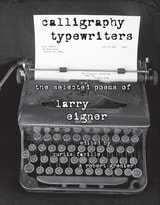
Calligraphy Typewriters
The Selected Poems of Larry EignerLarry Eigner, Edited and introduced by Curtis Faville and Robert Grenier, Foreword by Charles Bernstein
University of Alabama Press, 2016
The first and only single-volume collection of Larry Eigner’s most significant poems, gathering in one place the most celebrated of the several thousand poems that constitute his remarkable life’s work
Larry Eigner began writing poetry at age eight and was first published at age nine. Revered by poets and artists across a broad spectrum of generations and schools, Eigner’s remarkably moving poetry was created through enormous effort: because of severe physical disabilities, he produced his texts by typing with only one index finger and thumb on a 1940 Royal manual typewriter, creating a body of work that is unparalleled in its originality.
Calligraphy Typewriters showcases the most celebrated of Eigner's several thousand poems, which are an important part of the Black Mountain/Projectivist movement that began in the 1950s and which remain a primary inspiration for many younger writers, including those in the Language movement that began in the 1970s. In its two sections—Swampscott and Berkeley, named for the two locales where Eigner lived and worked—the volume traces his fantastic perception of the ordinary and his zeal for language. Eigner’s use of visual space, metaphor, and description provide fascinating insights into both his own life and the world that surrounded him. This volume maintains the distinctive visual spacing of his original typescripts, reminders of his method, aesthetic sensibility, and creative ability to compose on the typewriter.
A collection that reimagines the ordinary, Calligraphy Typewriters is the definitive selection of Eigner’s poems, and will serve well not only poets and students of poetry, but readers and writers of every vein.
Cauterized
Laura Apol
Michigan State University Press, 2024
Cenizas
PoemsCynthia Guardado
University of Arizona Press, 2022
Guardado crafted the poems in Cenizas over a ten-year period, often traveling to El Salvador for research and to conduct interviews. The Salvadoran Civil War haunts the pages of this collection as it unflinchingly explores war, its aftermath, and the bittersweet legacies that are passed down from one generation to the next. The poems mourn those who were lost and honor the strength of the speaker’s ancestors. “All my people have been born from the ashes of volcanoes,” she writes, invoking a family lineage that has endured the atrocities committed against them. Even so, El Salvador keeps pulling the speaker back—and despite warnings of danger, she still manages to find beauty among the ruins.
Cenotaph
PoemsBrock Jones
University of Arkansas Press, 2016
Finalist, 2016 Miller Williams Poetry Prize, edited by Billy Collins
Out of the contradiction, paradox, loss, and strange beauty of contemporary warfare, Brock Jones brings us Cenotaph, a collection of poems that have as their genesis Jones’s deployments to Iraq in 2002 and 2005, when he was in the US Army.
These are war poems, but also love poems and hate poems, poems about dying and living, poems about hope and hopelessness. These are poems that beautifully reflect Jones’s resignation to and rejection of the impossibility of saying anything definitive or honest about war.
These are poems that strive to do what poet Bruce Weigl described as the poet’s job: to find “some kind of miraculous way th at if you work hard enough to get the words right, that which you call horrific and wrong is defeated.”
Cenotaph is a poet doing the poet’s work: trying, hoping to get the words right.
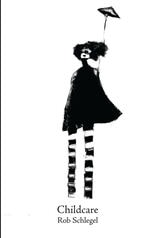
Childcare
Rob Schlegel
Four Way Books, 2023
Crackling with the hypervigilance of parenthood, Childcare explores the paradox at the root of raising kids: the joy of new life accompanies an awareness of potential loss. Rob Schlegel’s fourth collection observes the tangled emotions of fatherhood; even as he wonders at the strange intelligence of youth, he elegizes the present moment. The longitudinal wisdom of this collection appears in the choreography of its leaps — how it moves from the aside “[My son] needs my love the most when he least deserves it / Is something I read” to the reflection that “Death / Names my shape. I keep my clothes / From dust and ghosts and time. / I’m angry at my father for aging.” From Schlegel’s relentless curiosity and keen observations, the artistic crisis driving the book emerges: does poetry memorialize the ephemeral moment, saving something for us, or does it remove us from experience? The duality of language’s role — that it, ultimately, has the capacity to do both — doubles the significance of “childcare” in this collection, which comes to represent not just the work of child rearing but the dutiful care by adult children for their parents. Perhaps nothing can convey the scope and quality of family life like the concatenated dependencies of “(Un)conditional,” which terminate here: “If the cut draws blood / If life ends in desire // If it begins in love.”
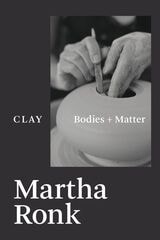
Clay
Martha Ronk
Omnidawn, 2025
The poems in Clay look to the process of forming clay on a potter’s wheel to examine our sense of touch and texture, emptiness, fragility, and the nature of time. Martha Ronk moves through the steps of creating a pot that must be formed, dried, bisque-fired, glazed, and fired again. This practice is paralleled in Ronk’s process-oriented language that addresses how we read texture and color, the ways history and landscapes appear in glazes, Mimbres bowls that covered the faces of the dead, and Giorgio Morandi’s still life paintings of ceramic forms.
For Ronk, pottery raises questions about the value of repetition, inevitable failure, and how we may become one with matter. As the potter’s hands ache and age, the bowl seems to age as it slumps or breaks. Clay includes observations from other potters and writers as well as small photographs of pots.

Clouds Upside Down Among the Flowers
New & SelectedCal Bedient
Omnidawn, 2026
The poems in Clouds Upside Down Among the Flowers speak to the emotionally and existentially tough challenge presented by Gilles Deleuze and Félix Guattari in What is Philosophy: “It may be that believing in this world, in this life, becomes our most difficult task.”Filled with wit, color, and high-spirited invention, these selected poems offer no room for softness and sentiment. They carry variant voices, whispers like dramatic asides, and mind-expanding assertions as they reveal their layers and nuances. Bedient confronts disasters of politics, love, and faithless time, never turning away from the glinting axe.
This collection also includes new poems that are direct in dealing with the difficulties of keeping faith through life. They recognize that making something—for instance, poetry—is necessary to coach the world into realness and render oneself real in the process, a journey of both intensive investigation and creativity.
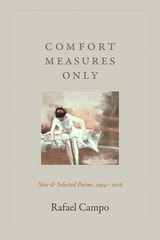
Comfort Measures Only
New and Selected Poems, 1994–2016Rafael Campo
Duke University Press, 2018
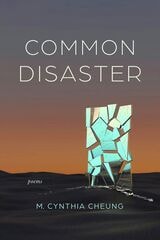
Common Disaster
PoemsM. Cynthia Cheung
Acre Books, 2025
As a front-line physician, M. Cynthia Cheung started writing poetry during the worst days of the COVID-19 pandemic. Her remarkable debut collection, Common Disaster, chronicles these experiences. Confronting not just the coronavirus but also war crimes and the death of loved ones, Cheung shows us that the pandemic is only one of many disasters we hold in common. In poems that look to both the past and future, she takes a stand against the extinction of self and memory, challenging the violence of erasure.
The period covered by the book is geologic and vast. It examines present-day evidence of ancient human activity and natural history, including the Lascaux caves, asteroid craters, tar pits, and Viking ruins. The poems include ghazals, thoughtful free verse, and work that takes up the page in reframing classical Chinese oracular texts to situate the pain of a doctor in crisis.
As a physician-poet, Cheung asks us to see beyond the every day to the devastating truths about the human condition.
Creature
Michael Dumanis
Four Way Books, 0
Crossroad Mirror
PoemsHussain Ahmed
Northwestern University Press, 2026
War and its reverberations propel people across the Nigerian landscape in Hussain Ahmed’s third collection
In Crossroad Mirror many poems begin after sundown—in quiet moments when the bounds between the past and the present, the living and the dead, blur. War and its aftershocks often form the backdrop for these scenes, though Ahmed’s verse rarely brings us to the battlefield itself. Instead, we hear the stories of refugees, civilian casualties, and ordinary soldiers trying to make sense of their circumstances. “There’s no vocabulary in the army—for grief, or death,” writes Ahmed. “Each door you exit, leads to another parade ground.” A group of soldiers wait out a rainstorm—and the war—together in a tent. Their families linger by the radio and listen for news. The “missing” loom as large as the dead.
Tracing the threads of migration that war so often catalyzes, Crossroad Mirror takes us from grassland to cornfield to coastline and explores the role storytelling and spirituality play in leaving and grieving.