114 books match the query 'Decision Making' and 12 start with c
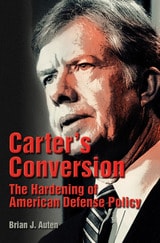
cover of Carter's Conversion: The Hardening of American Defense Policy

Carter's Conversion

The Hardening of American Defense Policy

Brian J. Auten

University of Missouri Press, 2008
When presidential candidate Jimmy Carter advocated defense budget cuts, he did so not only to save money but also with the hope of eventually abolishing nuclear weapons. Three yearslater, when President Carter announced his support of full-scale development of the MX missile and modernization of NATO’s Long-Range Theater Nuclear Force, it marked a dramatic policy shift for his administration.
In light of Carter’s cost-cutting in the first year of his administration, previous observers have attributed Carter’s subsequent shift either to the “shocks of 1979”—the Soviet Union’s move into Afghanistan and the seizure of power by Islamic revolutionaries in Iran—or to domestic political pressure, such as interest group activity, executive-legislative bargaining, or interbureaucratic conflict. Brian Auten now argues that these explanations only partially explain this midterm policy change.
In Carter’s Conversion, Auten reveals how strategic ideas and studies, allied relations, and arms control negotiations each worked to deflect Carter’s initial defense stance away from the policy path suggested by the prevailing international military environment. He also shows how the administration’s MX and Long-Range Theater Nuclear Force decisions subsequently hardened following significant adjustments to these three variables.
Employing the approach to international relations known as neoclassical realism, Auten demonstrates that Carter reassessed his strategic thinking and revised his policy stance accordingly. Integrating declassified documents, interviews, and private archives with a mountain of secondary sources, he provides a historical analysis of defense policy transformation over the first three years of the Carter administration and a detailed examination of how Carter and his national security team addressed challenges posed by the expansion of Soviet military power.
Full of rich history and cogent analysis, Carter’s Conversion presents a wealth of detailed arguments about how Carter adjusted his policy outlook, couched in a thorough understanding of weapons, arms control dynamics, and defense policy-making. As a revision ofcommon interpretations, it provides both an example of self-correcting policy change and a realist argument about the end of superpower détente and the start of the “Second Cold War.”
[more]
cover of Choices: An Introduction to Decision Theory

Choices

An Introduction to Decision Theory

Michael Resnik

University of Minnesota Press, 1987
Provides a broad yet rigorous introduction to the fundamentals of decision theory (the collection of mathematical, logical, and philosophical theories of decision making by rational individuals) that pays particular attention to matters of philosophical and logical interest.
[more]
cover of Citizen Power: A Citizen Leadership Manual Introducing the Art of No-Blame Problem Solving

Citizen Power

A Citizen Leadership Manual Introducing the Art of No-Blame Problem Solving

Harry S. Pozycki

Rutgers University Press, 2020
The Citizens Campaign, co-founded by the author and his wife, Caroline B. Pozycki, offers citizen leadership training and citizen leadership service opportunities for regular citizens. CITIZEN POWER gives all Americans the know how to become no-blame problem solvers and be part of what is emerging as a new model for a citizen driven national public service.
[more]
[more]
cover of Civil Wars and Foreign Powers: Outside Intervention in Intrastate Conflict

Civil Wars and Foreign Powers

Outside Intervention in Intrastate Conflict

Patrick M. Regan

University of Michigan Press, 2002

We have seen recent massive intervention by the United States and its allies in Europe in internal conflict in Bosnia and Kosovo. In Civil Wars and Foreign Powers: Outside Intervention in Intrastate Conflict, Patrick Regan systematically answers the question about the conditions under which third parties intervene in civil conflicts to stop the fighting. It uses data on all civil conflicts since 1945 to identify those conflicts that are amenable to outside interventions and the types of interventions that are more likely to be successful. Civil Wars and Foreign Powers is a book about how governments can help facilitate the end of civil conflicts. In a time when internal conflicts appear to be increasing in number, and increasingly destabilizing, governments need to know what policies work and when. Interventions are generally of two sorts -- unilateral, or when one state takes action, and multilateral, such as UN or NATO action. This book examines the conditions under which each form of intervention is most likely and most effective. The analysis suggests that three conditions associated with multi-lateral interventions will increase the likelihood of success: mutual consent of the parties involved; impartiality on the part of the intervenors; and the existence of a coherent intervention strategy. The questions are posed from the perspective of the decision maker and the answers offered are framed in a language familiar to the decision-making community. The book mixes descriptive case material with systematic statistical analysis of a unique data set of all civil conflicts since World War II, providing contemporary examples to illustrate overall trends in the data. Beyond the policy implications this work is also rich in theoretical development about issues of conflict and conflict management. This book will appeal to students of international conflict, civil war, ethnic conflict, and those who are concerned with developing policy in the post-cold war world to deal with intrastate conflict.
[more]
cover of Cloud Ethics: Algorithms and the Attributes of Ourselves and Others

Cloud Ethics

Algorithms and the Attributes of Ourselves and Others

Louise Amoore

Duke University Press, 2020
In Cloud Ethics Louise Amoore examines how machine learning algorithms are transforming the ethics and politics of contemporary society. Conceptualizing algorithms as ethicopolitical entities that are entangled with the data attributes of people, Amoore outlines how algorithms give incomplete accounts of themselves, learn through relationships with human practices, and exist in the world in ways that exceed their source code. In these ways, algorithms and their relations to people cannot be understood by simply examining their code, nor can ethics be encoded into algorithms. Instead, Amoore locates the ethical responsibility of algorithms in the conditions of partiality and opacity that haunt both human and algorithmic decisions. To this end, she proposes what she calls cloud ethics—an approach to holding algorithms accountable by engaging with the social and technical conditions under which they emerge and operate.
[more]
cover of Coalition Politics and Cabinet Decision Making: A Comparative Analysis of Foreign Policy Choices

Coalition Politics and Cabinet Decision Making

A Comparative Analysis of Foreign Policy Choices

Juliet Kaarbo

University of Michigan Press, 2013

Every day, coalition cabinets make policy decisions critical to international politics. Juliet Kaarbo examines the dynamics of these multiparty cabinets in parliamentary democracies in order to assess both the quality of coalition decision making and the degree to which coalitions tend to favor peaceful or military solutions. Are coalition cabinets so riddled by conflict that they cannot make foreign policy effectively, or do the multiple voices represented in the cabinet create more legitimate and imaginative responses to the international system? Do political and institutional constraints inherent to coalition cabinets lead to nonaggressive policies? Or do institutional and political forces precipitate more belligerent behavior?

Employing theory from security studies and political psychology as well as a combination of quantitative cross-national analyses and twelve qualitative comparative case studies of foreign policy made by coalition cabinets in Japan, the Netherlands, and Turkey, Kaarbo identifies the factors that generate highly aggressive policies, inconsistency, and other policy outcomes. Her findings have implications not merely for foreign policy but for all types of decision making and policy-making by coalition governments.

[more]
cover of Cochlear Implants in Children: Ethics and Choices

Cochlear Implants in Children

Ethics and Choices

John B. Christiansen

Gallaudet University Press, 2002

Cochlear Implants in Children: Ethics and Choices addresses every facet of the ongoing controversy about implanting cochlear hearing devices in children as young as 12 months old and in some cases, younger. Authors John B. Christiansen and Irene W. Leigh and contributors Jay Lucker and Patricia Elizabeth Spencer analyzed the sensitive issues connected with the procedure by reviewing 439 responses to a survey of parents with children who have cochlear implants. They followed up with interviews of the parents of children who have had a year's experience using their implants, and also the children themselves. Their findings shape the core of this useful and telling study.

       Cochlear Implants begins with a history of their development and an explanation of how implants convert sound into electric impulses that stimulate the brain. The second section focuses on pediatric implants, starting with the ways parents coped with the discovery that their child was deaf. Parents share how they learned about cochlear implants and how they chose an implant center. They also detail their children's experiences with the implants after surgery, and their progress with language acquisition and in school.

       The final part treats the controversy associated with cochlear implants, particularly the reaction of the Deaf community and the ethics of implanting young children without their consent. Cochlear Implants concludes with sage observations and recommendations for parents and professionals that complete it as the essential book on the pros and cons of this burgeoning technology.

[more]
cover of Cognitive Ecology: The Evolutionary Ecology of Information Processing and Decision Making

Cognitive Ecology

The Evolutionary Ecology of Information Processing and Decision Making

Edited by Reuven Dukas

University of Chicago Press, 1998

How does the environment shape the ways an animal processes information and makes decisions? How do constraints imposed on nervous systems affect an animal's activities? To help answer these questions, Cognitive Ecology integrates evolutionary ecology and cognitive science, demonstrating how studies of perception, memory, and learning can deepen our understanding of animal behavior and ecology.

Individual chapters consider such issues as the evolution of learning and its influence on behavior; the effects of cognitive mechanisms on the evolution of signaling behavior; how neurobiological and evolutionary processes have shaped navigational activities; functional and mechanical explanations for altered behaviors in response to changing environments; how foragers make decisions and how these decisions are influenced by the risks of predation; and how cognitive mechanisms affect partner choice.

Cognitive Ecology will encourage biologists to consider how animal cognition affects behavior, and will also interest comparative psychologists and cognitive scientists.
[more]
cover of Congressmen's Voting Decisions

Congressmen's Voting Decisions

John W. Kingdon

University of Michigan Press, 1989

Congressmen’s Voting Decisions, now in its third edition, is a classic, influential analysis of how members of the U.S. House of Representatives decide how to vote. Drawing on extensive, in-depth interviews with legislators, staff, lobbyists, and other actors in the policymaking process, John W. Kingdon moves beyond abstract theories to examine the real-world influences and rules of thumb that guide floor voting.Combining statistical analysis with qualitative fieldwork, Kingdon identifies and clarifies the roles played by various actors—including constituents, fellow congressmen, party and committee leaders, interest groups, the administration, staff, and the mass media. He argues that, far from being dominated by one factor, legislative decision-making is nuanced and adaptive, with members weighing information sources, constituency expectations, interpersonal cues, and their own policy attitudes. The book explores the pressures of modern congressional service, the rise of decentralized power through subcommittees and increased staff, and the evolving impact of campaign finance and party polarization.Revised to reflect key changes in the institution from the 1970s through the 1980s—including the rise of single-issue advocacy, institutional reforms, and the impact of divided government—this edition offers readers a rich framework for understanding both enduring patterns and contemporary developments in legislative behavior.Essential reading for students of American politics, political scientists, and informed citizens, Congressmen’s Voting Decisions remains a foundational work for anyone interested in what truly shapes the decisions in America’s legislative branch.
[more]
cover of Crime and Justice, Volume 9: Prediction and Classification in Criminal Justice Decision Making

Crime and Justice, Volume 9

Prediction and Classification in Criminal Justice Decision Making

Edited by Don M. Gottfredson and Michael Tonry

University of Chicago Press Journals, 1988
Prediction and Classification: Criminal Justice Decision Making, a collection of commissioned essays by distinguished international scholars, is the ninth volume in the Crime and Justice series. Like its predecessors, Prediction and Classification is essential reading for scholars and researchers seeking a unified source of knowledge about crime, its causes, and its cure.
[more]
cover of Crisis Bargaining and the State: The Domestic Politics of International Conflict

Crisis Bargaining and the State

The Domestic Politics of International Conflict

Susan Peterson

University of Michigan Press, 1996

The first book to systematically explore the importance of domestic institutions to crisis bargaining, Crisis Bargaining and the State argues that the influence of a state's bargaining behavior on its opponents foreign policy depends on the nature of the opposing government--its institutional structures and the strategic beliefs of its leaders. The author shows in three detailed case studies--the Crimean War crisis, the Fashoda crisis, and the Berlin crisis--the significance of domestic factors to questions of war and peace.
Peterson offers a comprehensive analysis of the domestic politics of crisis bargaining. She uses differences in state structure to explain variations in foreign policy processes and outcomes. By introducing domestic structure as a crucial intervening variable between the international environment and a state's foreign policy during an acute conflict, Peterson shows how existing cognitive and bureaucratic approaches provide complementary, not competing, explanations of crisis bargaining.
Crisis Bargaining and the State: The Domestic Politics of International Conflict applies recent research in the field of international political economy on the relationship between ideas, institutions, and the international environment to the issue of crisis bargaining. It will appeal to students, scholars, and policymakers interested in crisis bargaining, international security, and international relations.
Susan Peterson is Assistant Professor, Department of Government, The College of William & Mary.
[more]