Results by title
106 books match the query 'Dictionaries' and 5 start with c
Comanche Vocabulary
Trilingual EditionCompiled by Manuel García Rejón
University of Texas Press, 1995
The Comanche Vocabulary collected in Mexico during the years 1861-1864 by Manuel García Rejón is by far the most extensive Comanche word list compiled before the establishment of the Kiowa-Comanche-Apache Reservation in 1867. It preserves words and concepts that have since changed or even disappeared from the language, thus offering a unique historical window on earlier Comanche culture.
This translation adds the English equivalents to the original Spanish-Comanche list of 857 words, as well as a Comanche-English vocabulary and comparisons with later Comanche word lists. Daniel J. Gelo's introduction discusses the circumstances in which García Rejón gathered his material and annotates significant aspects of the vocabulary in light of current knowledge of Comanche language and culture. The book also includes information on pictography, preserving a rare sample of Comanche scapula drawing.
This information will help scholars understand the processes of language evolution and cultural change that occurred among all Native American peoples following European contact. The Comanche Vocabulary will also hold great interest for the large public fascinated by this once-dominant tribe.
Concise Dictionary of Minnesota Ojibwe
John Nichols
University of Minnesota Press, 1994
The most up-to-date resource for those interested in the linguistic and cultural heritage of the Anishinaabe, A Concise Dictionary of Minnesota Ojibwe contains more than 7,000 of the most frequently used Ojibwe words. Presented in Ojibwe-English and English-Ojibwe sections, this dictionary spells words to reflect their actual pronunciation with a direct match between the letters used and the speech sounds of Ojibwe. It contains many ancient words and meanings as well as language added in the twentieth century.
Most entries give several sample inflected forms such as the plural, diminutive, and locative forms of nouns and first person and participle forms of verbs. The basic patterns of Ojibwe word structure and the organization of the dictionary entries are clearly explained in the introduction. The most widely used modern standard writing system for Ojibwe is used throughout, and some of the key objects of Ojibwe life are authentically illustrated by coauthor and artist Earl Nyholm.Acknowledged as one of the three largest Native American languages, Ojibwe is spoken in many local varieties in the Upper Midwest and across Central and Eastern Canada. Minnesota Ojibwe is spoken in Central and Northern Minnesota, and is very similar to the Ojibwe spoken in the Ontario-Minnesota border region, Wisconsin, and Michigan's Upper Peninsula. A Concise Dictionary of Minnesota Ojibwe is an essential reference for all students of Ojibwe culture, history, language, and literature.
Counting-Out Rhymes
A DictionaryEdited by Roger D. Abrahams and Lois Rankin
University of Texas Press, 1980
Eeny, meeny, figgledy, fig.
Delia, dolia, dominig,
Ozy, pozy doma-nozy,
Tee, tau, tut,
Uggeldy, buggedy, boo!
Out goes you. (no. 129)
You can stand,
And you can sit,
But, if you play,
You must be it. (no. 577)
Counting-out rhymes are used by children between the ages of six and eleven as a special way of choosing it and beginning play. They may be short and simple ("O-U-T spells out/And out goes you") or relatively long and complicated; they may be composed of ordinary words, arrant nonsense, or a mixture of the two.
Roger D. Abrahams and Lois Rankin have gathered together a definitive compendium of counting-out rhymes in English reported to 1980. These they discovered in over two hundred sources from the nineteenth and twentieth centuries, including rhymes from England, Scotland, Ireland, Australia, New Zealand, and the United States. Representative texts are given for 582 separate rhymes, with a comprehensive listing of sources and variants for each one, as well as information on each rhyme's provenience, date, and use. Cross-references are provided for variants whose first lines differ from those of the representative texts. Abrahams's introduction discusses the significance of counting-out rhymes in children's play.
Children's folklore and speech play have attracted increasing attention in recent years. Counting-Out Rhymes will be a valuable resource for researchers in this field.
Country Music Humorists and Comedians
Loyal Jones
University of Illinois Press, 2008
Q: Is he afraid of work?
A: No, he can lie down beside it and go to sleep.
This volume is an encyclopedia of the many country music performers who made comedy a central part of their careers. Loyal Jones offers an informative biographical sketch of each performer and many entries include a sample of the artist's humor, a recording history, and amusing anecdotal tidbits. Starting with vaudeville and radio barn dance figures like the Skillet Lickers and the Weaver Brothers and Elviry, Jones moves on to the regulars on Hee Haw and the Grand Old Opry and present-day comedians from the Austin Lounge Lizards to Jeff Foxworthy.
Jones's introductory essay discusses such topics as stock comic figures, venues for comedic performance, and benchmark performers. Throughout the volume, he places each performer squarely in the context of the country music community, its performing traditions, and each artist's place in the larger cultural milieu.
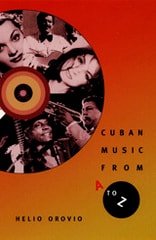
Cuban Music from A to Z
Helio Orovio
Duke University Press, 2004
The life’s work of Cuban historian and musician Helio Orovio, Cuban Music from A to Z presents the people, genres, and history of Cuban music. Arranged alphabetically and cross-referenced, the entries span from Abakuá music and dance to Eddy Zervigón, a Cuban bandleader based in New York City. They reveal an extraordinary fusion of musical elements, evident in the unique blend of African and Spanish traditions of the son musical genre and in the integration of jazz and rumba in the timba style developed by bands like Afrocuba, Chucho Valdés’s Irakeke, José Luis Cortés’s ng La Banda, and the Buena Vista Social Club. Folk and classical music, little-known composers and international superstars, drums and string instruments, symphonies and theaters—it’s all here.