Results by title
74 books match the query 'Discourse analysis' and 6 start with c
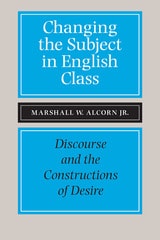
Changing the Subject in English Class
Discourse and the Constructions of DesiresMarshall W. Alcorn Jr.
Southern Illinois University Press, 2002
Drawing on the theoretical work of Jacques Lacan, Marshall W. Alcorn Jr. formulates a systematic explanation of the function and value of desire in writing instruction.
Alcorn argues that in changing the subject matter of writing instruction in order to change student opinions, composition instructors have come to adopt an insufficiently complex understanding of subjectivity. This oversimplification hinders attempts to foster cultural change. Alcorn proposes an alternative mode of instruction that makes effective use of students’ knowledge and desire. The resulting freedom in expression—personal as well as political—engenders the recognition, circulation, and elaboration of desire necessary for both human communication and effective politics.
Responding to James Berlin’s reconception of praxis in the classroom, Theresa Ebert’s espousal of disciplined instructions, and Lester Faigley’s introduction of a postmodern theory of subjectivity, Alcorn follows both Lacan and Slavoj Žižek in insisting desire be given free voice and serious recognition. In composition as in politics, desire is the ground of agency. Competing expressions of desire should generate a dialectic in social-epistemic discourse that encourages enlightenment over cynicism and social development over authoritarian demands.
With clarity and personal voice, Alcorn explains how discourse is rooted in primitive psychological functions of desire and responds to complex cultural needs. In its theoretical scope this book describes a new pedagogy that links thought to emotion and the personal to the social.
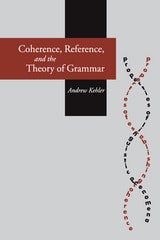
Coherence, Reference, and the Theory of Grammar
Andrew Kehler
CSLI, 2001
In this book, Andrew Kehler provides an analysis of coherence relationships between utterances that is rooted in three types of 'connection among ideas' first articulated by the philosopher David Hume—Resemblance, Cause or Effect, and Contiguity. Kehler then shows how these relationships affect the distribution of a variety of linguistic phenomena, including verb phrase ellipsis, gapping, extraction from coordinate structures, tense, and pronominal reference. In each of these areas, Kehler demonstrates how the constraints imposed by linguistic form interact with those imposed by the process of establishing coherence to explain data that has eluded previous analyses. his book will be of interest to researchers from the broad spectrum of disciplines from which discourse is studied, as well as those working in syntax, semantics, computational linguistics, psycholinguistics, and philosophy of language.
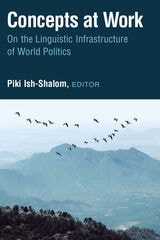
Concepts at Work
On the Linguistic Infrastructure of World PoliticsPiki Ish-Shalom, Editor
University of Michigan Press, 2021
Concepts are socially and linguistically constructed and used for multiple purposes, such as justifying war in the name of democracy; or, using the idea of democracy to resist Western intervention and influence. In this fascinating and novel edited collection, Piki Ish-Shalom and the contributors interrogate the “conceptions of concepts” in international relations. Using theoretical frameworks from Gramsci and Bourdieu, among others, the authors show that not interrogating the meaning of the language we use to talk about international relations obscures the way we understand (or portray) IR. The authors examine self-determination, winning in war, avoidance of war, military design and reform agenda, vagueness in political discourse, “blue economy,” friendship, and finally, the very idea of the “international community” itself. As the author asserts, Bourdieu’s sociology of field and Gramsci’s political theory, combined, “offer us a socio-political theory of relations of power and domination concealed by doxic knowledge and taken-for-granted rules, in which essential contested concepts and political-serving conceptions can and do play an important role.”
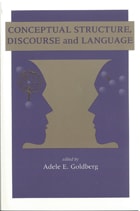
Conceptual Structure, Discourse and Language
Edited by Adele Goldberg
CSLI, 1996

Contemporary French and Francophone Narratology
Edited by John Pier
The Ohio State University Press, 2020
The essays included in this collection seek to take the pulse of recent developments in narratological research in the French-speaking countries. Theorists in these countries heavily participated in and shaped narratology, an outgrowth of the structuralist movement during the 1960s and 1970s. While US, German, and Scandinavian theorists took the forefront in the 1990s, narratology in France faded into the background. It was not until the turn of the century that a new interest in narratological issues among French researchers emerged. Activity in the field has since intensified, spurred on, in part, by the realization that narratology cannot be summed up by its formalist and structuralist origins.
Well-versed in French narrative theory, both classical and more recent, the authors in this collection also draw on scholarship coming from other research traditions. The result is that these contributions offer a number of syntheses and perspectives representative of recent French-language scholarship in the field that readers may not be familiar with or that provide them with further insight into subjects they may have encountered in other contexts. This volume will leave readers with a greater awareness of the directions taken by present-day French-language narratology as well as new and developing themes in narrative theory generally.
Contributors
Raphaël Baroni, Denis Bertrand, Olivier Caïra, Claude Calame, Benoît Hennaut, Françoise Lavocat, Sylvie Patron, John Pier, Françoise Revaz, and Richard Saint-Gelais
Conversational Rhetoric
The Rise and Fall of a Women's Tradition, 1600-1900Jane Donawerth
Southern Illinois University Press, 2011
Donawerth traces the development of women’s rhetorical theory through the voices of English and American women (and one much-translated French woman) over three centuries. She demonstrates how they cultivated theories of rhetoric centered on conversation that faded once women began writing composition textbooks for mixed-gender audiences in the latter part of the nineteenth century. She recovers and elucidates the importance of the theories in dialogues and defenses of women’s education by Bathsua Makin, Mary Astell, and Madeleine de Scudéry; in conduct books by Hannah More, Lydia Sigourney, and Eliza Farrar; in defenses of women’s preaching by Ellen Stewart, Lucretia Mott, Catherine Booth, and Frances Willard; and in elocution handbooks by Anna Morgan, Hallie Quinn Brown, Genevieve Stebbins, and Emily Bishop. In each genre, Donawerth explores facets of women’s rhetorical theory, such as the recognition of the gendered nature of communication in conduct books, the incorporation of the language of women’s rights in the defenses of women’s preaching, and the adaptation of sentimental culture to the cultivation of women’s bodies as tools of communication in elocution books.
Rather than a linear history, Conversational Rhetoric follows the starts, stops, and starting over in women’s rhetorical theory. It covers a broad range of women’s rhetorical theory in the Anglo-American world and places them in their social, rhetorical, and gendered historical contexts. This study adds women’s rhetorical theory to the rhetorical tradition, advances our understanding of women’s theories and their use of rhetoric, and offers a paradigm for analyzing the differences between men’s and women’s rhetoric from 1600 to 1900.