230 books match the query 'Doctrines' and 18 start with c
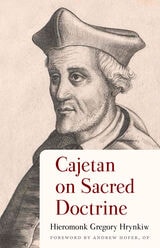
cover of Cajetan on Sacred Doctrine

Cajetan on Sacred Doctrine

Hieromonk Gregory Hrynkiw

Catholic University of America Press, 2020
Cardinal Tommaso de Vio (1469-1534), commonly known as Cajetan, remains a misunderstood figure. Cajetan on Sacred Doctrine is the first ever monograph on Cajetan as a theologian in his own right, and it fills an immense lacuna in the debate on the nature of sacred doctrine from the Thomism of the Renaissance. Confirming Cajetan as a key protagonist within the emergent Reformation, this work delivers an indispensable immersion into his theological method in relation to his closest predecessors and contemporaries: Hervaeus Natalis, Blessed Duns Scotus, Gregory of Rimini, Johannes Capreolus, Silvestro Mazzolini da Prierio, Martin Luther, and others. The first ever commentary on St. Thomas Aquinas’s entire Summa Theologiae was published by Cajetan. This monograph focuses primarily on the Summa Theologiae Ia pars, question 1, concerning sacred doctrine, and how Cajetan unpacks the potency of Aquinas’s opening syllogism, setting forth a coherent division of the question, and ultimately touching the mind of Aquinas when revealing the articles of the Apostles’ Creed as the Summa Theologiae’s macrostructure. Finally, we are shown how Cajetan emphasizes the essential link between ecclesiology and the communication of sacred doctrine, especially the papacy’s role in guaranteeing the proposal and explication of the faith. Cajetan’s accomplishments as a biblical exegete established him as a renowned Renaissance scholar and a forerunner of future ecumenical dialogue. Furthermore, his grasp of theology’s perennial properties continue to make him an important interlocutor in the renewed quest for a unity in theology in an ever more fragmented aggregation of theologies. Cajetan’s theological labor is a perpetuation of the via antiqua, a biblical-theological worldview handed down through Tradition. St. Gregory the Theologian (329-390), the via antiqua’s preeminent Eastern representative and chief theological constructor of Christendom, offers the monograph’s author--himself a Byzantine Hieromonk--a prime opportunity for a few closing insights on the innate symphony between two very distant periods and distinct theological traditions within the one ecumenical Church.
[more]
cover of Canon Law, Religion, and Politics: "Liber Amicorum" Robert Somerville

Canon Law, Religion, and Politics

"Liber Amicorum" Robert Somerville

Uta-Renate Blumenthal

Catholic University of America Press, 2012
Canon Law, Religion, and Politics extends and honors the work of the distinguished historian Robert Somerville, a preeminent expert on medieval church councils, law, and papal history.
[more]
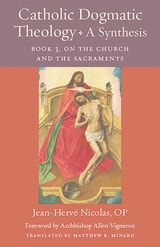
cover of Catholic Dogmatic Theology: A Synthesis, Book 3: On the Church and the Sacraments

Catholic Dogmatic Theology

A Synthesis, Book 3: On the Church and the Sacraments

Jean-Herve Nicolas

Catholic University of America Press, 2024
Every discipline, including theology, requires a synthetic overview of its acquisitions and open questions, a kind of "topography" to guide the new student and refresh the gaze of specialists. In his Synthèse dogmatique, Fr. Jean-Hervé Nicolas, OP (1910-2001) presents just such a map of Thomistic theology, focusing on the central topics of Dogmatic Theology: The One and Triune God, Christology, Mariology, Ecclesiology, the Sacraments, and the Last Things. Drawing on decades of research and teaching, Fr. Nicolas synthetically presents these topics from a faithfully Thomistic perspective. While broadly and genially engaging the theological literature of the 20th century, he nonetheless remains deeply indebted to the Thomistic school that would have formed him in his youth as a theologian. This provides the reader with an unparalleled theological vision, masterfully bringing forth, at once, what is new and what is classical. Catholic Theology: A Dogmatic Synthesis is being published in English as a multi-volume work. In this volume, Fr. Nicolas takes up the raison d’être for the mission of the Holy Spirit: the work of sanctification in and through the Church, the mystical body of Christ and sacrament of salvation. In the ecclesiology articulated in this volume, he presents a theology of the Church that is at once wholly Thomistic and also faithful to the great themes of the Second Vatican Council, drawing especially from the works of Journet, Congar, and Bouyer, in critical dialogue with other theologians of his day. He then presents a complete and detailed sacramental theology, both concerning the nature of the sacraments in general, as well as concerning each sacrament in particular, carefully striving to balance positive and scholastic theology. Serving as a professor for decades, including at the University of Fribourg, Fr. Nicolas was at once a profound scholar and a masterful pedagogue. Gathering the work of a lifetime into a single pedagogical narrative, Fr. Nicolas's Catholic Theology: A Dogmatic Synthesis provides a resource for students and scholars alike. In view of the hyper-specialization of theology today, this series of volumes provides readers with a synthetic and sapiential overview of the fundamentals of dogmatic theology from a robust and profound Thomistic perspective.
[more]
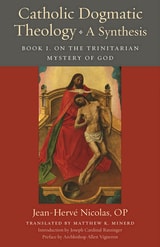
cover of Catholic Dogmatic Theology: A Synthesis: Book 1, On the Trinitarian Mystery of God

Catholic Dogmatic Theology

A Synthesis: Book 1, On the Trinitarian Mystery of God

Jean Herve Nicolas, OP

Catholic University of America Press, 2021
Every discipline, including theology, requires a synthetic overview of its acquisitions and open questions, a kind of “topography” to guide the new student and refresh the gaze of specialists. In his Synthèse dogmatique, Fr. Jean-Hervé Nicolas, OP (1910-2001) presents just such a map of Thomistic theology, focusing on the central topics of Dogmatic Theology: The One and Triune God, Christology, Mariology, Ecclesiology, the Sacraments, and the Last Things. Drawing on decades of research and teaching, Fr. Nicolas synthetically presents these topics from a faithfully Thomistic perspective. While broadly and genially engaging the theological literature of the 20th century, he nonetheless remains deeply indebted to the Thomistic school that would have formed him in his youth as a theologian. This provides the reader with an unparalleled theological vision, masterfully bringing forth, at once, what is new and what is classical. Catholic Theology: A Dogmatic Synthesis will be published in English as a multi-volume work. In this volume, Fr. Nicolas discusses the nature of theological science and the mystery of the Triune God. At once historically-informed and speculatively-detailed, this volume carefully introduces the reader to classical Thomistic positions concerning the theological articulation of the Trinitarian mystery, including the topic of the divine missions, that is, the sending of the Son and the Spirit in the economy of salvation, thereby providing an important connection between the dogmatic portion of theology and its spiritual / moral concerns. Given the central luminosity of the Trinitarian mystery in the life of faith and in theology, this volume is a pivotal chapter in theological reflection. Indeed, objectively speaking, it is the most important discussion in all of theology. Serving as a professor for decades, including at the University of Fribourg, Fr. Nicolas was at once a profound scholar and a masterful pedagogue. Gathering the work of a lifetime into a single pedagogical narrative, Fr. Nicolas’s Catholic Theology: A Dogmatic Synthesis provides a resource for students and scholars alike. In view of the hyper-specialization of theology today, this series of volumes provides readers with a synthetic and sapiential overview of the fundamentals of dogmatic theology from a robust and profound Thomistic perspective.
[more]
cover of Catholic Dogmatic Theology: A Synthesis: Book 2: On the Incarnation and Redemption

Catholic Dogmatic Theology

A Synthesis: Book 2: On the Incarnation and Redemption

Jean-Herve Nicolas

Catholic University of America Press, 2022
Every discipline, including theology, requires a synthetic overview of its acquisitions and open questions, a kind of "topography" to guide the new student and refresh the gaze of specialists. In his Synthèse dogmatique, Fr. Jean-Hervé Nicolas, OP (1910-2001) presents just such a map of Thomistic theology, focusing on the central topics of Dogmatic Theology: The One and Triune God, Christology, Mariology, Ecclesiology, the Sacraments, and the Last Things. Drawing on decades of research and teaching, Fr. Nicolas synthetically presents these topics from a faithfully Thomistic perspective. While broadly and genially engaging the theological literature of the 20th century, he nonetheless remains deeply indebted to the Thomistic school that would have formed him in his youth as a theologian. This provides the reader with an unparalleled theological vision, masterfully bringing forth, at once, what is new and what is classical. Catholic Theology: A Dogmatic Synthesis will be published in English as a multi-volume work. In this volume, Fr. Nicolas discusses the mysteries of faith directly connected with the Redemptive Incarnation: the formation of orthodox Christological dogma in the course of the first centuries of the Church; the nature of the Hypostatic Union; the latter's effects in Christ's holiness, knowledge, and incarnate activity; the mariological mysteries connected to the divine maternity; the soteriological meaning of Christ's vicarious satisfaction; and the eschatological return of Christ in Glory. Serving as a professor for decades, including at the University of Fribourg, Fr. Nicolas was at once a profound scholar and a masterful pedagogue. Gathering the work of a lifetime into a single pedagogical narrative, Fr. Nicolas's Catholic Theology: A Dogmatic Synthesis provides a resource for students and scholars alike. In view of the hyper-specialization of theology today, this series of volumes provides readers with a synthetic and sapiential overview of the fundamentals of dogmatic theology from a robust and profound Thomistic perspective.
[more]
cover of Catholic Dogmatic Theology: A Synthesis: Book 4: On Creation and the Creator

Catholic Dogmatic Theology

A Synthesis: Book 4: On Creation and the Creator

Jean-Herve Nicolas, OP, Jean-Herve

Catholic University of America Press, 2024
Every discipline, including theology, requires a synthetic overview of its acquisitions and open questions, a kind of "topography" to guide the new student and refresh the gaze of specialists. In his Synthèse dogmatique, Fr. Jean-Hervé Nicolas, OP (1910-2001) presents just such a map of Thomistic theology, focusing on the central topics of Dogmatic Theology: The One and Triune God, Christology, Mariology, Ecclesiology, the Sacraments, and the Last Things. Drawing on decades of research and teaching, Fr. Nicolas synthetically presents these topics from a faithfully Thomistic perspective. While broadly and genially engaging the theological literature of the 20th century, he nonetheless remains deeply indebted to the Thomistic school that would have formed him in his youth as a theologian. This provides the reader with an unparalleled theological vision, masterfully bringing forth, at once, what is new and what is classical. Catholic Dogmatic Theology: A Synthesis is being published in English as a multi-volume work. In this volume, originally written as a supplement to his large Synthèse dogmatique, Fr. Nicolas returns to the theological topics of the One God and Creation. In a tightly unified presentation, he discusses: what we can naturally and supernaturally know about the One God; the nature of creation and providence; the nature of bodily creatures and their evolution; the nature and activity of spiritual creatures, men and angels alike; the problem of evil; and the relationship between the natural and the supernatural. By returning to these themes classically treated in the context of the Prima pars of the Summa theologiae, Fr. Nicolas presents his readers with the completion of his dogmatic synthesis. Serving as a professor for decades, including at the University of Fribourg, Fr. Nicolas was at once a profound scholar and a masterful pedagogue. Gathering the work of a lifetime into a single pedagogical narrative, Fr. Nicolas's Catholic Dogmatic Theology: A Synthesis provides a resource for students and scholars alike. In view of the hyper-specialization of theology today, this series of volumes provides readers with a synthetic and sapiential overview of the fundamentals of dogmatic theology from a robust and profound Thomistic perspective.
[more]
cover of Catholic Social Teaching

Catholic Social Teaching

Mary Hobgood

Temple University Press, 1991
"This excellent book is one of the few scholarly investigations that analyze the official Catholic School Teaching from the perspective of the secular, economic, and political sciences." --Gregory Baum Drawing upon a lively debate within the field of social theory, Mary E. Hobgood argues that the paradigm conflict between orthodox neoclassical and radical economic models is reflected in Catholic documents that address economic justice. She maintains that dynamics within Catholic teaching are explicable only in terms of this clash of fundamentally opposing perspectives. This study shows how normative values of social justice are always tied to a particular social theory or model of society. When assumptions shift from one model to another, the concrete actions mandated by these justice norms change significantly. Consequently, the Catholic social justice tradition contains not only two mutually exclusive analyses of capitalist dynamics, it also has very different interpretations of such norms as economic democracy and a preferential notion for the poor. Hobgood argues that the Church needs to clarify the economic models that inform its social justice mandates and to assess those models for their compatibility with the Church's moral concerns, otherwise, Catholic social teaching's interpretations of justice and how Christians must act for it remain inconsistent. "[Mary Hobgood] asks what Catholic teaching itself has assumed about the way the economy works, and she brings to the fore hidden assumptions that are fundamental to the policy prescriptions in Catholic teaching.... The result is a clear picture of the divided mind and practice of Catholicism when confronting twentieth-century economic realities. If Catholic teaching did us all the service of finding a strong moral and theological voice for a critique of secular economics, Dr. Hobgood points the way to make that voice a clearer one, more aware of its limitations and of its potential." --Larry L. Rasmussen, from the Foreword "This is one of the most enlightening analyses of Catholic social teaching that I have ever read. It goes far beyond the available commentaries because of its sharp focus on the economic--not just as the content of the teaching, but its provision of the theoretical framework in which to situate the economic content. The book is very insightful with regard to Catholic social teaching, but I think her exposition holds great value for the analysis of World Council of Churches' positions and the positions of any denomination. Even beyond that, her models throw light on the daily battles within any church institution that is working for justice and peace while at the same time engaging in the compromises and contradictions required to maintain itself within the current economic system." --Marie J. Giblin, Maryknoll School of Theology
[more]
cover of Catholicism and Liberal Democracy: Forgotten Roots and Future Prospects

Catholicism and Liberal Democracy

Forgotten Roots and Future Prospects

James Martin Carr

Catholic University of America Press, 2022
Catholicism and Liberal Democracy seeks to clarify if there is a place for Catholicism in the public discourse of modern liberal democracy, bringing secular liberalism, as articulated by Jürgen Habermas, into conversation with the Catholic tradition. James Martin Carr explores three aspects of the Catholic tradition relevant to this debate: the Church’s response to democracy from the nineteenth century up until the eve of the Second Vatican Council; the Council’s engagement with modernity, in particular through Gaudium et spes and Dignitatis humanae; and Joseph Ratzinger’s theology of politics as a particularly incisive (and influential) articulation of the Catholic tradition in this area. Jürgen Habermas’s theorization of the place of religion in modern democracy, both in his earlier secularist phase and after his ‘post-secular’ turn, is evaluated. The adequacy of Habermas’s recent attempts to accommodate religious citizens are critically examined and it is argued that developments in his later thought logically require a more thoroughgoing revision of his earlier theory. These developments, it is argued, create tantalizing openings for fruitful dialogue between Habermas and the Catholic tradition. Using analytical tools drawn from communications theory, the debates on same-sex marriage at Westminster and in the Irish referendum campaign are analyzed, assessing whether Catholic contributions to these debates comply with Habermasian rules of civic discourse. In light of this analysis, the prospects of, and impediments to, Catholic participation in public discourse are appraised. Carr concludes by proposing a Ratzingerian critique of contemporary attempts to redefine marriage within a broader, more fundamental critique of the modern democratic state as currently configured. A political system founded upon secularist monism cannot but regard Christian Gelasianism, and its Catholic variant in particular, as an existential threat. Thus, Catholics, however Habermasian their political behavior, can never be more than uneasy bedfellows with modern liberal democracy.
[more]
cover of Christ Our Hope: An Introduction to Eschatology

Christ Our Hope

An Introduction to Eschatology

Paul O'Callaghan

Catholic University of America Press, 2011
Christ Our Hope is a masterful reflection on Christian eschatology, in a textbook of twelve accessible chapters.
[more]
cover of Christ and Spirituality in St. Thomas Aquinas

Christ and Spirituality in St. Thomas Aquinas

Jean-Pierre Torrell

Catholic University of America Press, 2011
The studies in this volume investigate themes of particular spiritual relevance in Aquinas's theology: friendship, charity, prayer, configuration to Christ, priesthood, preaching.
[more]
cover of Christian faith & human understanding: studies on the Eucharist, Trinity, and the human person

Christian faith & human understanding

studies on the Eucharist, Trinity, and the human person

Robert Sokolowski

Catholic University of America Press, 2006
In this collection of essays, renowned philosopher Robert Sokolowski illustrates how Christian faith is not an alternative to reason, but rather an enhancement of it.
[more]
cover of Church and Communion: An Introduction to Ecumenical Theology, Second Edition

Church and Communion

An Introduction to Ecumenical Theology, Second Edition

Philip Goyret

Catholic University of America Press, 2021
This book is about ecumenism, from a Catholic point of view. The first part, chapters 1 and 2, describe the history of divisions within the Church, as well as of the efforts to bring about Christian unity. The second part examines Ecumenism from a systematic theological perspective. This first part takes into account the different factors that led to definitive ruptures within the Church, which usually are not only theological. The text gives useful information about what happened after the respective divisions as well as about the various attempts to restore unity, the development of the Ecumenical Movement in the 20th Century, and the current situation of ecumenical dialogue within the Catholic Church. While offering insight into the sad history that has led to the present disunity, this work also highlights the way Christians have sought to bring to fulfill the petition of Christ that his disciples might be one, as He and the Father are one. The second part―chapters three, four and five―offers a systematic theological analysis of unity in the Church, from the point of view of dogmatic theology. We find here an explanation of the Catholic concept of ecumenism, of how Catholic theology understands the unity of the Church, and, finally, of the Catholic principles which sustain the efforts for regaining unity in the Church. The Second Vatican Council, and particularly the Constitution Lumen gentium and the Decree Unitatis redintegratio, are at the foundation of these reflections. At the same time, since the theology of the Church and the life of the Church are intimately connected, there is a profound link between this dogmatic section and the earlier historical section. The last chapter, about the practice of ecumenism, is also written from a theological perspective, but with more links with life and spirituality. The chapter recalls that ecumenism can never simply remain a set of theological principles, but rather inspires an attitude and action in charity which are essential to the Christian life.
[more]
cover of Church, State, and Society: An Introduction to Catholic Social Doctrine

Church, State, and Society

An Introduction to Catholic Social Doctrine

J. Brian Benestad

Catholic University of America Press, 2011
Church, State, and Society explains the nuanced understanding of human dignity and the common good found in the Catholic intellectual tradition.
[more]
cover of Church, State, and Society: An Introduction to Catholic Social Doctrine, Second Edition

Church, State, and Society

An Introduction to Catholic Social Doctrine, Second Edition

J. Brian Benestad

Catholic University of America Press, 2025
Church, State, and Society explains the nuanced understanding of human dignity and the common good found in the Catholic intellectual tradition. It makes the case that liberal-arts education is an essential part of the common good because it helps people understand their dignity and all that justice requires. The book is divided into four parts. The first treats key themes of social life: the dignity of the human person, human rights, natural law, and the common good. Part two focuses on the three principal mediating institutions of civil society: the family, the Church, and the Catholic university. Part three considers the economy, work, poverty, immigration, and the environment, while part four focuses on the international community and just war principles. The conclusion discusses tension between Catholic Social Doctrine and liberal democracy. This second edition contains new chapters on religious liberty, cooperation with evil, issues around gender ideology, and contemporary questions of Catholics in political life, including regarding the reception of the sacraments. The book also includes new material on economic and social teaching of the Magisterium promulgated since the first edition, especially related to the teaching of Benedict XVI.
[more]
cover of Conscience and Community: Sterling M. McMurrin, Obert C. Tanner, and Lowell L. Bennion

Conscience and Community

Sterling M. McMurrin, Obert C. Tanner, and Lowell L. Bennion

Edited by Robert Alan Goldberg, L. Jackson Newell, and Linda K. Newell

University of Utah Press, 2018

Lowell Bennion, Sterling McMurrin, and Obert Tanner were colleagues whose lives often intertwined. All professors at the University of Utah, these three scholars addressed issues and events of their time; each influenced the thought and culture of Mormonism, helping to institute a period of intellectual life and social activism. In Conscience and Community multiple scholars, family members, and others look at the private and public aspects of three lives and examine the roles they played in shaping their communities inside and out of their university and church.
 
Lowell Bennion was founding director of the LDS Institute of Religion and professor of sociology at the University of Utah. He established multiple community service entities. Sterling McMurrin was distinguished professor of philosophy and history, dean of the graduate school, and former commissioner of education under JFK. He dismissed dogma and doctrine as barriers to a search for moral and spiritual understanding. Obert Tanner, also of the university’s Philosophy Department, excelled in teaching and business and became especially well known for philanthropy. The lives and work of these three men reveal the tensions between faith and reason, conscience and obedience. Their stories speak to us today because their concerns remain our concerns: racial justice, women’s equality, gay rights, and the meaning of integrity and conscience. 
[more]
cover of Contemplation and the Cross: A Catholic Introduction to the Spiritual Life

Contemplation and the Cross

A Catholic Introduction to the Spiritual Life

Thomas Joseph White, OP

Catholic University of America Press, 2025
What are the aims of the Christian spiritual life and how can we deepen our life in Christ? What is the Catholic form of the spiritual life and what are its causes? This book serves as an introduction to Catholic spirituality by examining the mystery of Jesus Christ- His Crucifixion, and His Resurrection- as the center of our spiritual life. The central argument of the book is that the life, death, and resurrection of Jesus present us with the form or essence of the Christian spiritual life and orient us toward union with the Trinity as the final end or aim of human existence. The means of union with God through sacraments, the interior life of the theological virtues (faith, hope, and charity), and the virtue of religion are considered as vehicles by which we rejoin God in Christ. The effects of the Cross are considered in our life by a study of the spiritual and corporal works of mercy. The Virgin Mary is considered as a model of the spiritual life. What results is a Christ-centered spirituality that is sacramental and Marian, and that depicts the life of the Church living in contemplative charity as the basic expression of Catholic spirituality.
[more]
cover of Continuing Revelation: Essays on Doctrine

Continuing Revelation

Essays on Doctrine

Bryan Buchanan

Signature Books, 2021

Determining what is and what is not Mormon doctrine is a difficult endeavor. The Church of Jesus Christ of Latter-day Saints embraces four books of scripture as its canon, but also believes the church is led by a living prophet. Additions to the canon have been rare since the death of church founder Joseph Smith. Joseph Fielding Smith, tenth church president, said that if the prophet ever contradicts canon, canon prevails. On the other hand, Ezra Taft Benson, the church’s thirteenth president, said that the living prophet’s words are more important than cannon. Such messages create no shortage of confusion among church members. 

The question “What is doctrine?” opens the door for theologians and historians to wrestle over the answer, and to do so thoughtfully and insightfully. In Continuing Revelation, editor Bryan Buchanan has compiled essays that seek greater understanding about what doctrine is and why it matters. 

The Challenge of Defining LDS Doctrine, by Loyd Isao Ericson • LDS Theology and the Omnis: The Dangers of Theological Speculation, by David H. Bailey • Crawling out of the Primordial Soup: A Step toward the Emergence of an LDS Theology Compatible with Organic Evolution, by Steven L. Peck • “To Destroy the Agency of Man”: The War in Heaven in LDS Thought, by Boyd Petersen • Three Sub-Degrees in the Celestial Kingdom?, by Shannon P. Flynn • Heavenly Mother: The Mother of All Women, by Blaire Ostler • Mormonism and the Problem of Heterodoxy, by Kelli D. Potter • Women at the Gates of Mortality: Relief Society Birth and Death Rituals, by Susanna Morrill • “Shake Off the Dust of Thy Feet”: The Rise and Fall of Mormon Ritual Cursing, by Samuel R. Weber • “Satan Mourns Naked Upon the Earth: Locating Mormon Possession and Exorcism Rituals in the American Religious Landscape, 1830–1977, by Stephen C. Taysom
[more]
cover of Counsels of Imperfection: Thinking Through Catholic Social Teaching

Counsels of Imperfection

Thinking Through Catholic Social Teaching

Edward Hadas

Catholic University of America Press, 2021

For more than a century, the teaching authority of the Catholic Church has attempted to walk along with the modern world, criticizing what is bad and praising what is good. Counsels of Imperfection described the current state of that fairly bumpy journey. The book is divided into 11 chapters. First comes an introduction to ever-changing modernity and the unchanging Christian understanding of human nature and society. Then come two chapters on economics, including a careful delineation of the Catholic response, past and present, to socialism and capitalism. The next topic is government, with one chapter on Church and State, another on War, and a third that runs quickly through democracy, human rights, the welfare state, crimes and punishments (including the death penalty), anti-Semitism, and migration. Counsels of Imperfection then dedicates two chapters on ecology, including an enthusiastic analysis of Francis’s “technocratic paradigm”. The last topic is the family teaching, which presents the social aspects of the Church’s sexual teaching. A brief concluding chapter looks at the teaching’s changing response to the modern world, and at the ambiguous Catholic appreciation of the modern idea of progress. For each topic, Counsels of Imperfection provides biblical, historical and a broad philosophical background. Thomas Aquinas appears often, but so does G. W. F Hegel. The goal is not only to explain what the Church really says, but also how it got to its current position and who it is arguing with. In the spirit of a doctrine that is always in development, Counsels of Imperfection points out both strong-points and imperfections in the teaching. The book should be of interest to specialists in Catholic Social Teaching, but its main audience is curious newcomers, especially people who do not want to be told that there are simple Catholic answers to the complicated problems of the modern world.
[more]