Results by title
76 books match the query 'Educational change' and 7 start with c

Campaigns of Knowledge
U.S. Pedagogies of Colonialism and Occupation in the Philippines and JapanMalini Johar Schueller
Temple University Press, 2019
The creation of a new school system in the Philippines in 1898 and educational reforms in occupied Japan, both with stated goals of democratization, speaks to a singular vision of America as savior, following its politics of violence with benevolent recuperation. The pedagogy of recovery—in which schooling was central and natives were forced to accept empire through education—might have shown how Americans could be good occupiers, but it also created projects of Orientalist racial management: Filipinos had to be educated and civilized, while the Japanese had to be reeducated and “de-civilized.”
In Campaigns of Knowledge, Malini Schueller contrapuntally reads state-sanctioned proclamations, educational agendas, and school textbooks alongside political cartoons, novels, short stories, and films to demonstrate how the U.S. tutelary project was rerouted, appropriated, reinterpreted, and resisted. In doing so, she highlights how schooling was conceived as a process of subjectification, creating particular modes of thought, behaviors, aspirations, and desires that would render the natives docile subjects amenable to American-style colonialism in the Philippines and occupation in Japan.
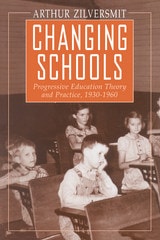
Changing Schools
Progressive Education Theory and Practice, 1930-1960Arthur Zilversmit
University of Chicago Press, 1993
Through a focus on actual classroom practices in several school systems in the Chicago area, Zilversmit examines the impact of Dewey's ideas at a national and local level. He looks at the course of progressivism from the 1930s, when its influence was at its height but reform was difficult because of the Depression, through the post-World War II period when the baby boom led to rapid school expansion. The new affluence made reform possible, but the Cold War put progressivism on the defensive.
Zilversmit's goal is to illuminate the role of the ideas of the progressives in determining school practices so we can develop a better understanding of the relationship between education ideas and educational practices. This understanding, argues Zilversmit, will better enable us to determine new directions for educational reform, and to determine how reforms can be successfully implemented.
Charter School City
What the End of Traditional Public Schools in New Orleans Means for American EducationDouglas N. Harris
University of Chicago Press, 2020
New Orleans became the first US city ever to adopt a school system based on the principles of markets and economics. When the state took over all of the city’s public schools, it turned them over to non-profit charter school managers accountable under performance-based contracts. Students were no longer obligated to attend a specific school based upon their address, allowing families to act like consumers and choose schools in any neighborhood. The teacher union contract, tenure, and certification rules were eliminated, giving schools autonomy and control to hire and fire as they pleased.
In Charter School City, Douglas N. Harris provides an inside look at how and why these reform decisions were made and offers many surprising findings from one of the most extensive and rigorous evaluations of a district school reform ever conducted. Through close examination of the results, Harris finds that this unprecedented experiment was a noteworthy success on almost every measurable student outcome. But, as Harris shows, New Orleans was uniquely situated for these reforms to work well and that this market-based reform still required some specific and active roles for government. Letting free markets rule on their own without government involvement will not generate the kinds of changes their advocates suggest.
Combining the evidence from New Orleans with that from other cities, Harris draws out the broader lessons of this unprecedented reform effort. At a time when charter school debates are more based on ideology than data, this book is a powerful, evidence-based, and in-depth look at how we can rethink the roles for governments, markets, and nonprofit organizations in education to ensure that America’s schools fulfill their potential for all students.
Checklist for Change
Making American Higher Education a Sustainable EnterpriseZemsky, Robert
Rutgers University Press, 2013
Robert Zemsky details the complications that have impeded every credible reform intended to change American higher education. He demythologizes such initiatives as the Morrill Act, the GI Bill, and the Higher Education Act of 1972, shedding new light on their origins and the ways they have shaped higher education in unanticipated and not commonly understood ways. Next, he addresses overly simplistic arguments about the causes of the problems we face and builds a convincing argument that well-intentioned actions have combined to create the current mess for which everyone is to blame.
Using provocative case studies, Zemsky describes the reforms being implemented at a few institutions with the hope that these might serve as harbingers of the kinds of change needed: the University of Minnesota at Rochester’s compact curriculum in the health sciences only, Whittier College’s emphasis on learning outcomes, and the University of Wisconsin Oshkosh’s coherent overall curriculum.
In conclusion, Zemsky describes the principal changes that must occur not singly but in combination. These include a fundamental recasting of federal financial aid; new mechanisms for better channeling the competition among colleges and universities; recasting the undergraduate curriculum; and a stronger, more collective faculty voice in governance that defines not why, but how the enterprise must change.
Closing The Book On Homework
Enhancing Public EducationJohn Buell
Temple University Press, 2003
Collection Management for Youth
Equity, Inclusion, and LearningSandra Hughes-Hassell
American Library Association, 2020
With a renewed emphasis on facilitating learning, supporting multiple literacies, and advancing equity and inclusion, the thoroughly updated and revised second edition of this trusted text provides models and tools that will enable library staff who serve youth to create and maintain collections that provide equitable access to all youth. And as Hughes-Hassell demonstrates, the only way to do this is for collection managers to be learner-centered, confidently acting as information guides, change agents, and leaders. Based on the latest educational theory and research, this book
- presents the argument for why collection management decisions and practices should focus on equity, exploring systemic inequities, educational paradigm shifts, developments in the information environment, and other key factors;
- lays out the theoretical foundation for developing and managing a library collection that facilitates learning, supports the development of multiple literacies, and provides equitable access to an increasingly diverse group of young learners;
- touches upon current competencies and standards by AASL, YALSA, and ALSC;
- uses a learner-centered and equity perspective to cover core issues and criteria such as selection and removal of materials, budgeting, and cooperation among libraries;
- shows how a business viewpoint can assist the learner-centered collector in articulating the central significance of the collection to learning;
- discusses how library staff can work collaboratively to create policy and negotiate budgets; and
- includes customizable tools and templates, including a Stakeholder Contact/SWOT Analysis, Decision-Making Model for Selecting Resources and Access Points that Support Learning and Advance Equity, and Collection Development Analysis Worksheet.
This resource will be as useful to current school librarians and supervisors, youth librarians in public libraries, and educators as it will to LIS students.

Culture Wars
School and Society in the Conservative RestorationIra Shor
University of Chicago Press, 1992
"An outstanding work of educational theory and history."—John Coatsworth, University of Chicago