Results by title
79 books match the query 'Election' and 9 start with c
Campaign Crossroads
Presidential Politics in Indiana from Lincoln to ObamaAndrew E. Stoner
Indiana Historical Society Press, 2017
Campaign Dynamics
The Race for GovernorThomas M. Carsey
University of Michigan Press, 2001
Campaign Inc.
How Leadership and Organization Propelled Barack Obama to the White HouseHenry F. De Sio., Jr.
University of Iowa Press, 2014
De Sio shows readers that Obama himself was direct about his vision for the campaign when he instructed his staff to “run it like a business.” Thus, this is less the story of Barack Obama, candidate, and more the story of Barack Obama, CEO. Because campaigns are launched from scratch during every election cycle, they are the ultimate entrepreneurial experience. In the course of the election, the Obama campaign scaled up from a scrappy start-up to a nearly $1 billion operation, becoming a hothouse environment on which the glare of the media spotlight was permanently trained.
Campaign Inc. allows readers to peek behind the curtain at the underdog organization that brought down the Clinton campaign and later went on to defeat the Republican machine, while offering lessons in leadership and organization to innovators, executives, and entrepreneurs.
Campaign
A Cartoon History of Bill Clinton's Race for the White HouseMary Ann Barton
University of Arkansas Press, 1993
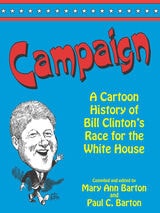
For many people, in the United States and abroad, the dramas of the campaign created the character of Clinton. From the Gennifer Flowers debacle to Clinton’s
resurrection at the Democratic National Convention and the triumph of the election win, the incisive cartoons in this collection capture Clinton’s emerging image in a way that no written word can. The forty-five contributing artists use these cartoons to depict the breathtaking and colorful events that only a presidential campaign can produce and offer hours of entertainment for any reader.
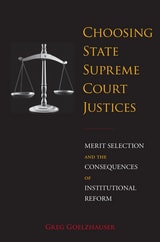
Choosing State Supreme Court Justices
Merit Selection and the Consequences of Institutional ReformGreg Goelzhauser
Temple University Press, 2016
Since 1940, more than half of all states have switched at least in part from popular election or elite appointment to experiment with merit selection in choosing some or all of their state supreme court justices. Under merit selection, a commission—often comprising some combination of judges, attorneys, and the general public—is tasked with considering applications from candidates vying to fill a judicial vacancy. Ostensibly, the commission forwards the best candidates to the governor, who ultimately appoints them. Presently, numerous states are debating whether to adopt or abolish merit selection.
In his short, sharp book, Choosing State Supreme Court Justices, Greg Goelzhauser utilizes new data on more than 1,500 state supreme court justices seated from 1960 through 2014 to answer the question, Does merit selection produce better types of judges? He traces the rise of merit selection and explores whether certain judicial selection institutions favor candidates who have better qualifications, are more diverse, and have different types of professional experience.
Goelzhauser’s results ultimately contribute to the broader debate concerning comparative institutional performance with respect to state judicial selection.
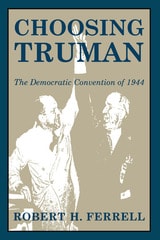
Choosing Truman
The Democratic Convention of 1944Robert H. Ferrell
University of Missouri Press, 2000
As Franklin D. Roosevelt's health deteriorated in the months leading up to the Democratic National Convention of 1944, Democratic leaders confronted a dire situation. Given the inevitability of the president's death during a fourth term, the choice of a running mate for FDR was of profound importance. The Democrats needed a man they could trust. They needed Harry S. Truman.
Robert Ferrell tells an engrossing tale of ruthless ambition, secret meetings, and party politics. Roosevelt emerges as a manipulative leader whose desire to retain power led to a blatant disregard for the loyalty of his subordinates and the aspirations of his vice presidential hopefuls. Startling in its conclusions, impeccable in its research, Choosing Truman is an engrossing, behind-the-scenes look at the making of the nation's thirty-third president.
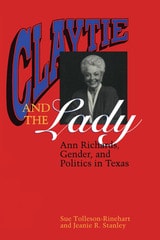
Claytie and the Lady
Ann Richards, Gender, and Politics in TexasBy Sue Tolleson-Rinehart and Jeanie R. Stanley
University of Texas Press, 1994
It was like a remake of The Cowboy and the Lady, except that this time they weren't friends. The 1990 Texas governor's race pitted Republican Clayton Williams, a politically conservative rancher and oil millionaire, against Democrat Ann Richards, an experienced progressive politician noted for her toughness and quick wit. Their differences offered voters a choice not only of policies and programs but also of stereotypes and myths of men's and women's proper roles.
Claytie and the Lady is the first in-depth look at how gender affected the 1990 governor's race. The authors' analysis reveals that Ann Richards' victory was a result of a unique combination of characteristics. She was simultaneously tough enough to convince voters that she could lead and feminine enough to put them at ease. At the same time, she remained committed to the progressive and women's issues that had won her the early support of feminists and progressives. The authors also show how Clayton Williams' appeal to the Texas cowboy myth backfired when he broke the cowboy code of chivalry to women.
The authors set their discussion within the historical context of twentieth-century Texas politics and the theoretical context of gender politics in order to pose a number of thought-provoking questions about the effects of women's participation in political life. Interviews with key players in the 1990 election, including Governor Ann Richards, add a lively and insightful counterpoint to the text.
Color of Law
A NovelDavid Milofsky
University Press of Colorado, 2000
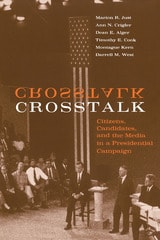
Crosstalk
Citizens, Candidates, and the Media in a Presidential CampaignMarion R. Just, Ann N. Crigler, Dean E. Alger, Timothy E. Cook, Montague Kern, a
University of Chicago Press, 1996
Examining political advertisements, news coverage, ad watches, and talk shows in Los Angeles, Boston, Winston-Salem, and Fargo/Moorhead, the authors chart the impact of different information environments on citizens and show how people developed images of candidates over the course of the campaign. Crosstalk presents persuasive evidence that campaigns do matter, that citizens are active participants in the campaign process, and their perceptions of a candidate's character is the central factor in the voting process.
This innovative study contributes significantly to our understanding of the 1992 presidential campaign and of campaigns in general, and shows how election campaigns can play an important role in the long-term vitality of democracy.