Results by title
271 books match the query 'Employment' and 17 start with c
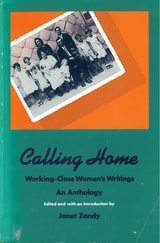
Calling Home
Working-Class Women's WritingsZandy, Janet
Rutgers University Press, 1990
The geography of home, identity, parents, sex, motherhood, the dominance of the job, the overlapping of private and public worlds, the promise of solidarity and community are a few of the themes of this book. Here is a chorus of working class women's voices: Sandra Cisneros, Barbara Garson, Meridel Le Sueur, Tillie Olsen, Barbara Smith, Endesha I. M. Holland, Mother Jones, Nellie Wong, Agnes Smedley, Bobbie Louise Hawkins, Sharon Doubiago, Carol Tarlen, Hazel Hall, Margaret Randall, Judy Grahn, and many others!
The aesthetic impulse is shaped by class, but not limited to one ruling class. What connects these writers is a collective consciousness, a class, which rejects bondage and lays claim to liberation through all the possibilities of language. Calling Home is illustrated with family photographs as well as images of working women by professional photographers.
Capturing Labor
A History of Unfree Work in the SouthwestEdited by Jessica R. Pliley and John Mckiernan-González
University of Texas Press, 2026
A collection of essays grappling with the many, often overlooked, forms of unfree labor in the West.
When Americans think of unfree labor—coerced, extracted from workers unable to freely enter and exit contracts—what comes to mind is Black slavery and peonage in the South. But other forms of unfree labor also built the United States. Collecting a diverse range of sharply argued historical essays, Capturing Labor shares the story of unfree labor in the Southwest, affecting mainly Indigenous people, Mexican Americans, and people of color.
In Texas and elsewhere, state agents developed various methods for directing the movement of workers, seizing their time, and controlling the products of their efforts. Case studies highlight the detention during World War I of Indigenous children and unaccompanied women, who were placed in boarding schools, fined, and obligated to work off the resulting debt. Other essays expose authorities forcing workers to break strikes and jailing Americans who supported labor uprisings in rural Mexico and the United States. Prisons and asylums supplied coerced agricultural workers and musicians who were never compensated for their labor or by the labels that took their recordings.
Editors Jessica Pliley and John Mckiernan-González contend that unfree labor continues to shape American life, and is all around us today. Understanding its history aids us in recognizing and bringing attention to the grim realities of the present.

Changing Corporate America from Inside Out
Lesbian and Gay Workplace RightsNicole C. Raeburn
University of Minnesota Press, 2004
Investigates how gays, lesbians, and bisexuals have succeeded in securing equitable benefits
Despite the backlash against lesbian and gay rights occurring in cities and states across the country, a growing number of corporations are actually expanding protections and benefits for their gay and lesbian employees. Why this should be, and why some corporations are increasingly open to inclusive policies while others are determinedly not, is what Nicole C. Raeburn seeks to explain in Changing Corporate America from Inside Out.
A long-overdue study of the workplace movement, Raeburn’s analysis focuses on the mobilization of lesbian, gay, and bisexual employee networks over the past fifteen years to win domestic partner benefits in Fortune 1000 companies. Drawing on surveys of nearly one hundred corporations with and without gay networks, intensive interviews with human resources executives and gay employee activists, as well as a number of case studies, Raeburn reveals the impact of the larger social and political environment on corporations’s openness to gay-inclusive policies, the effects of industry and corporate characteristics on companies’s willingness to adopt such policies, and what strategies have been most effective in transforming corporate policies and practices to support equitable benefits for all workers.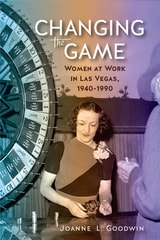
Changing the Game
Women at Work in Las Vegas, 1940-1990Joanne L. Goodwin
University of Nevada Press, 2014
Their experiences anticipated major trends in post-World War II labor history: the national migration of workers during and after the war, the growing proportion of women in the labor force, balancing work with family life, the unionization of service workers, and, above all, the desegregation of the labor force by sex and race. These narratives show women in Las Vegas resisting preassigned roles, seeing their work as a testimony of skill, a measure of independence, and a fulfillment of needs. Overall, these stories of women who lived and worked in Las Vegas in the last half of the twentieth century reveal much about the broader transitions for women in America between 1940 and 1990.
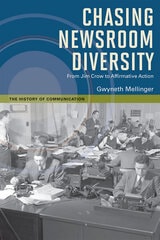
Chasing Newsroom Diversity
From Jim Crow to Affirmative ActionGwyneth Mellinger
University of Illinois Press, 2013
Cheaper by the Hour
Temporary Lawyers and the Deprofessionalization of the LawAuthored by Robert A. Brooks
Temple University Press, 2012
Recent law school graduates often work as temporary attorneys, but law firm layoffs and downsizing have strengthened the temporary attorney industry. Cheaper by the Hour is the first book-length account of these workers.
Drawing from participant observation and interviews, Robert A. Brooks provides a richly detailed ethnographic account of freelance attorneys in Washington, DC. He places their document review work in the larger context of the deprofessionalization of skilled labor and considers how professionals relegated to temporary jobs feel diminished, degraded, or demeaned by work that is often tedious, repetitive, and well beneath their abilities.
Brooks documents how firms break a lawyer's work into discrete components that require less skill to realize maximum profits. Moreover, he argues that information technology and efficiency demands are further stratifying the profession and creating a new underclass of lawyers who do low-end commodity work.

Children of Other Worlds
Exploitation in the Global MarketJeremy Seabrook
Pluto Press, 2001
City of Women
Sex and Class in New York, 1789-1860Christine Stansell
University of Illinois Press, 1987
City of Women delves into the misfortunes that New York City's laboring women suffered and the problems that resulted. Looking at how and why a community of women workers came into existence, Christine Stansell analyzes the social conflicts surrounding laboring women and they social pressure these conflicts brought to bear on others. The result is a fascinating journey into economic relations and cultural forms that influenced working women's lives—one that reveals at last the female city concealed within America's first great metropolis.
Comrade or Brother?
A History of the British Labour MovementMary Davis
Pluto Press, 2009
Critical and iconoclastic, Comrade or Brother? traces the history of the British Labour Movement from its beginnings at the onset of industrialisation through its development within a capitalist society, up to the end of the twentieth-century. Written by a leading activist in the labour movement, the book redresses the balance in much labour history writing. It examines the place of women and the influence of racism and sexism as well as providing a critical analysis of the rival ideologies which played a role in the uneven development of the labour movement.
Constituting Workers, Protecting Women
Gender, Law and Labor in the Progressive Era and New Deal YearsJulie Novkov
University of Michigan Press, 2001
During the Progressive Era and New Deal, courts often invalidated generalized protective legislation, but frequently upheld measures that limited women's terms and conditions of labor. The book explores the reasoning in such cases that were decided between 1873 and 1937. By analyzing all reported opinion on the state and federal level, as well as materials from the women's movement and briefs filed in the U.S. Supreme Court, the study demonstrates that considerations of cases involving women's measures ultimately came to drive the development of doctrine.
The study combines historical institutionalism and feminism to address constitutional interpretation, showing that an analysis of conflict over the meaning of legal categories provides a deeper understanding of constitutional development. In doing so, it rejects purely political interpretations of the so-called Lochner era, in which the courts invalidated many legislative efforts to ameliorate the worst effects of capitalism. By addressing the dynamic interactions among interested laypersons, attorneys, and judges, it demonstrates that no individuals or institutions have complete control over the generation of constitutional meaning.
Julie Novkov is Assistant Professor of Political Science, University of Oregon

Consuming Work
Youth Labor in AmericaYasemin Besen-Cassino
Temple University Press, 2014
Continually Working
Black Women, Community Intellectualism, and Economic Justice in Postwar MilwaukeeCrystal Marie Moten
Vanderbilt University Press, 2023
Moten emphasizes the ways in which Black women transformed the urban landscape by simultaneously occupying spaces from which they had been historically excluded and creating their own spaces. Black women refused to be marginalized within the historically white and middle‑class Milwaukee Young Women's Christian Association (MYWCA), an association whose mission centered on supporting women in urban areas. Black women forged interracial relationships within this organization and made it, not without much conflict and struggle, one of the most socially progressive organizations in the city. When Black women could not integrate historically white institutions, they created their own. They established financial and educational institutions, such as Pressley School of Beauty Culture, which beautician Mattie Pressley DeWese opened in 1946 as a result of segregation in the beauty training industry. This school served economic, educational, and community development purposes as well as created economic opportunities for Black women. Historically and contemporarily, Milwaukee has been and is still known as one of the most segregated cities in the nation. Black women have always contested urban inequality, by making space for themselves and others on the margins. In so doing, they have transformed both the urban landscape and urban history.
Coping With Poverty
The Social Contexts of Neighborhood, Work, and Family in the African-American CommunitySheldon Danziger and Ann Chih Lin, Editors
University of Michigan Press, 2000
Crafting Selves
Power, Gender, and Discourses of Identity in a Japanese WorkplaceDorinne K. Kondo
University of Chicago Press, 1990
"Kondo's work is significant because she goes beyond disharmony, insisting on complexity. Kondo shows that inequalities are not simply oppressive-they are meaningful ways to establish identities."—Nancy Rosenberger, Journal of Asian Studies

Crip Spacetime
Access, Failure, and Accountability in Academic LifeMargaret Price
Duke University Press, 2024
Crippled Justice
The History of Modern Disability Policy in the WorkplaceRuth O'Brien
University of Chicago Press, 2001
O'Brien shows how the remnants of postwar cultural values bogged down the rights-oriented policy in the 1970s and how they continue to permeate judicial interpretations of provisions under the Americans with Disabilities Act. In effect, O'Brien argues, these decisions have created a lose/lose situation for the very people the act was meant to protect. Covering developments up to the present, Crippled Justice is an eye-opening story of government officials and influential experts, and how our legislative and judicial institutions have responded to them.

Crisis in Employment
Jane Jerrard
American Library Association, 2008