Results by title
496 books match the query 'Ethnic identity' and 38 start with c
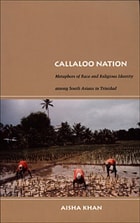
Callaloo Nation
Metaphors of Race and Religious Identity among South Asians in TrinidadAisha Khan
Duke University Press, 2004
Khan combines ethnographic research she conducted in Trinidad over the course of a decade with extensive archival research to explore how Hindu and Muslim Indo-Trinidadians interpret authority, generational tensions, and the transformations of Indian culture in the Caribbean through metaphors of mixing. She demonstrates how ambivalence about the desirability of a callaloo nation—a multicultural society—is manifest around practices and issues, including rituals, labor, intermarriage, and class mobility. Khan maintains that metaphors of mixing are pervasive and worth paying attention to: the assumptions and concerns they communicate are key to unraveling who Indo-Trinidadians imagine themselves to be and how identities such as race and religion shape and are shaped by the politics of multiculturalism.
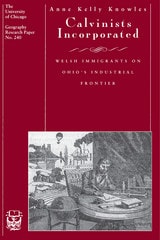
Calvinists Incorporated
Welsh Immigrants on Ohio's Industrial FrontierAnne Kelly Knowles
University of Chicago Press, 1996
capitalist transformation, Anne Kelly Knowles traces a community of
Welsh immigrants to Jackson and Gallia counties in southern Ohio. After
reconstructing the gradual process of community-building, Knowles
focuses on the pivotal moment when the immigrants became involved with
the industrialization of their new region as workers and investors in
Welsh-owned charcoal iron companies. Setting the southern Ohio Welsh in
the context of Welsh immigration as a whole from 1795 to 1850, Knowles
explores how these strict Calvinists responded to the moral dilemmas
posed by leaving their native land and experiencing economic success in
the United States.
Knowles draws on a wide variety of sources, including obituaries and
community histories, to reconstruct the personal histories of over 1,700
immigrants. The resulting account will find appreciative readers not
only among historical geographers, but also among American economic
historians and historians of religion.
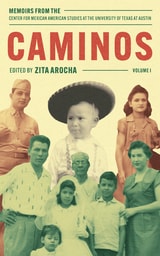
Caminos
Memoirs from the Center for Mexican American Studies at the University of Texas at AustinEdited by Zita Arocha
University of Texas Press, 2026
Fourteen writers reflect on the complexities of Mexican American identity in hyphenated America.
At a time when memoir has become an increasingly popular form of self-expression, fourteen writers from diverse backgrounds engaged with one another in a series of writing workshops sponsored by the Center for Mexican American Studies at UT Austin to reflect on their life journeys. They wrestle with issues that shaped them in provocative, evocative, and sometimes humorous short essays. The writers include a lawyer, a civil rights activist, actors, journalists, and professors who write of belonging, national and sexual identity, coping with illness and loss, career challenges, and life-altering events familiar to us all. The contributors write poignantly about losing a parent at an early age; growing up in segregated communities; bravely confronting serious health problems; living in a household with a mentally disturbed family member; the complexity of being “American” as well as “Mexican”; and the professional challenges facing all hyphenated Americans, many of whom are often the first person of color in their workplaces.
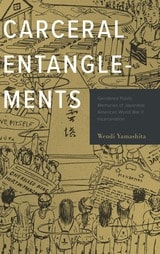
Carceral Entanglements
Gendered Public Memories of Japanese American World War II IncarcerationWendi Yamashita
Temple University Press, 2024
Carceral Entanglements features interviews, archival research, and texts to explore racial violence and patriotic masculinity and explain how Japanese American history and identity are publicly memorialized. Yamashita examines museums, digital archives, pilgrimages, and student-run and performed plays to understand how Japanese Americans occupy a “contradictory location” produced by the state. She also addresses historical erasure, race relations and the struggle for redress and reparations.
Carceral Entanglements is about the interlocking relationship Japanese American incarceration memories have to the prison industrial complex and the settler colonial logics that at times unknowingly sustain it.

Caribbean Spaces
Escapes from Twilight ZoneCarol Boyce Davies
University of Illinois Press, 2013
Central American Counterpoetics
Diaspora and RememoryKarina Alma
University of Arizona Press, 2024
Author Karina Alma offers a systemic method and artistic mode for unpacking social and political memory formation that resists dominant histories. Central American Counterpoetics responds to political repression through acts of creativity that prioritize the well-being of anticolonial communities. Building on Toni Morrison’s theory of rememory, the volume examines the concept as an embodied experience of a sensory place and time lived in the here and now. By employing primary sources of image and word, interviews of creatives, and a critical self-reflection as a Salvadoran immigrant woman in academia, Alma’s research breaks ground in subject matter and methods by considering cultural and historical ties across countries, regions, and traditions. The diverse creatives included explore critical perspectives on topics such as immigration, forced assimilation, maternal love, gender violence, community arts, and decolonization.
Chains of Babylon
The Rise of Asian AmericaDaryl J. Maeda
University of Minnesota Press, 2009
In Chains of Babylon, Daryl J. Maeda presents a cultural history of Asian American activism in the late 1960s and early 1970s, showing how the movement created the category of "Asian American" to join Asians of many ethnicities in racial solidarity. Drawing on the Black Power and antiwar movements, Asian American radicals argued that all Asians in the United States should resist assimilation and band together to oppose racism within the country and imperialism abroad.
As revealed in Maeda's in-depth work, the Asian American movement contended that people of all Asian ethnicities in the United States shared a common relationship to oppression and exploitation with each other and with other nonwhite peoples. In the early stages of the civil rights era, the possibility of assimilation was held out to Asian Americans under a model minority myth. Maeda insists that it was only in the disruption of that myth for both African Americans and Asian Americans in the 1960s and 1970s that the full Asian American culture and movement he describes could emerge. Maeda challenges accounts of the post-1968 era as hopelessly divisive by examining how racial and cultural identity enabled Asian Americans to see eye-to-eye with and support other groups of color in their campaigns for social justice.
Asian American opposition to the war in Vietnam, unlike that of the broader antiwar movement, was predicated on understanding it as a racial, specifically anti-Asian genocide. Throughout he argues that cultural critiques of racism and imperialism, the twin "chains of Babylon" of the title, informed the construction of a multiethnic Asian American identity committed to interracial and transnational solidarity.
Chasing the American Dream in China
Chinese Americans in the Ancestral HomelandLeslie Kim Wang
Rutgers University Press, 2021
Chicana Sexuality and Gender
Cultural Refiguring in Literature, Oral History, and ArtDebra J. Blake
Duke University Press, 2008
Blake looks at how the Chicana professional intellectuals and the U.S. Mexicana women refigure confining and demeaning constructions of female gender roles and racial, ethnic, and sexual identities. She organizes her analysis around re-imaginings of La Virgen de Guadalupe, La Llorona, indigenous Mexica goddesses, and La Malinche, the indigenous interpreter for Hernán Cortés during the Spanish conquest. In doing so, Blake reveals how the professional intellectuals and the working-class and semiprofessional women rework or invoke the female icons to confront the repression of female sexuality, limiting gender roles, inequality in male and female relationships, and violence against women. While the representational strategies of the two groups of women are significantly different and the U.S. Mexicanas would not necessarily call themselves feminists, Blake nonetheless illuminates a continuum of Chicana feminist thinking, showing how both groups of women expand lifestyle choices and promote the health and well-being of women of Mexican origin or descent.
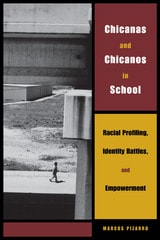
Chicanas and Chicanos in School
Racial Profiling, Identity Battles, and EmpowermentBy Marcos Pizarro
University of Texas Press, 2005
By any measure of test scores and graduation rates, public schools are failing to educate a large percentage of Chicana/o youth. But despite years of analysis of this failure, no consensus has been reached as to how to realistically address it. Taking a new approach to these issues, Marcos Pizarro goes directly to Chicana/o students in both urban and rural school districts to ask what their school experiences are really like, how teachers and administrators support or thwart their educational aspirations, and how schools could better serve their Chicana/o students.
In this accessible, from-the-trenches account of the Chicana/o school experience, Marcos Pizarro makes the case that racial identity formation is the crucial variable in Chicana/o students' success or failure in school. He draws on the insights of students in East Los Angeles and rural Washington State, as well as years of research and activism in public education, to demonstrate that Chicana/o students face the daunting challenge of forming a positive sense of racial identity within an educational system that unintentionally yet consistently holds them to low standards because of their race. From his analysis of this systemic problem, he develops a model for understanding the process of racialization and for empowering Chicana/o students to succeed in school that can be used by teachers, school administrators, parents, community members, and students themselves.
Chicanismo
The Forging of a Militant Ethos among Mexican AmericansIgnacio M. García
University of Arizona Press, 1997
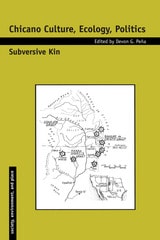
Chicano Culture, Ecology, Politics
Subversive KinDevon G. Peña
University of Arizona Press, 1998
Employing a variety of genres ranging from poetry to autobiography to theoretical and empirical essays, the voices in this collection speak to the most significant issues of environmentalism and social justice, recognizing throughout the need for a pluralism of Chicana/o philosophies. The contributors provide an excellent basis for understanding how multiple Chicana/o views on the environment play out in the context of dominant social, political and economic views. Chicano Culture, Ecology, Politics examines a number of Chicana/o ecological perspectives. How can the ethics of reciprocity present in Chicana/o agropastoral life be protected and applied on a broader scale? How can the dominant society, whose economic structure is invested in "placeless mobility," take note of the harm caused to land-based cultures, take responsibility for it, and take heed before it is too late? Will the larger society be "ecologically housebroken" before it destroys its home?
Grounded in actual political struggles waged by Chicana/o communities over issues of environmental destruction, cultural genocide, and socioeconomic domination, this volume provides an important series of snapshots of Chicana/o history. Chicano Culture, Ecology, Politics illuminates the bridges that exist—and must be understood—between race, ethnicity, class, gender, politics, and ecology.
CONTENTS
Part 1: IndoHispano Land Ethics
Los Animalitos: Culture, Ecology, and the Politics of Place in the Upper R¡o Grande, Devon G. Peña
Social Action Research, Bioregionalism, and the Upper Río Grande, Rubén O. Martínez
Notes on (Home)Land Ethics: Ideas, Values, and the Land, Reyes García
Part 2: Environmental History and Ecological Politics
Ecological Legitimacy and Cultural Essentialism: Hispano Grazing in Northern New Mexico, Laura Pulido
The Capitalist Tool, the Lawless, and the Violent: A Critique of Recent Southwestern Environmental History, Devon G. Peña and Rubén O. Martínez
Ecofeminism and Chicano Environmental Struggles: Bridges across Gender and Race, Gwyn Kirk
Philosophy Meets Practice: A Critique of Ecofeminism through the Voices of Three Chicana Activists, Malia Davis
Part 3: Alternatives to Destruction
The Pasture Poacher (a poem), Joseph C. Gallegos
Acequia Tales: Stories from a Chicano Centennial Farm, Joseph C. Gallegos
A Gold Mine, an Orchard, and an Eleventh Commandment, Devon G. Peña
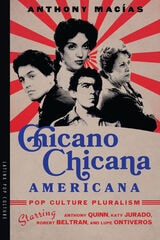
Chicano-Chicana Americana
Pop Culture Pluralism Starring Anthony Quinn, Katy Jurado, Robert Beltran, and Lupe OntiverosAnthony Macías
University of Arizona Press, 2023
Each biographical chapter analyzes an underappreciated actor, revealing their artistic contributions to U.S. common culture. Their long-shot careers tell a tale of players taking action with agency and fighting for screen time and equal opportunity despite disadvantages and differential treatment in Hollywood. These dynamic and complex individuals altered cinematic representations—and audience expectations—by surpassing stereotypes.
The book explores American national character by showing how ethnic Mexicans attained social and cultural status through fair, open competition without a radical realignment of political or economic structures. Their creative achievements demanded dignity and earned respect. Anthony Macías argues that these performances demonstrated a pop culture pluralism that subtly changed mainstream America, transforming it from the mythological past of the Wild West to the speculative future of science fiction.

Children of the Dragonfly
Native American Voices on Child Custody and EducationRobert Bensen
University of Arizona Press, 2001
Native American children have long been subject to removal from their homes for placement in residential schools and, more recently, in foster or adoptive homes. The governments of both the United States and Canada, having reduced Native nations to the legal status of dependent children, historically have asserted a surrogate parentalism over Native children themselves.
Children of the Dragonfly is the first anthology to document this struggle for cultural survival on both sides of the U.S.-Canadian border. Through autobiography and interviews, fiction and traditional tales, official transcripts and poetry, these voices— Seneca, Cherokee, Mohawk, Navajo, and many others— weave powerful accounts of struggle and loss into a moving testimony to perseverance and survival. Invoking the dragonfly spirit of Zuni legend who helps children restore a way of life that has been taken from them, the anthology explores the breadth of the conflict about Native childhood.
Included are works of contemporary authors Sherman Alexie, Joy Harjo, Luci Tapahonso, and others; classic writers Zitkala-Sa and E. Pauline Johnson; and contributions from twenty important new writers as well. They take readers from the boarding school movement of the 1870s to the Sixties Scoop in Canada and the Indian Child Welfare Act of 1978 in the United States. They also spotlight the tragic consequences of racist practices such as the suppression of Indian identity in government schools and the campaign against Indian childbearing through involuntary sterilization.
CONTENTS
Part 1. Traditional Stories and Lives
Severt Young Bear (Lakota) and R. D. Theisz, To Say "Child"
Zitkala-Sa (Yankton Sioux), The Toad and the Boy
Delia Oshogay (Chippewa), Oshkikwe's Baby
Michele Dean Stock (Seneca), The Seven Dancers
Mary Ulmer Chiltoskey (Cherokee), Goldilocks Thereafter
Marietta Brady (Navajo), Two Stories
Part 2. Boarding and Residential Schools
Embe (Marianna Burgess), from Stiya: or, a Carlisle Indian Girl at Home
Black Bear (Blackfeet), Who Am I?
E. Pauline Johnson (Mohawk), As It Was in the Beginning
Lee Maracle (Stoh:lo), Black Robes
Gordon D. Henry, Jr. (White Earth Chippewa), The Prisoner of Haiku
Luci Tapahonso (Navajo), The Snakeman
Joy Harjo (Muskogee), The Woman Who Fell from the Sky
Part 3. Child Welfare and Health Services
Problems That American Indian Families Face in Raising Their Children, United States Senate, April 8 and 9, 1974
Mary TallMountain (Athabaskan), Five Poems
Virginia Woolfclan, Missing Sister
Lela Northcross Wakely (Potawatomi/Kickapoo), Indian Health
Sherman Alexie (Spokane/Coeur d'Alene), from Indian Killer
Milton Lee (Cheyenne River Sioux) and Jamie Lee, The Search for Indian
Part 4. Children of the Dragonfly
Peter Cuch (Ute), I Wonder What the Car Looked Like
S. L. Wilde (Anishnaabe), A Letter to My Grandmother
Eric Gansworth (Onondaga), It Goes Something Like This
Kimberly Roppolo (Cherokee/Choctaw/Creek), Breeds and Outlaws
Phil Young (Cherokee) and Robert Bensen, Wetumka
Lawrence Sampson (Delaware/Eastern Band Cherokee), The Long Road Home
Beverley McKiver (Ojibway), When the Heron Speaks
Joyce carlEtta Mandrake (White Earth Chippewa), Memory Lane Is the Next Street Over
Alan Michelson (Mohawk), Lost Tribe
Patricia Aqiimuk Paul (Inupiaq), The Connection
Terry Trevor (Cherokee/Delaware/Seneca), Pushing up the Sky
Annalee Lucia Bensen (Mohegan/Cherokee), Two Dragonfly Dream Songs
Chinese American Transnationalism
The Flow of People, ResourcesSucheng Chan
Temple University Press, 2005
Chinese Americans and the Politics of Race and Culture
Sucheng Chan
Temple University Press, 2008
Sucheng Chan introduces this valuable new anthology with a commanding discussion of the field of Chinese American studies, in which she examines its history and points the way ahead. Here she and Madeline Y. Hsu have brought together leading-edge scholarship from a new generation of thinkers, as useful for scholars as it is for undergraduate readers.
The contributors address a broad range of issues, from the activism of left-wing and Communist Chinese immigrants to the U.S. in the 1920s and early 1930s and humanitarian relief during the Sino-Japanese War to the construction of new Chinese regional identities in New York.
Chinese Ways of Being Muslim
Negotiating Ethnicity and Religiosity in IndonesiaHew Wai Weng
National University of Singapore Press, 2018
Chineseness across Borders
Renegotiating Chinese Identities in China and the United StatesAndrea Louie
Duke University Press, 2004
Louie focuses on “In Search of Roots,” a program that takes young Chinese American adults of Cantonese descent to visit their ancestral villages in China’s Guangdong province. Through ethnographic interviews and observation, Louie examines the experiences of Chinese Americans both during village visits in China and following their participation in the program, which she herself took part in as an intern and researcher. She presents a vivid portrait of two populations who, though connected through family ties generations back, are meeting for the first time in the context of a rapidly changing contemporary China. Louie situates the participants’ and hosts’ shifting understandings of China and Chineseness within the context of transnational flows of people, media, goods, and money; China’s political and economic policies; and the racial and cultural politics of the United States.
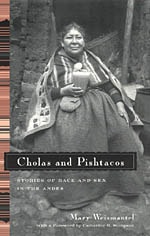
Cholas and Pishtacos
Stories of Race and Sex in the AndesMary Weismantel
University of Chicago Press, 2001
Cholas and Pishtacos are two provocative characters from South American popular culture—a sensual mixed-race woman and a horrifying white killerwho show up in everything from horror stories and dirty jokes to romantic novels and travel posters. In this elegantly written book, these two figures become vehicles for an exploration of race, sex, and violence that pulls the reader into the vivid landscapes and lively cities of the Andes. Weismantel's theory of race and sex begins not with individual identity but with three forms of social and economic interaction: estrangement, exchange, and accumulation. She maps the barriers that separate white and Indian, male and female-barriers that exist not in order to prevent exchange, but rather to exacerbate its inequality.
Weismantel weaves together sources ranging from her own fieldwork and the words of potato sellers, hotel maids, and tourists to classic works by photographer Martin Chambi and novelist José María Arguedas. Cholas and Pishtacos is also an enjoyable and informative introduction to a relatively unknown region of the Americas.

Compositional Subjects
Enfiguring Asian/American WomenLaura Hyun Yi Kang
Duke University Press, 2002
The book opens by tracking the jagged emergence of “Asian American women” as a distinct social identity over the past three decades. Kang then directs critical attention to how the attempts to compose them as discrete subjects of consciousness, visibility, and action demonstrate a broader, ongoing tension between socially particularized subjects and disciplinary knowledges. In addition to the shifting meanings and alignments of “Asian,” “American,” and “women,” the book examines the discourses, political and economic conditions, and institutional formations that have produced Asian/American women as generic authors, as visibly desirable and desiring bodies, as excludable aliens and admissible citizens of the United States, and as the proper labor for transnational capitalism. In analyzing how these enfigurations are constructed and apprehended through a range of modes including autobiography, cinematography, historiography, photography, and ethnography, Kang directs comparative attention to the very terms of their emergence as Asian/American women in specific disciplines.
Finally, Kang concludes with a detailed examination of selected literary and visual works by Korean women artists located in the United States and Canada, works that creatively and critically contend with the problematics of identification and representation that are explored throughout the book. By underscoring the forceful and contentious struggles that animate all of these compositional gestures, Kang proffers Asian/American women as a vexing and productive figure for cultural, political and epistemological critique.
Confronting Colonial Legacies
A History of Chicana/o Indigeneities and Transnational ActivismJosé Luis Serrano Nájera
University of Arizona Press, 2026
This work offers a groundbreaking account of how Chicana/o activists have engaged in sustained efforts to reclaim Indigenous identity through political struggle, cultural expression, and transnational solidarity.
Author José Luis Serrano Nájera takes an in-depth look at the history of Chicana/o indigeneity, starting with the Chicana/o Movement of the 1960s and 1970s and through twenty-first century transnational activism and solidarity movements. Serrano Nájera reveals how claims to indigeneity were rooted in reciprocal relationships with Indigenous communities and driven by a shared commitment to decolonization. Through chapters on visual and performing arts, ceremony, education, and grassroots organizing, this book challenges reductive narratives of cultural appropriation and instead foregrounds the complex and historically grounded nature of Chicana/o indigeneity.
Drawing on extensive archival research, Serrano Nájera demonstrates how Chicana/o indigeneity has contributed to broader Indigenous rights movements, including efforts that culminated in the 2007 United Nations Declaration on the Rights of Indigenous Peoples. This work highlights the intercontinental dimensions of Chicana/o activism and offers a vital source for scholars and students in Chicana/o studies, Indigenous studies, ethnic studies, history, and political science. Confronting Colonial Legacies is a compelling call to rethink the politics of identity, sovereignty, and solidarity across the Americas.
Conjured Bodies
Queer Racialization in Contemporary LatinidadLaura Grappo
University of Texas Press, 2022
2022 Honorable Mention, John Leo & Dana Heller Award for Best Single Work, Anthology, Multi-Authored, or Edited Book in LGBTQ Studies, Popular Culture Association (PCA)
2023 Honorable Mention, Outstanding Book, Latinx Studies Section of Latin American Studies Association (LASA)
2024 Honorable Mention — Best LGBTQ+ Themed Book, Empowering Latino Futures’ International Latino Book Awards
This study argues that powerful authorities and institutions exploit the ambiguity of Latinidad in ways that obscure inequalities in the United States.
Is Latinidad a racial or an ethnic designation? Both? Neither? The increasing recognition of diversity within Latinx communities and the well-known story of shifting census designations have cast doubt on the idea that Latinidad is a race, akin to white or Black. And the mainstream media constantly cover the “browning” of the United States, as though the racial character of Latinidad were self-evident.
Many scholars have argued that the uncertainty surrounding Latinidad is emancipatory: by queering race—by upsetting assumptions about categories of human difference—Latinidad destabilizes the architecture of oppression. But Laura Grappo is less sanguine. She draws on case studies including the San Antonio Four (Latinas who were wrongfully accused of child sex abuse); the football star Aaron Hernandez’s incarceration and suicide; Lorena Bobbitt, the headline-grabbing Ecuadorian domestic-abuse survivor; and controversies over the racial identities of public Latinx figures to show how media institutions and state authorities deploy the ambiguities of Latinidad in ways that mystify the sources of Latinx political and economic disadvantage. With Latinidad always in a state of flux, it is all too easy for the powerful to conjure whatever phantoms serve their interests.
Constituting Central American–Americans
Transnational Identities and the Politics of DislocationCárdenas, Maritza E
Rutgers University Press, 2018
Constructing Identities in Mexican-American Political Organizations
Choosing Issues, Taking SidesBy Benjamin Márquez
University of Texas Press, 2003
A Choice Outstanding Academic Book, 2002
The formation of a group identity has always been a major preoccupation of Mexican American political organizations, whether they seek to assimilate into the dominant Anglo society or to remain separate from it. Yet organizations that sought to represent a broad cross section of the Mexican American population, such as LULAC and the American G.I. Forum, have dwindled in membership and influence, while newer, more targeted political organizations are prospering—clearly suggesting that successful political organizing requires more than shared ethnicity and the experience of discrimination.
This book sheds new light on the process of political identity formation through a study of the identity politics practiced by four major Mexican American political organizations—the Southwest Network for Environmental and Economic Justice, the Southwest Industrial Areas Foundation, the Texas Association of Mexican American Chambers of Commerce, and the Mexican American Women's National Association (now known as MANA—A National Latina Organization). Through interviews with activists in each organization and research into their records, Benjamin Marquez clarifies the racial, class-based, and cultural factors that have caused these organizations to create widely differing political identities. He likewise demonstrates why their specific goals resonate only with particular segments of the Mexican American community.
Constructing Muslims in France
Discourse, Public Identity, and the Politics of CitizenshipJennifer Fredette
Temple University Press, 2014
Contemporary Archaeologies of the Southwest
William Walker
University Press of Colorado, 2011
Chapters address place-making in Chaco Canyon, recent trends in landscape archaeology, the formation of identities, landscape boundaries, and the movement associated with these aspects of place-making. They address how interaction of peoples with objects brings landscapes to life. Representing a diverse cross section of Southwestern archaeologists, the authors of this volume push the boundaries of archaeological method and theory, building a strong foundation for future Southwest studies.
This book will be of interest to professional and academic archaeologists, as well as students working in the American Southwest.
Contemporary Asian American Communities
Intersections And Divergencesedited by Linda Trinh Võ and Rick Bonus
Temple University Press, 2002
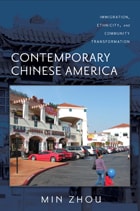
Contemporary Chinese America
Immigration, Ethnicity, and Community TransformationMin Zhou, foreword by Alejandro Portes
Temple University Press, 2009
Contemporary Chinese America is the most comprehensive sociological investigation of the experiences of Chinese immigrants to the United States—and of their offspring—in the late twentieth and early twenty-first centuries. The author, Min Zhou, is a well-known sociologist of the Chinese American experience. In this volume, she collects her original research on a range of subjects, including the causes and consequences of emigration from China, demographic trends of Chinese Americans, patterns of residential mobility in the U.S., Chinese American "ethnoburbs," immigrant entrepreneurship, ethnic enclave economies, gender and work, Chinese language media, Chinese schools, and intergenerational relations. The concluding chapter, "Rethinking Assimilation," ponders the future for Chinese Americans. Also included are an extensive bibliography and a list of recommended documentary films.
While the book is particularly well-suited for college courses in Chinese American studies, ethnic studies, Asian studies, and immigration studies, it will interest anyone who wants to more fully understand the lived experience of contemporary Chinese Americans.
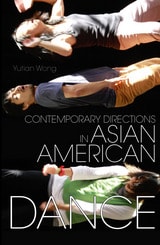
Contemporary Directions in Asian American Dance
Edited by Yutian Wong
University of Wisconsin Press, 2018
The contributors to this volume address such topics as the role of the 1960s Asian American Movement in creating Japanese American taiko groups, and the experience of internment during World War II influencing butoh dance in Canada. Essays about artists such as Jay Hirabayashi, Alvin Tolentino, Shen Wei, Kun-Yang Lin, Yasuko Yokoshi, Eiko & Koma, Sam Kim, Roko Kawai, and Denise Uyehara look closely at the politics of how Asian aesthetics are set into motion and marketed. The volume includes first-person narratives, interviews, ethnography, cultural studies, performance studies, and comparative ethnic studies.
Contemporary Latina/o Theater
Wrighting EthnicityJon D. Rossini
Southern Illinois University Press, 2008
In Contemporary Latina/o Theater, Jon D. Rossini explores the complex relationship between theater and the creation of ethnicity in an unprecedented examination of six Latina/o playwrights and their works: Miguel Piñero, Luis Valdez, Guillermo Reyes, Octavio Solis, José Rivera, and Cherríe Moraga. Rossini exposes how these writers use the genre as a tool to reveal and transform existing preconceptions about their culture. Through “wrighting”—the triplicate process of writing plays, righting misconceptions about ethnic identity, and creating an entirely new way of understanding Latina/o culture—these playwrights directly intervene in current conversations regarding ethnic identity, providing the tools for audiences to reexplore their previously held perspectives outside the theater.
Examining these writers and their works in both cultural and historical contexts, Rossini reveals how playwrights use the liminal space of the stage—an area on the thresholds of both theory and reality—to “wright” new insights into Latina/o identity. They use the limits of the theater itself to offer practical explorations of issues that could otherwise be discussed only in highly theoretical terms.
Rossini traces playwrights’ methods as they address some of the most challenging issues facing contemporary Latinas/os in America: from the struggles for ethnic solidarity and the dangers of a community based in fear, to stereotypes of Latino masculinity and the problematic fusion of ethnicity and politics. Rossini discusses the looming specter of the border in theater, both as a conceptual device and as a literal reality—a crucial subject for modern Latinas/os, given recent legislation and other actions. Throughout, the author draws intriguing comparisons to the cultural limbo in which many Latinas/os find themselves today.
An indispensable volume for anyone interested in drama and ethnic studies, Contemporary Latina/o Theater underscores the power of theatricality in exploring and rethinking ethnicity. Rossini provides the most in-depth analysis of these plays to date, offering a groundbreaking look at the ability of playwrights to correct misconceptions and create fresh perspectives on diversity, culture, and identity in Latina/o America.
Continental Shifts
Migration, Representation, and the Struggle for Justice in Latin(o) AmericaBy John D. "Rio" Riofrio
University of Texas Press, 2015
Applying a broad geographical approach to comparative Latino literary and cultural studies, Continental Shifts illuminates how the discursive treatment of Latinos changed dramatically following the enactment of NAFTA—a shift exacerbated by 9/11. While previous studies of immigrant representation have focused on single regions (the US/Mexico border in particular), specific genres (literature vs. political rhetoric), or individual groups, Continental Shifts unites these disparate discussions in a provocative, in-depth examination.
Bringing together a wide range of groups and genres, this intercultural study explores novels by Latin American and Latino writers, a border film by Tommy Lee Jones and Guillermo Arriaga, “viral” videos of political speeches, popular television programming (particularly shows that feature incarceration and public shaming), and user-generated YouTube videos. These cultural products reveal the complexity of Latino representations in contemporary discourse. While tropes of Latino migrants as threatening, diseased foreign bodies date back to the nineteenth century, Continental Shifts marks the more pernicious, recent images of Latino laborers (legal and not) in a variety of contemporary media. Using vivid examples, John Riofrio demonstrates the connections between rhetorical and ideological violence and the physical and psychological violence that has more intensely plagued Latino communities in recent decades. Culminating with a consideration of the “American” identity, this eye-opening work ultimately probes the nation’s ongoing struggle to uphold democratic ideals amid dehumanizing multiethnic tension.
Contours of White Ethnicity
Popular Ethnography and the Making of Usable Pasts in Greek AmericaYiorgos Anagnostou
Ohio University Press, 2009
In Contours of White Ethnicity, Yiorgos Anagnostou explores the construction of ethnic history and reveals how and why white ethnics selectively retain, rework, or reject their pasts. Challenging the tendency to portray Americans of European background as a uniform cultural category, the author demonstrates how a generalized view of American white ethnics misses the specific identity issues of particular groups as well as their internal differences.
Interdisciplinary in scope, Contours of White Ethnicity uses the example of Greek America to illustrate how the immigrant past can be used to combat racism and be used to bring about solidarity between white ethnics and racial minorities. Illuminating the importance of the past in the construction of ethnic identities today, Anagnostou presents the politics of evoking the past to create community, affirm identity, and nourish reconnection with ancestral roots, then identifies the struggles to neutralize oppressive pasts.
Although it draws from the scholarship on a specific ethnic group, Contours of White Ethnicity exhibits a sophisticated, interdisciplinary methodology, which makes it of particular interest to scholars researching ethnicity and race in the United States and for those charting the directions of future research for white ethnicities.

Creating Germans Abroad
Cultural Policies and National Identity in NamibiaDaniel Joseph Walther
Ohio University Press, 2002
When World War I brought an end to German colonial rule in Namibia, much of the German population stayed on. The German community, which had managed to deal with colonial administration, faced new challenges when the region became a South African mandate under the League of Nations in 1919. One of these was the issue of Germanness, which ultimately resulted in public conversations and expressions of identity.
In Creating Germans Abroad, Daniel Walther examines this discourse and provides striking new insights into the character of the German populace in both Germany and its former colony, Southwest Africa, known today as Namibia. In addition to German colonialism, Walther considers issues of race, class, and gender and the activities of minority groups. He offers new perspectives on German cultural and national identity during the Empire, the Weimar Republic, and the Third Reich.
In a larger context, Creating Germans Abroad acts as a model for investigating the strategies and motivations of groups and individuals engaged in national or ethnic engineering and demonstrates how unforeseen circumstances can affect the nature and outcome of these endeavors.
Crescent over Another Horizon
Islam in Latin America, the Caribbean, and Latino USAEdited by Maria del Mar Logroño Narbona, Paulo G. Pinto, and John Tofik Karam
University of Texas Press, 2015
Muslims have been shaping the Americas and the Caribbean for more than five hundred years, yet this interplay is frequently overlooked or misconstrued. Brimming with revelations that synthesize area and ethnic studies, Crescent over Another Horizon presents a portrait of Islam’s unity as it evolved through plural formulations of identity, power, and belonging. Offering a Latino American perspective on a wider Islamic world, the editors overturn the conventional perception of Muslim communities in the New World, arguing that their characterization as “minorities” obscures the interplay of ethnicity and religion that continues to foster transnational ties.
Bringing together studies of Iberian colonists, enslaved Africans, indentured South Asians, migrant Arabs, and Latino and Latin American converts, the volume captures the power-laden processes at work in religious conversion or resistance. Throughout each analysis—spanning times of inquisition, conquest, repressive nationalism, and anti-terror security protocols—the authors offer innovative frameworks to probe the ways in which racialized Islam has facilitated the building of new national identities while fostering a double-edged marginalization. The subjects of the essays transition from imperialism (with studies of morisco converts to Christianity, West African slave uprisings, and Muslim and Hindu South Asian indentured laborers in Dutch Suriname) to the contemporary Muslim presence in Argentina, Brazil, Mexico, and Trinidad, completed by a timely examination of the United States, including Muslim communities in “Hispanicized” South Florida and the agency of Latina conversion. The result is a fresh perspective that opens new horizons for a vibrant range of fields.

Cuban Underground Hip Hop
Black Thoughts, Black Revolution, Black ModernityBy Tanya L. Saunders
University of Texas Press, 2015
Honorable Mention, Barbara T. Christian Literary Award, Caribbean Studies Association, 2017
In the wake of the 1959 Cuban Revolution, a key state ideology developed: racism was a systemic cultural issue that ceased to exist after the Revolution, and any racism that did persist was a result of contained cases of individual prejudice perpetuated by US influence. Even after the state officially pronounced the end of racism within its borders, social inequalities tied to racism, sexism, and homophobia endured, and, during the economic liberalization of the 1990s, widespread economic disparities began to reemerge.
Cuban Underground Hip Hop focuses on a group of self-described antiracist, revolutionary youth who initiated a social movement (1996–2006) to educate and fight against these inequalities through the use of arts-based political activism intended to spur debate and enact social change. Their “revolution” was manifest in altering individual and collective consciousness by critiquing nearly all aspects of social and economic life tied to colonial legacies. Using over a decade of research and interviews with those directly involved, Tanya L. Saunders traces the history of the movement from its inception and the national and international debates that it spawned to the exodus of these activists/artists from Cuba and the creative vacuum they left behind. Shedding light on identity politics, race, sexuality, and gender in Cuba and the Americas, Cuban Underground Hip Hop is a valuable case study of a social movement that is a part of Cuba’s longer historical process of decolonization.
Cultural Compass
Martin Manalansan
Temple University Press, 2000
Drawing upon recent theoretical discussions and methodological innovations, the contributors explore the construction and displacement of self, community, and home integral to Asian American cultural journeys in the late twentieth century. Some discuss the unique situation of doing ethnographic work "at home" -- that is researching one's own ethnic group or another group with Asian America. Others draw on rich and diverse field experiences. Whether they are doing homework or fieldwork, contributors reflect on the ways that particular matters of identity -- gender, class, sexuality, ethnicity, age -- play out between researchers and informants. Individual essays and the book as a whole challenge the notion of a monolithic, spatially bounded Asian American community, pointing the way to multiple sites of political struggle, cultural critique, and social change.
Cultural Logics and Global Economies
Maya Identity in Thought and PracticeBy Edward F. Fischer
University of Texas Press, 2002
A Choice Outstanding Academic Book, 2002
As ideas, goods, and people move with increasing ease and speed across national boundaries and geographic distances, the economic changes and technological advances that enable this globalization are also paradoxically contributing to the balkanization of states, ethnic groups, and special interest movements. Exploring how this process is playing out in Guatemala, this book presents an innovative synthesis of the local and global factors that have led Guatemala's indigenous Maya peoples to assert and defend their cultural identity and distinctiveness within the dominant Hispanic society.
Drawing on recent theories from cognitive studies, interpretive ethnography, and political economy, Edward F. Fischer looks at individual Maya activists and local cultures, as well as changing national and international power relations, to understand how ethnic identities are constructed and expressed in the modern world. At the global level, he shows how structural shifts in international relations have opened new venues of ethnic expression for Guatemala's majority Maya population. At the local level, he examines the processes of identity construction in two Kaqchikel Maya towns, Tecpán and Patzún, and shows how divergent local norms result in different conceptions and expressions of Maya-ness, which nonetheless share certain fundamental similarities with the larger pan-Maya project. Tying these levels of analysis together, Fischer argues that open-ended Maya "cultural logics" condition the ways in which Maya individuals (national leaders and rural masses alike) creatively express their identity in a rapidly changing world.
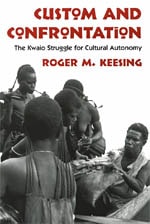
Custom and Confrontation
The Kwaio Struggle for Cultural AutonomyRoger M. Keesing
University of Chicago Press, 1992
"A major contribution to the ethnography and history of Malaita and Melanesia, and to the growing literature on cultural resistance. But above all, his humane and painful analysis of the meeting of peoples living in different worlds and constructing their agendas and moralities on incommensurate—and apparently equally arbitrary—principles, represents a major contribution and challenge to anthropological thought, addressing the basic issue of what it is to be human."—Fredrik Barth