Results by title
3745 books match the query 'Europe' and 216 start with c
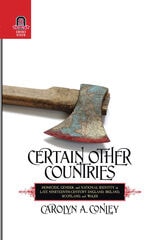
CERTAIN OTHER COUNTRIES
Homicide, Gender, and National Identity in Late Nineteenth-Century England, Ireland, Scotland, and WalesCarolyn A. Conley
The Ohio State University Press, 2007
By combining quantitative techniques in the analysis of over seven thousand cases, as well as careful and detailed readings of individual cases, the book exposes trends and patterns that might not have been evident in works using only one method. For instance, by examining all homicide trials rather than concentrating exclusively on a few highly celebrated ones, it becomes clear that most female killers were not viewed with particular horror, but were treated much like their male counterparts.
The conclusions offer challenges and correctives to existing scholarship on gender, ethnicity, class, and violence. The book also demonstrates that the Welsh, Scots, and English remained quite distinct long after their melding as Britons was announced and celebrated. By blending a study of trends in violent behavior with ideas about national identity, Conley brings together rich and hotly debated fields of modern history. This book will be valuable both for scholars of crime and violence as well as for those studying British history.
CRIME, JUSTICE, HISTORY
ERIC MONKKONEN
The Ohio State University Press, 2002
Crime in the U.S. and the institutions for its control are deeply embedded in and shaped by history. The historical origins have often become invisible, and their recovery difficult, but any understanding of the contemporary situation requires historical context. For over twenty-five years Eric H. Monkkonen has worked on some of the puzzles and problems in recovering the history of crime and police.
Much of his work has appeared in articles, often in specialized journals or not in English, which this book collects for the first time. In addition to Monkkonen’s major published articles, this volume includes several new ones. The topics embrace violence, public disorder, policing, popular culture, and contrasts between the U.S. and Europe. Some articles illuminate special methodological and source issues that challenge historians of criminal justice. As well as dealing with serious crime, this book includes several articles on specifically urban problems and solutions associated with disorder, crime, and poverty.
In contrast to the more technical articles, several chapters, which originally appeared as op-ed pieces, show how historical understanding can help address current policy issues in crime and crime control. All too often, current policy debates occur without proper historical background. As a result, old ideas that have been tried and rejected are re-introduced, or new and sometimes simple ideas are ignored.

Caamano in London
The Exile of a Latin American RevolutionaryFred Halliday
University of London Press, 2011
The result is a complex and informative study on a missing chapter in the history of the Dominican Republic and, more broadly, a contribution to the often forgotten history of the cold war in the Caribbean.
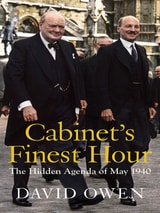
Cabinet's Finest Hour
The Hidden Agenda of May 1940David Owen
Haus Publishing, 2016
Eight months into the war, defeat seemed to many a certainty. With the United States still a year and half away from entering, Britain found itself in a perilous position, and foreign secretary Lord Halifax pushed prime minister Winston Churchill to explore the possibility of a negotiated peace with Hitler, using Mussolini as a conduit. Speaking for England is the story of Churchill’s triumph in the face of this pressure, but it is also about how collective debate and discussion won the day—had Churchill been alone, Owen argues, he would almost certainly have lost to Halifax, changing the course of history. Instead, the Cabinet system, all too often disparaged as messy and cumbersome, worked in Britain’s interests and ensured that a democracy on the brink of defeat had the courage to fight on.
Cages of Reason
The Rise of the Rational State in France, Japan, the United States, and Great BritainBernard S. Silberman
University of Chicago Press, 1993
Whereas Weber contends that the administration of all modern nation-states would eventually converge in one form characterized by rationality and legal authority, Silberman argues that the process of bureaucratic rationalization took, in fact, two courses. One path is characterized by permeable organizational boundaries and the allocation of information by "professionals." The other features well-defined boundaries and the allocation of information by organizational rules. Through case studies of France, Japan, the United States, and Great Britain, Silberman demonstrates that this divergence stems from differences in leadership structure and in levels of uncertainty about leadership succession in the nineteenth century.
Silberman concludes that the rise of bureacratic rationality was primarily a response to political problems rather than social and economic concerns. Cages of Reason demonstrates how rationalization can have occurred over a wide range of cultures at various levels of economic development. It will be of considerable interest to readers in a number of disciplines: political science, sociology, history, and public administration.
"Silberman has produced an invaluable, densely packed work that those with deep knowledge of public administrative development will find extremely rewarding." —David H. Rosenbloom, American Political Science Review
"An erudite, incisive, and vibrant book, the product of intensive study and careful reflection. Given its innovative theoretical framework and the wealth of historical materials contained in it, this study will generate debate and stimulate research in sociology, political science, and organizational theory. It is undoubtedly the best book on the comparative evolution of the modern state published in the last decade."—Mauro F. Guillen, Contemporary Sociology
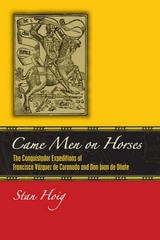
Came Men on Horses
The Conquistador Expeditions of Francisco Vázquez de Coronado and Don Juan de OñateStan Hoig
University Press of Colorado, 2013
Guided by myths of golden cities and worldly rewards, policy makers, conquistador leaders, and expeditionary aspirants alike came to the new world in the sixteenth century and left it a changed land. Came Men on Horses follows two conquistadors—Francisco Vázquez de Coronado and Don Juan de Oñate—on their journey across the southwest.
Driven by their search for gold and silver, both Coronado and Oñate committed atrocious acts of violence against the Native Americans, and fell out of favor with the Spanish monarchy. Examining the legacy of these two conquistadors Hoig attempts to balance their brutal acts and selfish motivations with the historical significance and personal sacrifice of their expeditions. Rich human details and superb story-telling make Came Men on Horses a captivating narrative scholars and general readers alike will appreciate.
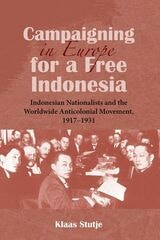
Campaigning in Europe for a Free Indonesia
Indonesian Nationalists and the Worldwide Anticolonial Movement, 1917–1932Klaas Stutje
National University of Singapore Press, 2019
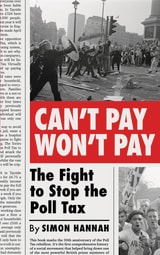
Can't Pay, Won't Pay
The Fight to Stop the Poll TaxSimon Hannah
Pluto Press, 2020
Starting in Scotland where the 'Community Charge' was first trialled, Can't Pay, Won't Pay immerses the reader in the gritty history of the rebellion. Amidst the drama of large scale protests and blockaded estates a number of key figures and groups emerge: Neil Kinnock and Tommy Sheridan; Militant, Class War and the Metropolitan Police.
Assessing this legacy today, Hannah demonstrates the centrality of the Poll Tax resistance as a key chapter in the history of British popular uprisings, Labour Party factionalism, the anti-socialist agenda and failed Tory ideology.
Canada and Eastern Europe, 1945–1991
Meeting in the MiddleAndrea Chandler
Central European University Press, 2024
How democratic regimes should engage with authoritarian regimes, or self-proclaimed authorities in states under occupation, has long been a subject of debate. The work examines Canada's relations with member-states of the Warsaw Pact during the Cold War. Central and East European communist states were nominally independent but established under occupation. Canadian leaders explored whether engaging in foreign relations with these countries would encourage liberalization or embolden dictatorships. Over time, Canada's position evolved as a policy of encouraging bilateral and multilateral diplomacy, while calling for the respect of human rights. However, Canada's economic relationship with East European states was at times at cross-purposes with its democratic principles. Andrea Chandler concludes that while Canada did play a role in encouraging democratization, the country's leaders did not sufficiently consider the impact of these policies on the citizens of Warsaw Pact countries.
This book treats Canada’s engagement with Hungary, Poland, the German Democratic Republic, Romania, Bulgaria and Czechoslovakiaduring the Cold War, in which the Western countries of the North Atlantic Treaty Organization (including Canada) had an adversarial relation with the Soviet bloc nations.
Canon Law in the Age of Reforms (c. 1000 to c. 1150)
Christof Rolker
Catholic University of America Press, 2023
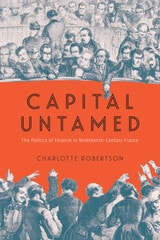
Capital Untamed
The Politics of Finance in Nineteenth-Century FranceCharlotte Robertson
University of Chicago Press, 2026
The story of a bold political experiment in nineteenth-century France to establish power through finance.
Amid the rise of industrial capitalism and revolutionary upheaval, French reformers asserted that finance should be reimagined as an instrument of economic and social transformation rather than left to the logic of private profit and speculation. In the 1850s, under Napoleon III’s authoritarian regime, this vision took institutional form as the Bonapartist state strategically deployed finance, broadened market participation, and sponsored new banks with the promise of directing investment toward infrastructure and industry. Yet this effort to harness and mobilize capital ran into a problem: The financial markets refused to be tamed.
Drawing on rich archival sources—from police surveillance and courtroom transcripts to investment manuals and petitions for incorporation—Capital Untamed reveals how the financial markets became an instrument of political power, frustrated state ambitions, and ultimately escaped attempts at mastery. In this striking debut, historian Charlotte Robertson shows how the French state and its citizens navigated a turbulent era of European capitalism animated by debates over the social purpose of financial capital. Ultimately, politicians’ efforts to establish legitimacy by reorganizing finance—and their confrontations with the limits of that project—set the stage for a form of modern discontent with the financial system that survives to this day.
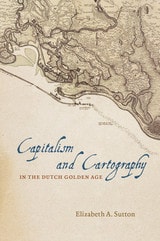
Capitalism and Cartography in the Dutch Golden Age
Elizabeth A. Sutton
University of Chicago Press, 2015
Building her exploration around the central figure of Claes Jansz Vischer, an Amsterdam-based publisher closely tied to the Dutch West India Company, Sutton shows how printed maps of Dutch Atlantic territories helped rationalize the Dutch Republic’s global expansion. Maps of land reclamation projects in the Netherlands, as well as the Dutch territories of New Netherland (now New York) and New Holland (Dutch Brazil), reveal how print media were used both to increase investment and to project a common narrative of national unity. Maps of this era showed those boundaries, commodities, and topographical details that publishers and the Dutch West India Company merchants and governing Dutch elite deemed significant to their agenda. In the process, Sutton argues, they perpetuated and promoted modern state capitalism.
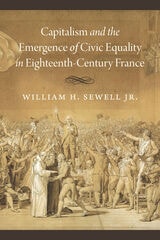
Capitalism and the Emergence of Civic Equality in Eighteenth-Century France
William H. Sewell Jr.
University of Chicago Press, 2021
William H. Sewell Jr. argues that the flourishing of commercial capitalism in eighteenth-century France introduced a new independence, flexibility, and anonymity to French social life. By entering the interstices of this otherwise rigidly hierarchical society, expanded commodity exchange colored everyday experience in ways that made civic equality thinkable, possible, even desirable, when the crisis of the French Revolution arrived. Sewell ties together masterful analyses of a multitude of interrelated topics: the rise of commerce, the emergence of urban publics, the careers of the philosophes, commercial publishing, patronage, political economy, trade, and state finance. Capitalism and the Emergence of Civic Equality in Eighteenth-Century France offers an original interpretation of one of history’s pivotal moments.
Capitalism from Outside?
Economic Cultures in Eastern Europe after 1989János Mátyás Kovács
Central European University Press, 2012
Captain Rock
The Irish Agrarian Rebellion of 1821–1824James S. Donnelly, Jr.
University of Wisconsin Press, 2009
Originating in west Limerick, the Rockite movement spread quickly under the impact of a prolonged economic depression. Before long the insurgency embraced many of the better-off farmers. The intensity of the Rockites’ grievances, the frequency of their resort to sensational violence, and their appeal on such key issues as rents and tithes presented a nightmarish challenge to Dublin Castle—prompting in turn a major reorganization of the police, a purging of the local magistracy, the introduction of large military reinforcements, and a determined campaign of judicial repression. A great upsurge in sectarianism and millenarianism, Donnelly shows, added fuel to the conflagration. Inspired by prophecies of doom for the Anglo-Irish Protestants who ruled the country, the overwhelmingly Catholic Rockites strove to hasten the demise of the landed elite they viewed as oppressors.
Drawing on a wealth of sources—including reports from policemen, military officers, magistrates, and landowners as well as from newspapers, pamphlets, parliamentary inquiries, depositions, rebel proclamations, and threatening missives sent by Rockites to their enemies—Captain Rock offers a detailed anatomy of a dangerous, widespread insurgency whose distinctive political contours will force historians to expand their notions of how agrarian militancy influenced Irish nationalism in the years before the Great Famine of 1845–51.
Captives and Their Saviors in the Medieval Crown of Aragon
Jarbel Rodriguez
Catholic University of America Press, 2007
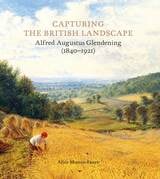
Capturing the British Landscape
Alfred Augustus Glendening (1840–1921)Alice Munro-Faure
Paul Holberton Publishing, 2022
Though critics often reviewed Alfred Augustus Glendening’s exhibitions, very little has been written about the artist himself. Here, new and extensive research removes layers of mystery and misinformation about his life, family, and career, accurately placing him amid the British art world during much of the nineteenth and into the twentieth century. Glendening was a man from humble origins, working full-time as a railway clerk when he managed to make his London exhibition debut at the age of twenty—a feat that would have been almost impossible before the Victorian era ushered in new possibilities of social mobility. Although his paintings show a tranquil and unspoiled landscape, his environment was rapidly being transformed by social, scientific, and industrial developments, while advances in transport, photography, and other technical discoveries undoubtedly influenced him and his fellow painters.
Celebrating his uniquely Victorian story, the book places Glendening within his proper historical context. Running alongside the main text is a timeline outlining significant landmarks, from political and social events to artistic and technical innovations. Thoroughly researched, the narrative explores why and for whom he painted, his artistic training, and his various inspirations. The book uncovers new information about the Victorian art world and embraces such aspects as Royal Academy prejudices, the popularity of Glendening’s work at home and abroad, his use of photography, and the sourcing of his art materials.
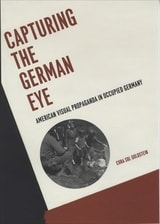
Capturing the German Eye
American Visual Propaganda in Occupied GermanyCora Sol Goldstein
University of Chicago Press, 2009
Shedding new light on the American campaign to democratize Western Germany after World War II, Capturing the German Eye uncovers the importance of cultural policy and visual propaganda to the U.S. occupation.
Cora Sol Goldstein skillfully evokes Germany’s political climate between 1945 and 1949, adding an unexpected dimension to the confrontation between the United States and the USSR. During this period, the American occupiers actively vied with their Soviet counterparts for control of Germany’s visual culture, deploying film, photography, and the fine arts while censoring images that contradicted their political messages. Goldstein reveals how this U.S. cultural policy in Germany was shaped by three major factors: competition with the USSR, fear of alienating German citizens, and American domestic politics. Explaining how the Americans used images to discredit the Nazis and, later, the Communists, she illuminates the instrumental role of visual culture in the struggle to capture German hearts and minds at the advent of the cold war.
Cardinal Newman in His Age
His Place in English Theology and LiteratureHarold L. Weatherby
Vanderbilt University Press, 1973

Carolingian Chronicles
Royal Frankish Annals and Nithard's HistoriesBernhard Walter Scholz
University of Michigan Press, 1970
Carolingian Portraits
A Study in the Ninth CenturyEleanor Shipley Duckett
University of Michigan Press, 1989
Carrying a Secret in My Heart
Children of the Victims of the Reprisals after the Hungarian Revolution in 1956 - An Oral HistoryZsuzsanna Korösi
Central European University Press, 2003
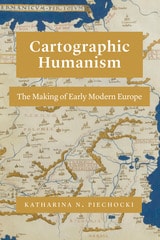
Cartographic Humanism
The Making of Early Modern EuropeKatharina N. Piechocki
University of Chicago Press, 2019
What is “Europe,” and when did it come to be? In the Renaissance, the term “Europe” circulated widely. But as Katharina N. Piechocki argues in this compelling book, the continent itself was only in the making in the fifteenth and sixteenth centuries.
Cartographic Humanism sheds new light on how humanists negotiated and defined Europe’s boundaries at a momentous shift in the continent’s formation: when a new imagining of Europe was driven by the rise of cartography. As Piechocki shows, this tool of geography, philosophy, and philology was used not only to represent but, more importantly, also to shape and promote an image of Europe quite unparalleled in previous centuries. Engaging with poets, historians, and mapmakers, Piechocki resists an easy categorization of the continent, scrutinizing Europe as an unexamined category that demands a much more careful and nuanced investigation than scholars of early modernity have hitherto undertaken. Unprecedented in its geographic scope, Cartographic Humanism is the first book to chart new itineraries across Europe as it brings France, Germany, Italy, Poland, and Portugal into a lively, interdisciplinary dialogue.

Cartography in France, 1660-1848
Science, Engineering, and StatecraftJosef Konvitz
University of Chicago Press, 1987
Concentrating on how and why new concepts and techniques of making and using maps were introduced, Josef Konvitz skillfully traces the modernization of cartography during the French Enlightenment. The story he unfolds is not merely a narrative of who did what, but an analysis of how the map itself influenced attitudes toward the land and the consequent effects on planning and the development of resources. Throughout, Konvitz demonstrates the significant relationship between cartography and political, economic, and military life. He emphasizes efforts to enlarge the practical applications of maps in government and the impact of government policy on the evolution of cartography.
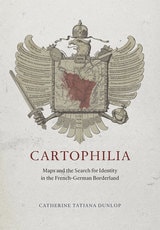
Cartophilia
Maps and the Search for Identity in the French-German BorderlandCatherine Tatiana Dunlop
University of Chicago Press, 2015
Turning to a previously undiscovered archive of popular maps, Cartophilia reveals Alsace-Lorraine’s lively world of citizen mapmakers that included linguists, ethnographers, schoolteachers, hikers, and priests. Together, this fresh group of mapmakers invented new genres of maps that framed French and German territory in original ways through experimental surveying techniques, orientations, scales, colors, and iconography. In focusing on the power of “bottom-up” maps to transform modern European identities, Cartophilia argues that the history of cartography must expand beyond the study of elite maps and shift its emphasis to the democratization of cartography in the modern world.
Casanova the Irresistible
Translated and with an Introduction by Armine Kotin Mortimer
University of Illinois Press, 2016
Armine Kotin Mortimer's translation of Sollers's reading tracks the alluring Venetian through the whole of his astounding and disreputable life. Eschewing myth, Sollers dares to present the plain realities of a man "simple, direct, courageous, cultivated, seductive, funny. A philosopher in action." The lovers are here, and the ruses and adventures. But Sollers also rescues Casanova the writer, a gifted composer of words who reigns as a titan of eighteenth-century literature. As always, Sollers seeks to shame society for its failure to recognize its failings. By admiring those of Casanova's admirable qualities present in himself, Sollers spurns bourgeois hypocrisy and cliché to affirm a jocund philosophy of life devoted to the twinned pursuits of pleasure and joy.
A masterful translation that captures Sollers's idiosyncratic style, Casanova the Irresistible escorts readers on a journey into the heads and hearts of two singular personalities.
Casanova's Lottery
The History of a Revolutionary Game of ChanceStephen M. Stigler
University of Chicago Press, 2022
In the 1750s, at the urging of famed adventurer Giacomo Casanova, the French state began to embrace risk in adopting a new Loterie. The prize amounts paid varied, depending on the number of tickets bought and the amount of the bet, as determined by each individual bettor. The state could lose money on any individual Loterie drawing while being statistically guaranteed to come out on top in the long run. In adopting this framework, the French state took on risk in a way no other has, before or after. At each drawing the state was at risk of losing a large amount; what is more, that risk was precisely calculable, generally well understood, and yet taken on by the state with little more than a mathematical theory to protect it.
Stephen M. Stigler follows the Loterie from its curious inception through its hiatus during the French Revolution, its renewal and expansion in 1797, and finally to its suppression in 1836, examining throughout the wider question of how members of the public came to trust in new financial technologies and believe in their value. Drawing from an extensive collection of rare ephemera, Stigler pieces together the Loterie’s remarkable inner workings, as well as its implications for the nature of risk and the role of lotteries in social life over the period 1700–1950.
Both a fun read and fodder for many fields, Casanova's Lottery shines new light on the conscious introduction of risk into the management of a nation-state and the rationality of playing unfair games.
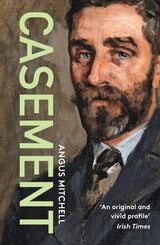
Casement
Angus Mitchell
Haus Publishing, 2026
At the time of his execution for treason in 1916, few were aware who Roger Casement was or what he represented. Since then, he has been lauded for his investigations into Belgian brutality in the Congo Free State and human rights abuses in the Peruvian rubber industry, but much else about him has remained obscured behind speculation about his sexuality and secret Irish revolutionary activity while in service of the British Empire. As such, his place in history has been ill-defined and multifarious: his involvement in the waging of war followed by the delicate negotiation of peace; his republicanism perceived variously as an eccentric enthusiasm and as a threat to the British Empire; his contemporary legacy overshadowed by the Black Diaries of disputed legitimacy, detailing alleged liaisons with young men.
In Casement, Angus Mitchell illuminates a life shrouded in mystery, which operated in the conflicting spheres of British foreign diplomacy and Irish revolutionary activity. Considering Casement’s rebellious nature, Mitchell asks if it was motivated as much by his “incorrigible” Irishness as by his exposure of the appalling crimes against humanity that he witnessed in Africa and South America. Most significantly, Casement demonstrates that his legacy cannot be ascribed to just one cause, whether as a critic of global colonialism or as a founding father of the modern Irish nation-state. Casement’s true commitment was to a universal understanding based on humanity, tolerance, and justice.
Castle and Cathedral
Longing for the Sacred in a Skeptical AgeBruce R. Berglund
Central European University Press, 2017
Cataclysms
A History of the Twentieth Century from Europe’s EdgeDan Diner, Translated by William Templer with Joel Golb
University of Wisconsin Press, 2007
Influenced by continental historical, legal, and social thought, Dan Diner views the totality of world history evolving from an Eastern and Southeastern European angle. A work of great synthesis, Cataclysms chronicles twentieth century history as a “universal civil war” between a succession of conflicting dualisms such as freedom and equality, race and class, capitalism and communism, liberalism and fascism, East and West.
Diner’s interpretation rotates around cataclysmic events in the transformation from multinational empires into nation states, accompanied by social revolution and “ethnic cleansing,” situating the Holocaust at the core of the century’s predicament. Unlike other Eurocentric interpretations of the last century, Diner also highlights the emerging pivotal importance of the United States and the impact of decolonization on the process of European integration.
Catalogue of the Slavonic Cyrillic Manuscripts of the National Szechenyi Library
Ralph Cleminson
Central European University Press, 2007
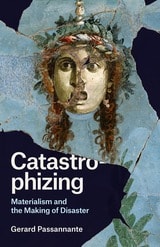
Catastrophizing
Materialism and the Making of DisasterGerard Passannante
University of Chicago Press, 2019
Reaching back to the time between the Renaissance and the Enlightenment, Passannante traces a history of catastrophizing through literary and philosophical encounters with materialism—the view that the world is composed of nothing but matter. As artists, poets, philosophers, and scholars pondered the physical causes and material stuff of the cosmos, they conjured up disasters out of thin air and responded as though to events that were befalling them. From Leonardo da Vinci’s imaginative experiments with nature’s destructive forces to the fevered fantasies of doomsday astrologers, from the self-fulfilling prophecies of Shakespeare’s tragic characters to the mental earthquakes that guided Kant toward his theory of the sublime, Passannante shows how and why the early moderns reached for disaster when they ventured beyond the limits of the sensible. He goes on to explore both the danger and the critical potential of thinking catastrophically in our own time.
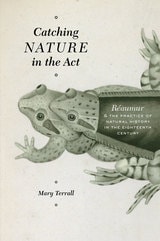
Catching Nature in the Act
Réaumur and the Practice of Natural History in the Eighteenth CenturyMary Terrall
University of Chicago Press, 2014
At the center of Terrall’s study is René-Antoine Ferchault de Réaumur (1683–1757)—the definitive authority on natural history in the middle decades of the eighteenth century—and his many correspondents, assistants, and collaborators. Through a close examination of Réaumur’s publications, papers, and letters, Terrall reconstructs the working relationships among these naturalists and shows how observing, collecting, and experimenting fit into their daily lives. Essential reading for historians of science and early modern Europe, Catching Nature in the Act defines and excavates a dynamic field of francophone natural history that has been inadequately mined and understood to date.
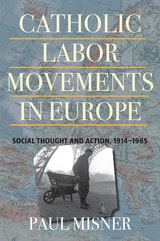
Catholic Labor Movements in Europe
Paul Misner
Catholic University of America Press, 2015
Catholics, Anglicans, and Puritans
Seventeenth-Century EssaysHugh Trevor-Roper
University of Chicago Press, 1988
The opening essay, a skillful work of historical detection, investigates the strange career of Nicholas Hill. In "Laudianism and Political Power," Trevor-Roper returns to the subject of his first, now classic, book. He analyzes the real significance of the ecclesiastical movement associated with Archbishop Laud and speculates on what might have happened if the Stuarts had not abandoned it. "James Ussher, Archbishop of Armagh" deals with a key figure in the intellectual and religious life of his time. A long essay on "The Great Tew Circle" reinstates Lord Falkland as an important influence on the continuity of ideas through the English revolution. The final essay reassesses the political ideology of Milton.
English intellectual history, as Trevor-Roper constructs it here for the seventeenth century, is conditioned by its social and political context. Always engaging and fresh, these essays deal with currently interesting historical topics and up-to-date controversies.
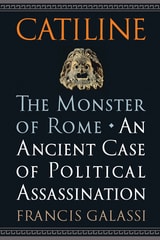
Catiline, The Monster of Rome
An Ancient Case of Political AssassinationFrancis Galassi
Westholme Publishing, 2014
In 62 BC, Roman Senator Lucius Sergius Catiline lay dead on a battlefield in Tuscany. He was slain along with his soldiers after his conspiracy to overthrow the Roman Republic had been exposed by his adversary Cicero. It was an ignominious end for a man described at the time as a perverted, insane monster who had attempted to return his family to fortune and social standing. Chroniclers were not kind to Catiline, and his name over the centuries was synonymous with treachery. Recently, scholars have been reappraising the life and influence of this ancient Roman. In Catiline, The Monster of Rome: An Ancient Case of Political Assassination, economic historian Francis Galassi provides the first book-length account of Catiline in more than a generation.
Rome first achieved a status as an empire during Catiline’s lifetime. The republic was, however, constantly at war with foreign powers and occasionally its own allies, and the disparity between the wealthy and the poor threatened to destabilize society. Catiline was from an aristocratic but impoverished family and first served as an officer with Cornelius Sulla during that general’s purges against Gaius Marius, the supposed champion of the oppressed masses. Catiline’s goal was to serve Sulla and then use that as a springboard to public office where he could recover his family’s former wealth and honor. However, the senatorial elite became suspicious if not threatened by the upstart Catiline and blocked his ambitions. Catiline was dogged by trumped-up charges, including raping a Vestal virgin and murdering his brother-in-law; he was acquitted each time, but his political life was ruined. With citizens demanding land and agrarian reform, Catiline genuinely embraced their dissatisfaction, and realizing that the elite would stop his attempt to gain status through elections, he organized a conspiracy to take control of Roman government through arms. Once his actions had been made public, many of his supporters and co-conspirators left him; but honoring the course he had chosen, he and his remaining soldiers fought a Roman army to their deaths. Rather than the “monster” as portrayed by his contemporaries, the author contends that Catiline was compelled to act for the benefit of common Romans to save Rome even if it meant overthrowing the government. As Galassi notes, Catiline’s contemporary, the slave Spartacus, has been a symbol of social reform for centuries, but it was actually Catiline, not Spartacus, who attempted to change Rome.
Catina’s Haircut
A Novel in StoriesPaola Corso
University of Wisconsin Press, 2010
Catina’s Haircut: A Novel in Stories spans four generations of a peasant family in the brutal poverty of post-Unification southern Italy and in an immigrant’s United States. The women in these tales dare to cross boundaries by discovering magical leaps inherent in the landscape, in themselves, and in the stories they tell and retell of family tragedy at a time of political unrest. Through an oral tradition embedded in the stone of memory and the flow of its reinvention, their passionate tale of resistance and transformation courses forward into new generations in a new world.
A woman threatens to join the land reform struggle in her Calabrian hill town, against her husband’s will, during a call for revolution in 1919. A brother and sister turn to the village sorceress in Fascist Italy to bring rain to their father’s drought-stricken farm. In Pittsburgh, new immigrants witness a miraculous rescue during the Great Flood of 1936. A young girl courageously dives into the Allegheny River to save her grandfather’s only memento of the old country. With only broken English to guide her, a widow hops a bus in search of live chickens to cook for Easter dinner in her husband’s memory. An aging woman in the title story is on a quest to cut the ankle-length hair as hard as the rocky soil of Calabria in a drought. A lonely woman who survived World War II bombings in her close-knit village, struggles to find community as a recent immigrant. A daughter visits her mother’s hill town to try and fulfill a wish for her to see the Fata Morgana. These haunting images permeate Corso’s linked stories of loss, hope, struggle, and freedom.
An official selection of The Sons of Italy® Book Club
Best Books for General Audiences, selected by the Public Library Association
Celia in the Revolution
Elena Fortún
Swan Isle Press, 2023
Set during the Spanish Civil War (1936–39), Celia in the Revolution is the last in a series of young adult novels written by Encarnación Aragoneses, known by the pen name Elena Fortún, one of the most prolific and popular Spanish authors of the mid-twentieth century.
In a series of more than twenty novels, Fortún’s protagonist is Celia Gálvez de Montalbán, a precocious and rebellious girl from an affluent family who’s not afraid to question authority and dream, and that often gets her into trouble. Readers watch her grow from age seven through adolescence to the threshold of womanhood at seventeen, which is her age in this dark, inspiring novel about the war that changed Spain.
In this last narrative in the legendary series, Celia has an awakening that not even her lively imagination could have anticipated. The once carefree, innocent child prone to playful fantasies must suddenly confront a world that’s utterly changed, finding herself amid a bloody conflict, la Guerra Civil. Celia, now a madrecita, a little mother to her two younger sisters since the death of their mother, is forced into a life of hardship, a world of hunger, witness to violence, executions, bombing raids, and death. With Celia’s sorrows come her courageous and profound compassion, consoling and caring for virtually every war victim that crosses her path, no matter their political inclinations, and no matter all that Celia must contend with herself. Celia, despite all her travails, manages to survive with determination, defiance, and dignity.
Written immediately after the war, Celia in the Revolution was not published during Elena Fortún’s lifetime, until after the death of the dictator, Francisco Franco, due to censorship. This first major English translation by eminent scholar and Hispanist Michael Ugarte captures the narrative and nuances of Celia’s voice and others in this character-rich novel, and fellow eminent scholar and Hispanist Nuria Capdevila-Arguëlles’s preface brings powerful insights into this remarkable work by Elena Fortún that transcends young adult literature.
Chaim Weizmann
A BiographyJehuda Reinharz and Motti Golani
Brandeis University Press, 2024
In Chaim Weizmann: A Biography, Jehuda Reinharz and Motti Golani show how Weizmann, a leader of the World Zionist Organization who became the first president of Israel, advocated for a Jewish state by gaining the support of influential politicians and statesmen as well as Jews around the world. Beginning with his childhood in Belorussia and concluding with his tenure as president, Reinharz and Golani describe how a Russian Jew, who immigrated to the United Kingdom in the early twentieth century, was able to advance the goals of Theodor Herzl, the founder of the Zionist Organization. Weizmann is also shown as a man of human foibles—his infatuations, political machinations, and elitism—as well as a man of admirable qualities—intelligence, wit, charisma, and dedication.
Weizmann, who came to the UK to work as a biochemist, was in regular communication with British political figures, including prime ministers Arthur James Balfour, David Lloyd George, Winston Churchill, and Ramsay MacDonald. He also met presidents of the United States from Woodrow Wilson to Harry Truman. His success in earning the support of British political figures helped lead to the Balfour Declaration, which advocated for a “national home” for the Jewish people in Palestine.
As the authors show in this authoritative account of Weizmann’s life, Weizmann was guided by the belief that “Zion shall be redeemed in justice,” a phrase that recurs often in his writings.
Chains of Command
The Rise and Cruel Reign of the Franchise EconomyBrian Callaci
University of Chicago Press, 2026
A surprising look at the big business of owning small businesses and what America’s franchise economy means for its workers.
Walk into a McDonald’s anywhere in the United States, and it will be identical to every other McDonald’s in the country. Yet, that particular store is almost certainly owned and operated by an “independent” franchisee. While McDonald’s presents an image of centralized uniformity to the consumer, it shows a different face to the small business owners operating its stores under its control and the workers preparing its product to its standards. How then does McDonald’s—and its big business peers—manage to be two things at once?
In this revelatory work, economist Brian Callaci shows how franchisors have altered the legal treatment of corporations in their favor through a decades-long crusade of lobbying and litigation. Their efforts subsequently unleashed a slew of legal and economic sins upon the US economy and labor force, allowing multinational corporations to control continent-spanning empires while outsourcing employment and scapegoating legal responsibilities onto small businesses. The result: the unfettered growth of some of America’s most recognizable businesses, at the aggregate expense of America’s workers.
Remarkable in both its scale and synthesis, Callaci’s story is the first chronicle of this business movement—initially resisted by US courts before experiencing a dramatic reversal of fortune after decades of campaigning by some of America’s most established entrepreneurs. An urgent and erudite history, Chains of Command reveals how the US labor market was tamed one small business at a time.
Chamfort
A BiographyClaude Arnaud
University of Chicago Press, 1992

Changing Identities in Early Modern France
Michael Wolfe, ed.
Duke University Press, 1997
After examining the interplay between competing ideologies and public institutions, from the monarchy to the Parlement of Paris to the aristocratic household, the volume explores the dynamics of deviance and dissent, particularly in regard to women’s roles in religious reform movements and such sensationalized phenomena as the witch hunts and infanticide trials. Concluding essays examine how regional and confessional identities reshaped French identity in response to the discovery of the New World and the spectacular spread of Calvinism.
Contributors. Charmarie Blaisdell, William Bouwsma, Lawrence M. Bryant, Denis Crouzet, Robert Descimon, Barbara B. Diefendorf, Richard M. Golden, Sarah Hanley, Mack P. Holt, Donald R. Kelley, Kristen B. Neuschel, J. H. M. Salmon, Zachary Sayre Schiffman, Silvia Shannon, Alfred Soman, Michael Wolfe
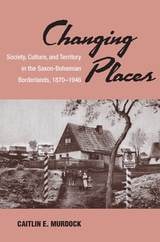
Changing Places
Society, Culture, and Territory in the Saxon-Bohemian Borderlands, 1870-1946Caitlin E. Murdock
University of Michigan Press, 2010
"Changing Places is an interesting meditation on the varying identities and rights claimed by residents of borderlands, the limits placed on the capacities of nation-states to police their borders and enforce national identities, and the persistence of such contact zones in the past and present. It is an extremely well-written and engaging study, and an absolute pleasure to read."
---Dennis Sweeney, University of Alberta
"Changing Places offers a brilliantly transnational approach to its subject, the kind that historians perennially demand of themselves but almost never accomplish in practice."
---Pieter M. Judson, Swarthmore College
Changing Places is a transnational history of the birth, life, and death of a modern borderland and of frontier peoples' changing relationships to nations, states, and territorial belonging. The cross-border region between Germany and Habsburg Austria---and after 1918 between Germany and Czechoslovakia---became an international showcase for modern state building, nationalist agitation, and local pragmatism after World War I, in the 1930s, and again after 1945.
Caitlin Murdock uses wide-ranging archival and published sources from Germany and the Czech Republic to tell a truly transnational story of how state, regional, and local historical actors created, and eventually destroyed, a cross-border region. Changing Places demonstrates the persistence of national fluidity, ambiguity, and ambivalence in Germany long after unification and even under fascism. It shows how the 1938 Nazi annexation of the Czechoslovak "Sudetenland" became imaginable to local actors and political leaders alike. At the same time, it illustrates that the Czech-German nationalist conflict and Hitler's Anschluss are only a small part of the larger, more complex borderland story that continues to shape local identities and international politics today.
Caitlin E. Murdock is Associate Professor of History at California State University, Long Beach.
Jacket Credit: Cover art courtesy of the author
Charity and Children in Renaissance Florence
The Ospedale degli Innocenti, 1410-1536Philip Gavitt
University of Michigan Press, 1991
Alongside the architectural splendor and intellectual brilliance of early Renaissance Florence there existed a second world of poverty, misery, social despair, and child abandonment. The Ospedale degli Innocenti (Hospital of the Innocents), designed and built between 1419 and 1445 by the renowned architect Filippo Brunelleschi, united these disparate worlds. Christian charity and compassion, as well as the humanist commitment to social perfection, family values, and love for children, were intertwined with a civic pride in which charity curried God's favor and invoked God's blessings on the city's fortunes.
Based on a close and attentive reading of archival material from the hospital and from the Florentine State Archives, Charity and Children in Renaissance Florence both chronicles the concerns and ambivalence of parents who abandoned children and follows the lives of the hospital's inhabitants from childhood to death. The book also demonstrates how hospital officials deliberately duplicated the structure and values of the Florentine family within the hospital walls. Gavitt's research shows that early modern foundling hospitals were not charnel houses where parents knowingly and impersonally abandoned their unwanted children to certain death. Charity and Children in Renaissance Florence provokes reflection on the contrast between our own views on the care of homeless children and those of the Italian Renaissance.
Winner of the Society for Italian Historical Studies 1988 Award for Best Unpublished Manuscript.
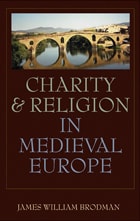
Charity and Religion in Medieval Europe
James William Brodman
Catholic University of America Press, 2009
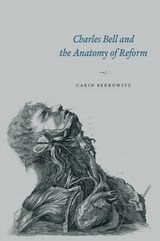
Charles Bell and the Anatomy of Reform
Carin Berkowitz
University of Chicago Press, 2015
In Charles Bell and the Anatomy of Reform, Carin Berkowitz takes readers into Bell’s world, helping us understand the life of medicine before the modern separation of classroom, laboratory, and clinic. Through Bell’s story, we witness the age when modern medical science, with its practical universities, set curricula, and medical professionals, was born.

Charles IV
Portrait of a Medieval RulerVáclav Žurek
Karolinum Press, 2023
Charles IV, King of Bohemia and Holy Roman Emperor, has been called “one of the most learned and diplomatically skillful sovereigns” of the fourteenth century. Having moved the seat of the Holy Roman Empire to Prague and founding the first university in Central Europe, Charles IV is a towering figure in Czech history and a crucial character in the story of medieval Europe.
Recent research, especially in art history, has tended to present Charles IV in a purely positive, unblemished light: viewing him and his imperial court as the engine behind a flourishing of culture in the region. This book views Charles IV through a more critical lens, examining the careful construction that went into the way he presented himself and the characteristic manifestations of Charles’ execution of royal power. The first part of the book offers a chronological description of Charles’ life within the broader context of the times and the House of Luxembourg. The second part provides a close look into Charles IV’s style of rule while focusing on phenomena that reveal his personal conception of power and how it was wielded.
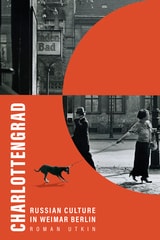
Charlottengrad
Russian Culture in Weimar BerlinRoman Utkin
University of Wisconsin Press, 2023
By closely examining the intellectual output of Charlottengrad, Roman Utkin explores how community members balanced their sense of Russianness with their position in a modern Western city charged with artistic, philosophical, and sexual freedom. He highlights how Russian authors abroad engaged with Weimar-era cultural energies while sustaining a distinctly Russian perspective on modernist expression, and follows queer Russian artists and writers who, with their German counterparts, charted a continuous evolution in political and cultural attitudes toward both the Weimar and Soviet states.
Utkin provides insight into the exile community in Berlin, which, following the collapse of the tsarist government, was one of the earliest to face and collectively process the peculiarly modern problem of statelessness. Charlottengrad analyzes the cultural praxis of “Russia Abroad” in a dynamic Berlin, investigating how these Russian émigrés and exiles navigated what it meant to be Russian—culturally, politically, and institutionally—when the Russia they knew no longer existed.
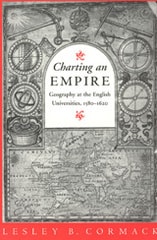
Charting an Empire
Geography at the English Universities 1580-1620Lesley B. Cormack
University of Chicago Press, 1997
Cormack demonstrates that geography was part of the Arts curriculum between 1580 and 1620, read at university by a broad range of soon-to-be political, economic, and religious leaders. By teaching these young Englishmen to view their country in a global context, and to see England playing a major role on that stage, geography supplied a set of shared assumptions about the feasibility and desirability of an English empire. Thus, the study of geography helped create an ideology of empire that made possible the actual forays of the next century.
Geography emerges in Cormack's account as the fruitful ground between college and court, in whose well-prepared soil the seeds of English imperialism took root. Charting an Empire will interest historians of science, geography, cartography, education, and empire.
Chaucer and the Subject of History
Lee Patterson
University of Wisconsin Press, 1991
Renowned scholar of medieval literature, Lee Patterson, presents a compelling vision of the shape and direction of Geoffrey Chaucer’s entire career in Chaucer and the Subject of History.
Chaucer's interest in individuality was strikingly modern. At the same time he was profoundly aware of the pressures on individuality exerted by the past and by society—by history. This tension between the subject and history is Patterson's topic. He begins by showing how Chaucer’s understanding of history as a subject for poetry—a world to be represented and a cultural force affecting human action—began to take shape in his poems on classical themes, especially in Troilus and Criseyde. Patterson's extended analysis of this profound yet deeply conflicted exploration of the relationship between "history" and "the subject" provides the basis for understanding Chaucer's shift to his contemporary world in the Canterbury Tales. There, in the shrewdest and most wide-ranging analysis of late medieval society we possess, Chaucer investigated not just the idea of history but the historical world intimately related to his own political and literary career.
Patterson's chapters on individual tales clarify and confirm his provocative arguments. He shows, for example, how the Knight's Tale represents the contemporary crisis of governance in terms of a crisis in chivalric identity itself; how the Miller’s Tale reflects the social pressures and rhetoric of peasant movements generally and the Rising of 1381 in particular; and how the tales of the Merchant and Shipman register the paradoxical placement of a bourgeois class lacking class identity. And Patterson's brilliant readings of the Wife of Bath’s Tale—"the triumph of the subject"—and the Pardoner’s Tale —"the subject of confession"—reveal how Chaucer reworked traditional materials to accomplish stunning innovations that make visible unmistakably social meanings. Chaucer and the Subject of History is a landmark book, one that will shape the way that Chaucer is read for years to come.