Results by title
54 books match the query 'Freedom of speech' and 3 start with c
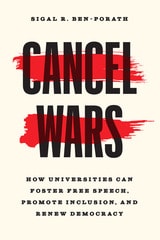
Cancel Wars
How Universities Can Foster Free Speech, Promote Inclusion, and Renew DemocracySigal R. Ben-Porath
University of Chicago Press, 2023
An even-handed exploration of the polarized state of campus politics that suggests ways for schools and universities to encourage discourse across difference.
College campuses have become flashpoints of the current culture war and, consequently, much ink has been spilled over the relationship between universities and the cultivation or coddling of young American minds. Philosopher Sigal R. Ben-Porath takes head-on arguments that infantilize students who speak out against violent and racist discourse on campus or rehash interpretations of the First Amendment. Ben-Porath sets out to demonstrate the role of the university in American society and, specifically, how it can model free speech in ways that promote democratic ideals.
In Cancel Wars, she argues that the escalating struggles over “cancel culture,” “safe spaces,” and free speech on campus are a manifestation of broader democratic erosion in the United States. At the same time, she takes a nuanced approach to the legitimate claims of harm put forward by those who are targeted by hate speech. Ben-Porath’s focus on the boundaries of acceptable speech (and on the disproportional impact that hate speech has on marginalized groups) sheds light on the responsibility of institutions to respond to extreme speech in ways that proactively establish conversations across difference. Establishing these conversations has profound implications for political discourse beyond the boundaries of collegiate institutions. If we can draw on the truth, expertise, and reliable sources of information that are within the work of academic institutions, we might harness the shared construction of knowledge that takes place at schools, colleges, and universities against truth decay. Of interest to teachers and school leaders, this book shows that by expanding and disseminating knowledge, universities can help rekindle the civic trust that is necessary for revitalizing democracy.
[more]
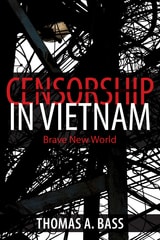
Censorship in Vietnam
Brave New WorldThomas A. Bass
University of Massachusetts Press, 2017
What does censorship do to a culture? How do censors justify their work? What are the mechanisms by which censorship—and self-censorship—alter people's sense of time and memory, truth and reality? Thomas Bass faced these questions when The Spy Who Loved Us, his account of the famous Time magazine journalist and double agent Pham Xuan An, was published in a Vietnamese edition. When the book finally appeared in 2014, after five years of negotiations with Vietnamese censors, more than four hundred passages had been altered or cut from the text.
After the book was published, Bass flew to Vietnam to meet his censors, at least the half dozen who would speak with him. In Censorship in Vietnam, he describes these meetings and examines how censorship works, both in Vietnam and elsewhere in the world. An exemplary piece of investigative reporting, Censorship in Vietnam opens a window into the country today and shows us the precarious nature of intellectual freedom in a world governed by suppression.
After the book was published, Bass flew to Vietnam to meet his censors, at least the half dozen who would speak with him. In Censorship in Vietnam, he describes these meetings and examines how censorship works, both in Vietnam and elsewhere in the world. An exemplary piece of investigative reporting, Censorship in Vietnam opens a window into the country today and shows us the precarious nature of intellectual freedom in a world governed by suppression.
[more]
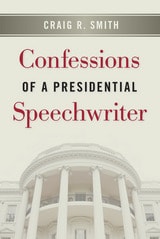
Confessions of a Presidential Speechwriter
Craig R. Smith
Michigan State University Press, 2014
An avid high school debater and enthusiastic student body president, Craig Smith seemed destined for a life in public service from an early age. As a sought-after speechwriter, Smith had a front-row seat at some of the most important events of the twentieth century, meeting with Robert Kennedy and Richard Nixon, advising Governor Ronald Reagan, writing for President Ford, serving as a campaign manager for a major U.S. senator’s reelection campaign, and writing speeches for a contender for the Republican nomination for president. Life in the volatile world of politics wasn’t always easy, however, and as a closeted gay man, Smith struggled to reconcile his private and professional lives. In this revealing memoir, Smith sheds light on what it takes to make it as a speechwriter in a field where the only constant is change. While bouncing in and out of the academic world, Smith transitions from consultantships with George H. W. Bush and the Republican caucus of the U.S. Senate to a position with Chrysler CEO Lee Iacocca. When Smith returns to Washington, D.C., as president and founder of the Freedom of Expression Foundation, he becomes a leading player on First Amendment issues in the nation’s capital. Returning at long last to academia, Smith finds happiness coming out of the closet and reaping the benefits of a dedicated and highly successful career.
[more]