Results by title
130 books match the query 'Gay men' and 8 start with c
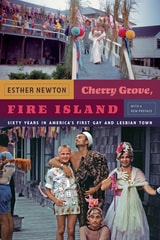
Cherry Grove, Fire Island
Sixty Years in America's First Gay and Lesbian TownEsther Newton
Duke University Press, 2014
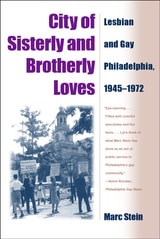
City Of Sisterly And Brotherly Loves
Lesbian And Gay Philadelphia, 1945-1972Marc Stein
Temple University Press, 2004

City of Sisterly and Brotherly Loves
Lesbian and Gay Philadelphia, 1945-1972Marc Stein
University of Chicago Press, 2000
Stein takes us on a tour through Philadelphia's bars, restaurants, bookstores, bathhouses, movie theaters, parks, and parades where lesbian and gay cultures thrived.
We learn about the scientific experts, religious leaders, public officials, and journalists who attacked and ignored same-sex sexualities. And we read about the courageous people who fought back with strategies of everyday resistance and organized political activism.
Stein argues against the idea that a conspiracy of silence surrounded gays and lesbians in the 1940s and 1950s. He shows that same-sex sexualities were regularly discussed in controversies concerning the tennis player Big Bill Tilden, the Walt Whitman Bridge, sex murders and crimes, and police raids. Philadelphians became national leaders in the gay and lesbian movement. They conducted sit-ins at Dewey's restaurant, organized pickets at Independence Hall, edited the movement's most widely circulated publications the Ladder and Drum, and pursued court cases all the way to the U.S. Supreme Court.
Beautifully crafted and exceptionally well-written, Stein's book not only provides a new starting place for thinking about lesbian and gay history but also challenges readers to rethink twentieth-century urban history.
Commodities of Care
The Business of HIV Testing in ChinaElsa L. Fan
University of Minnesota Press, 2021
How global health practices can end up reorganizing practices of care for the people and communities they seek to serve
Commodities of Care examines the unanticipated effects of global health interventions, ideas, and practices as they unfold in communities of men who have sex with men (MSM) in China. Targeted for the scaling-up of HIV testing, Elsa L. Fan examines how the impact of this initiative has transformed these men from subjects of care into commodities of care: through the use of performance-based financing tied to HIV testing, MSM have become a source of economic and political capital.
In ethnographic detail, Fan shows how this particular program, ushered in by global health donors, became the prevailing strategy to control the epidemic in China in the late 2000s. Fan examines the implementation of MSM testing and its effects among these men, arguing that the intervention produced new markets of men, driven by the push to meet testing metrics.
Fan shows how men who have sex with men in China came to see themselves as part of a global “MSM” category, adopting new selfhoods and socialities inextricably tied to HIV and to testing. Wider trends in global health programming have shaped national public health responses in China and, this book reveals, have radically altered the ways health, disease, and care are addressed.
Confronting AIDS through Literature
The Responsibilities of RepresentationEdited by Judith Laurence Pastore
University of Illinois Press, 1993
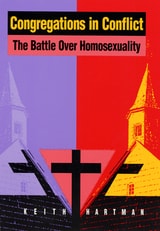
Congregations in Conflict
The Battle over HomosexualityHartman, Keith
Rutgers University Press, 1996
A Methodist church puts its minister on trial after he marches in a gay rights parade. A Quaker meeting struggles to decide whether to marry a lesbian couple. An entire congregation is thrown out of the Southern Baptist Convention for deciding that a gay divinity student had a sincere calling to the ministry, and an order of celibate monks comes out of the closet. An Episcopal priest blesses two same-sex relationships--then a closeted gay lawyer leads the charge to have him fired.
Homosexuality is the most divisive issue facing churches today. Like the issue of slavery 150 years ago, it is a matter that ignites passionate convictions on both sides, a matter that threatens to turn members of the same faith against each other, to divide congregations, and possibly even to fragment several denominations. Like slavery, it is an issue that calls up basic questions about what it means to be a Christian. How does one know right from wrong? Is the Bible fallible? Do good Christians always follow their church's teachings, or are they allowed to think for themselves on moral issues? And to what source does one finally look to determine what God really wants?
While many books have been written analyzing the scriptural and theological dimensions of the conflict, none has yet shown how it is being played out in the pews. Congregations in Conflict examines nine churches that were split by disagreements over gay and lesbian issues, and how the congregations resolved them.
Hartman explores in very readable prose how different denominations have handled their conflicts and what it says about the nature of their faith. He shows some churches coming through their struggles stronger and more unified, while others irrevocably split. Most importantly, he illuminates how people with a passionate clash of beliefs can still function together as a community of faith.
Cracks in the Iron Closet
Travels in Gay and Lesbian RussiaDavid Tuller
University of Chicago Press, 1997
"Tuller's observant reporting and personal experiences make for absorbing reading: the human comedy rendered in unexpected ways."—New Yorker
"Anyone who thinks San Francisco is the world capital of sexual polymorphism should read this book."—Adam Goodheart, Washington Post
"[This book is] is profoundly moving."—Jim Van Buskirk, San Francisco Chronicle
Crossings
Creative Ecologies of CruisingJoão Florêncio
Rutgers University Press, 2025
A creative dialogue between a queer artist and a queer academic reminiscing about and thinking with their cruising experiences, Crossings takes queer sex practices and cultures seriously as ways of knowing and world-making. The result is an erotic hybrid form hovering between scholarship and avant-garde experimentation, between critical manifesto and sex memoir. Here, the voices of each author, merged together in one, invite the reader to inhabit the erotic spacetime between self and other, the familiar and the strange, desire and pleasure, climax and release. That is, the spaces and temporalities of cruising itself.