Results by title
522 books match the query 'Gender' and 30 start with c

CERTAIN OTHER COUNTRIES
Homicide, Gender, and National Identity in Late Nineteenth-Century England, Ireland, Scotland, and WalesCarolyn A. Conley
The Ohio State University Press, 2007
By combining quantitative techniques in the analysis of over seven thousand cases, as well as careful and detailed readings of individual cases, the book exposes trends and patterns that might not have been evident in works using only one method. For instance, by examining all homicide trials rather than concentrating exclusively on a few highly celebrated ones, it becomes clear that most female killers were not viewed with particular horror, but were treated much like their male counterparts.
The conclusions offer challenges and correctives to existing scholarship on gender, ethnicity, class, and violence. The book also demonstrates that the Welsh, Scots, and English remained quite distinct long after their melding as Britons was announced and celebrated. By blending a study of trends in violent behavior with ideas about national identity, Conley brings together rich and hotly debated fields of modern history. This book will be valuable both for scholars of crime and violence as well as for those studying British history.
COURTS AND COMMERCE
GENDER, LAW, AND THE MARKET ECONOMY IN COLONIAL NEW YORKDeborah A. Rosen
The Ohio State University Press, 1997
Illuminates the legal engine behind colonial America’s market economy, revealing how law and commerce intertwined to sideline women's participation and lay the groundwork for industrial capitalism.
In Courts and Commerce, Deborah A. Rosen offers a fresh, incisive look at the economic and legal foundations of colonial New York. Drawing on a wide array of 18th-century sources—probate inventories, court records, petitions, and more—Rosen uncovers how law and commerce intertwined to shape a market economy long before the rise of industrial capitalism.
Rosen challenges the romanticized view of colonial America as a bastion of communal values. Instead, she reveals a society already driven by arm’s-length transactions and legal mechanisms that empowered men to expand their economic reach while systematically limiting women’s participation. Her analysis spans both urban and rural settings, highlighting regional contrasts and the gendered impact of legal structures.
This book pushes back against the idea that the nineteenth century marked a sudden economic transformation. Rosen shows that many of the legal and economic patterns associated with industrialization were already in motion a century earlier. Engaging and deeply researched, Courts and Commerce is essential reading for scholars of colonial history, legal and economic development, and gender studies. It reframes our understanding of early American life—and the roots of inequality in the modern economy.
COVID and Gender in the Middle East
Edited by Rita Stephan
University of Texas Press, 2023
As the coronavirus ravages the globe, its aftermaths have brought gender inequalities to the forefront of many conversations. Countries in the Middle East and North Africa have been slow to prepare for, adapt to, and mitigate the COVID-19 health crisis and its impacts on governance, economics, security, and rights. Women’s physical well-being, social safety nets, and economic participation have been disproportionately affected, and with widespread shutdowns and capricious social welfare programs, women are exiting the workplace and the classroom, carrying the caregiving burden.
With feminist foregrounding, Rita Stephan's collection COVID and Gender in the Middle East gathers an impressive group of local scholars, activists, and policy experts. The book examines a range of national and localized responses to gender-specific issues around COVID’s health impact and the economic fallout and resulting social vulnerabilities, including the magnified marginalization of Syrian refugees; the inequitable treatment of migrant workers in Bahrain; and the inadequate implementation of gender-based violence legislation in Morocco. An essential global resource, this book is the first to provide empirical evidence of COVID’s gendered effects.

Cancer Activism
Gender, Media, and Public PolicyKaren M. Kedrowski and Marilyn Stine Sarow
University of Illinois Press, 2010
Cancer Activism explores the interplay between advocacy, the media, and public perception through an analysis of breast cancer and prostate cancer activist groups over a nearly twenty-year period. Despite both diseases having nearly identical mortality and morbidity rates, Karen M. Kedrowski and Marilyn Stine Sarow present evidence from more than 4,200 news articles to show that the different groups have had markedly different impacts. They trace the rise of each movement from its beginning and explore how discussions about the diseases appeared on media, public, and government agendas. In an important exception to the feminist tenet that women as a group hold less power than men, Kedrowski and Sarow demonstrate that the breast cancer movement is not only larger and better organized than the prostate cancer movement, it is also far more successful at shaping media coverage, public opinion, and government policy.
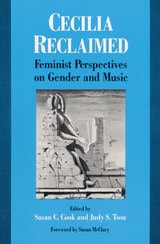
Cecilia Reclaimed
Feminist Perspectives on Gender and MusicEdited by Susan C. Cook and Judy S. Tsou
University of Illinois Press, 1994

Changing Sex
Transsexualism, Technology, and the Idea of GenderBernice L. Hausman
Duke University Press, 1994
Hausman’s inquiry into the development of endocrinology and plastic surgery shows how advances in medical knowledge were central to the establishment of the material and discursive conditions necessary to produce the demand for sex change—that is, to both "make" and "think" the transsexual. She also retraces the hidden history of the concept of gender, demonstrating that the semantic distinction between "natural" sex and "social" gender has its roots in the development of medical treatment practices for intersexuality—the condition of having physical characteristics of both sexes— in the 1950s. Her research reveals the medical institution’s desire to make heterosexual subjects out of intersexuals and indicates how gender operates semiotically to maintain heterosexuality as the norm of the human body. In critically examining medical discourses, popularizations of medical theories, and transsexual autobiographies, Hausman details the elaboration of "gender narratives" that not only support the emergence of transsexualism, but also regulate the lives of all contemporary Western subjects. Changing Sex will change the ways we think about the relation between sex and gender, the body and sexual identity, and medical technology and the idea of the human.

Chicana Sexuality and Gender
Cultural Refiguring in Literature, Oral History, and ArtDebra J. Blake
Duke University Press, 2008
Blake looks at how the Chicana professional intellectuals and the U.S. Mexicana women refigure confining and demeaning constructions of female gender roles and racial, ethnic, and sexual identities. She organizes her analysis around re-imaginings of La Virgen de Guadalupe, La Llorona, indigenous Mexica goddesses, and La Malinche, the indigenous interpreter for Hernán Cortés during the Spanish conquest. In doing so, Blake reveals how the professional intellectuals and the working-class and semiprofessional women rework or invoke the female icons to confront the repression of female sexuality, limiting gender roles, inequality in male and female relationships, and violence against women. While the representational strategies of the two groups of women are significantly different and the U.S. Mexicanas would not necessarily call themselves feminists, Blake nonetheless illuminates a continuum of Chicana feminist thinking, showing how both groups of women expand lifestyle choices and promote the health and well-being of women of Mexican origin or descent.

Chicano Rap
Gender and Violence in the Postindustrial BarrioBy Pancho McFarland
University of Texas Press, 2008
Powered by a driving beat, clever lyrics, and assertive attitudes, rap music and hip hop culture have engrossed American youth since the mid-1980s. Although the first rappers were African Americans, rap and hip hop culture quickly spread to other ethnic groups who have added their own cultural elements to the music. Chicano Rap offers the first in-depth look at how Chicano/a youth have adopted and adapted rap music and hip hop culture to express their views on gender and violence, as well as on how Chicano/a youth fit into a globalizing world.
Pancho McFarland examines over five hundred songs and seventy rap artists from all the major Chicano rap regions—San Diego, San Francisco and Northern California, Texas, and Chicago and the Midwest. He discusses the cultural, political, historical, and economic contexts in which Chicano rap has emerged and how these have shaped the violence and misogyny often expressed in Chicano rap and hip hop. In particular, he argues that the misogyny and violence of Chicano rap are direct outcomes of the "patriarchal dominance paradigm" that governs human relations in the United States. McFarland also explains how globalization, economic restructuring, and the conservative shift in national politics have affected Chicano/a youth and Chicano rap. He concludes with a look at how Xicana feminists, some Chicano rappers, and other cultural workers are striving to reach Chicano/a youth with a democratic, peaceful, empowering, and liberating message.
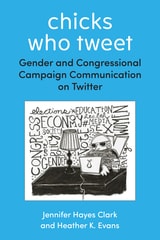
Chicks Who Tweet
Gender and Congressional Campaign Communication on TwitterJennifer Hayes Clark and Heather K. Evans
University of Michigan Press, 2027
Does gender shape campaign communication? Drawing on an original dataset of candidate tweets across six election cycles, Chicks Who Tweet demonstrates that gender systematically shapes congressional campaign messaging. Not only does gender predict the issues candidates emphasize, but also the tone of their communication and their strategic decisions to engage in negative campaigning. Even after controlling for partisanship, incumbency status, district competitiveness, and overall tweeting volume, gender remains a robust and statistically significant predictor of issue emphasis.
Working to reclaim the label “chicks,” the authors show that women candidates are acutely aware of the gendered stereotypes that shape voter expectations and media coverage. Women candidates tweet more frequently than men and are more likely to criticize their opponents. However, they often face backlash to negative campaigning that men do not. Interviews with campaign communication directors and staff further illuminate how strategic messaging decisions are filtered through gendered expectations about credibility, likability, and leadership. The authors also look at how race and ethnicity interact with gender to shape issue framing and agenda-setting strategies. Although social media platforms offer women candidates new avenues to articulate representational claims and mobilize supporters, Chicks Who Tweet shows that gendered double standards still constrain strategic choices and contribute to ongoing disparities in congressional representation.
City Requiem, Calcutta
Gender And The Politics Of PovertyAnanya Roy
University of Minnesota Press, 2002
Uses Calcutta as a site for the exploration of persistent structures of deprivation and want.
Housing developments emerge amid the paddy fields on the fringes of Calcutta; overflowing trains carry peasant women to informal urban labor markets in a daily commute against hunger; land is settled and claimed in a complex choreography of squatting and evictions: such, Ananya Roy contends, are the distinctive spaces of a communism for the new millennium-where, at a moment of liberalization, the hegemony of poverty is quietly reproduced. An ethnography of urban development in Calcutta, Roy’s book explores the dynamics of class and gender in the persistence of poverty.
City Requiem, Calcutta emphasizes how gender itself is spatialized and how gender relations are negotiated through the everyday practices of territory. Thus Roy shows how urban developmentalism, in its populist guise, reproduces the relations of masculinist patronage, and, in its entrepreneurial guise, seeks to reclaim a bourgeois Calcutta, gentlemanly in its nostalgias. In doing so, her work expands the field of poverty studies by showing how a politics of poverty is also a poverty of knowledge, a construction and management of social and spatial categories.
Cleansing the Nation
India, the Hindu Modern, and Mediations of GenderRaka Shome
Duke University Press, 2025

Clicas
Gender, Sexuality, and Struggle in Latina/o/x Gang Literature and FilmFrank García
University of Texas Press, 2024
2025 First Book Prize Honorable Mention, Cultural Studies Association
How Latina/o/x gang literature and film represent women and gay gang members’ challenges to gendered, sexual, racial, and class oppression.
Clicas examines Latina/o/x literature and film by and/or about gay and women gang members. Through close readings of literature and film, Frank García reimagines the typical narratives describing gang membership and culture, amplifying and complicating critical gang studies in the social sciences and humanities and looking at gangs across racial, ethnic, and national identities. Analyzing how the autobiographical poetry of Ana Castillo presents gang fashion, culture, and violence to the outside world, the effects of women performing female masculinity in the novel Locas, and gay gang members’ experiences of community in the documentary Homeboy, García complicates the dialogue regarding hypermasculine gang cultures. He shows how they are accessible not only to straight men but also to women and gay men who can appropriate them in complicated ways, which can be harming and also, at times, emancipating. Reading gang members as (de)colonial agents who contest the power relations, inequalities, oppressions, and hierarchies of the United States, Clicas considers how women and gay gang members resist materially and psychologically within a milieu shaped by the intersection of race, gender, sexuality, and class.

Coded Encounters
Writing, Gender, and Ethnicity in Colonial Latin AmericaFrancisco Javier Cevallos
University of Massachusetts Press, 1994

Colonial Angels
Narratives of Gender and Spirituality in Mexico, 1580-1750By Elisa Sampson Vera Tudela
University of Texas Press, 2000
Spain's attempt to establish a "New Spain" in Mexico never fully succeeded, for Spanish institutions and cultural practices inevitably mutated as they came in contact with indigenous American outlooks and ways of life. This original, interdisciplinary book explores how writing by and about colonial religious women participated in this transformation, as it illuminates the role that gender played in imposing the Spanish empire in Mexico.
The author argues that the New World context necessitated the creation of a new kind of writing. Drawing on previously unpublished writings by and about nuns in the convents of Mexico City, she investigates such topics as the relationship between hagiography and travel narratives, male visions of the feminine that emerge from the reworking of a nun's letters to her confessor into a hagiography, the discourse surrounding a convent's trial for heresy by the Inquisition, and the reports of Spanish priests who ministered to noble Indian women. This research rounds out colonial Mexican history by revealing how tensions between Spain and its colonies played out in the local, daily lives of women.
Coming On Strong
Gender and Sexuality in Women's SportSusan K. Cahn
University of Illinois Press, 2015
Communities and The Environment
Ethnicity, Gender, and the State in Community-Based ConservationAgrawal, Arun
Rutgers University Press, 2001
For years environmentalists thought natural resources could be best protected by national legislation. But the poor outcomes of this top-down policy have led conservation professionals today to regard local communities as the agents of conservation efforts. According to a recent survey, more than fifty countries report that they pursue partnerships with local communities in an effort to protect their forests. Despite the recent popularity of a community-based approach, the concept of community rarely receives the attention it should get from those concerned with resource management. This balanced volume redresses the situation, demonstrating both the promise and the potential dangers of community action.
Although the contributors advocate community-based conservation, they examine the record with a critical eye. They pay attention to the concrete political contexts in which communities emerge and operate. Understanding the nature of community requires understanding the internal politics of local regions and their relationship to external forces and actors. Especially critical are issues related to ethnicity, gender, and the state.

Constructing the Little House
Gender, Culture, and Laura Ingalls WilderAnn Romines
University of Massachusetts Press, 1997
Ann Romines interweaves personal observation with scholarly analysis to address these questions. Writing from a feminist perspective and drawing on resources of gender studies, cultural studies, and new historicist reading, she examines both the content of the novels and the process of their creation. She explores the relationship between mother and daughter working as collaborative authors and calls into question our assumptions about plot, juvenile fiction, and constructions of gender on the nineteenth-century frontier and in the Depression years when the Little House books were written.
This is a book that will appeal both to scholars and to general readers who might welcome an engaging and accessible companion volume to the Little House novels.
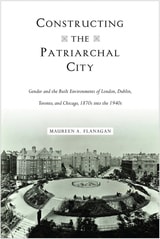
Constructing the Patriarchal City
Gender and the Built Environments of London, Dublin, Toronto, and Chicago, 1870s into the 1940sMaureen A. Flanagan
Temple University Press, 2018
In the Anglo-Atlantic world of the late nineteenth century, groups of urban residents struggled to reconstruct their cities in the wake of industrialization and to create the modern city. New professional men wanted an orderly city that functioned for economic development. Women’s vision challenged the men’s right to reconstruct the city and resisted the prevailing male idea that women in public caused the city’s disorder.
Constructing the Patriarchal City compares the ideas and activities of men and women in four English-speaking cities that shared similar ideological, professional, and political contexts. Historian Maureen Flanagan investigates how ideas about gender shaped the patriarchal city as men used their expertise in architecture, engineering, and planning to fashion a built environment for male economic enterprise and to confine women in the private home. Women consistently challenged men to produce a more equitable social infrastructure that included housing that would keep people inside the city, public toilets for women as well as men, housing for single, working women, and public spaces that were open and safe for all residents.

Contested Communities
Class, Gender, and Politics in Chile’s El Teniente Copper Mine, 1904-1951Thomas Miller Klubock
Duke University Press, 1998
Klubock shows how a militant working-class community was established through the interplay between capitalist development, state formation, and the ideologies of gender. In describing how the North American copper company attempted to reconfigure and reform the work and social-cultural lives of men and women who migrated to the mine, Klubock demonstrates how struggles between labor and capital took place on a gendered field of power and reconstituted social constructions of masculinity and femininity. As a result, Contested Communities describes more accurately than any previous study the nature of grassroots labor militancy, working-class culture, and everyday politics of gender relations during crucial years of the Chilean Popular Front in the 1930s and 1940s.
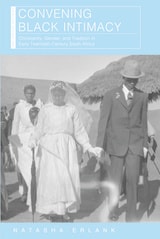
Convening Black Intimacy
Christianity, Gender, and Tradition in Early Twentieth-Century South AfricaNatasha Erlank
Ohio University Press, 2022
An unprecedented study of how Christianity reshaped Black South Africans’ ideas about gender, sexuality, marriage, and family during the first half of the twentieth century.
This book demonstrates that the primary affective force in the construction of modern Black intimate life in early twentieth-century South Africa was not the commonly cited influx of migrant workers but rather the spread of Christianity. During the late nineteenth and early twentieth centuries, African converts developed a new conception of intimate life, one that shaped ideas about sexuality, gender roles, and morality.
Although the reshaping of Black intimacy occurred first among educated Africans who aspired to middle-class status, by the 1950s it included all Black Christians—60 percent of the Black South African population. In turn, certain Black traditions and customs were central to the acceptance of sexual modernity, which gained traction because it included practices such as lobola, in which a bridegroom demonstrates his gratitude by transferring property to his bride’s family. While the ways of understanding intimacy that Christianity informed enjoyed broad appeal because they partially aligned with traditional ways, other individuals were drawn to how the new ideas broke with tradition. In either case, Natasha Erlank argues that what Black South Africans regard today as tradition has been unequivocally altered by Christianity.
In asserting the paramount influence of Christianity on unfolding ideas about family, gender, and marriage in Black South Africa, Erlank challenges social historians who have attributed the key factor to be the migrant labor system. Erlank draws from a wide range of sources, including popular Black literature and the Black press, African church and mission archives, and records of the South African law courts, which she argues have been underutilized in histories of South Africa. The book is sure to attract historians and other scholars interested in the history of African Christianity, African families, sexuality, and the social history of law, especially colonial law.
Covenant of Blood
Circumcision and Gender in Rabbinic JudaismLawrence A. Hoffman
University of Chicago Press, 1995
In the rabbinic system, Hoffman argues, circumcision was neither a birth ritual nor the beginning of the human life cycle, but a rite of covenantal initiation into a male "life line." Although the evolution of the rite was shaped by rabbinic debates with early Christianity, the Rabbis shared with the church a view of blood as providing salvation. Hoffman examines the particular significance of circumcision blood, which, in addition to its salvific role, contrasted with menstrual blood to symbolize the gender dichotomy within the rabbinic system. His analysis of the Rabbis' views of circumcision and menstrual blood sheds light on the marginalization of women in rabbinic law. Differentiating official mores about gender from actual practice, Hoffman surveys women's spirituality within rabbinic society and examines the roles mothers played in their sons' circumcisions until the medieval period, when they were finally excluded.

Crafting Selves
Power, Gender, and Discourses of Identity in a Japanese WorkplaceDorinne K. Kondo
University of Chicago Press, 1990
"Kondo's work is significant because she goes beyond disharmony, insisting on complexity. Kondo shows that inequalities are not simply oppressive-they are meaningful ways to establish identities."—Nancy Rosenberger, Journal of Asian Studies

Crafting Womanhood
Needlework, Gender, and Politics in the United States, 1810-1920Mariah Kupfner
University of Delaware Press, 2027
Decorative needlework was a key medium through which American women constructed femininity and its relationship to public and political concerns in the nineteenth and early twentieth centuries. Through samplers, needlecases, lace coats, silk sofas, cotton scraps, banners, and other textile things, scholars can see the ways in which women and girls related to education, property-holding, slavery and freedom, labor, and women’s right to vote. Needlework’s durable association with “traditional” notions about womanhood made it a potent resource through which to make gender in expansive and meaningful ways that had profound public, political implications as educational opportunities for girls and women were expanding, and the antislavery and women's suffrage movements were growing. Indeed, needlework's very conventionality and relationship to the past made it a useful tool for crafting womanhood anew.

Creating Rosie the Riveter
Class, Gender, and Propaganda during World War IIMaureen Honey
University of Massachusetts Press, 1984

Critical Fandom
Representations of Race, Gender, and Sexuality in Fan FictionCara Marta Messina
University of Iowa Press, 2026
Critical Fandom positions fan authors as rhetoricians and fan fiction as an action. Every fan author navigates—implicitly or explicitly—the politics of their fandom, the media they love, their lived experiences, digital technologies, reader expectations, and a larger culture. To better understand critical fans, Cara Marta Messina analyzes Archive of Our Own tagging practices, fan fictions, and interviews from four different fandoms.
Fans of The Legend of Korra celebrate queer relationships while understanding representation is just the first step in the face of systemic homophobia. Game of Thrones fan authors challenge racism and heteronormativity in both the community and the show. In online forums for Black Panther, fans make space for sapphic romances and explore the humanity of Erik Killmonger, ultimately contending with harmful stereotypes of radical Black men. And the Our Flag Means Death fandom demonstrates how a show can flourish when it centers queerness, especially for trans fans. Even in these moments of joy, there’s conflict. Critical Fandom seeks to answer what comes next.
Critical Terms for the Study of Gender
Edited by Catharine R. Stimpson and Gilbert Herdt
University of Chicago Press, 2014
So write women’s studies pioneer Catharine R. Stimpson and anthropologist Gilbert Herdt in their introduction to Critical Terms for the Study of Gender, laying out the wide-ranging nature of this interdisciplinary and rapidly changing field. The sixth in the series of “Critical Terms” books, this volume provides an indispensable introduction to the study of gender through an exploration of key terms that are a part of everyday discourse in this vital subject.
Following Stimpson and Herdt’s careful account of the evolution of gender studies and its relation to women’s and sexuality studies, the twenty-one essays here cast an appropriately broad net, spanning the study of gender and sexuality across the humanities and social sciences. Written by a distinguished group of scholars, each essay presents students with a history of a given term—from bodies to utopia—and explains the conceptual baggage it carries and the kinds of critical work it can be made to do. The contributors offer incisive discussions of topics ranging from desire, identity, justice, and kinship to love, race, and religion that suggest new directions for the understanding of gender studies. The result is an essential reference addressed to students studying gender in very different disciplinary contexts.
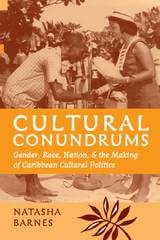
Cultural Conundrums
Gender, Race, Nation, and the Making of Caribbean Cultural PoliticsNatasha Barnes
University of Michigan Press, 2010
Natasha Barnes traces the use of cultural arguments in the making of Caribbean modernity, looking at the cultural performances of the Anglophone Caribbean—cricket, carnival, dancehall, calypso, and beauty pageants—and their major literary portrayals. Barnes historicizes the problematic linkage of culture and nation to argue that Caribbean anticolonialism has given expressive culture a critical place in the region’s identity politics. Her provocative readings of foundational thinkers C. L. R. James and Sylvia Winters will engender discussion and debate among the Caribbean intellectual community. This impressively interdisciplinary study will make important contributions to the fields of Afro-diaspora studies, postcolonial studies, literary studies, performance studies, and sociology.
--Simon Gikandi, Princeton University
Natasha Barnes is Associate Professor of African American Studies and English at the University of Illinois at Chicago.
Culture in the Marketplace
Gender, Art, and Value in the American SouthwestMolly H. Mullin
Duke University Press, 2001
Drawing on fiction, memoirs, journalistic accounts, and extensive interviews with artists, collectors, and dealers, Mullin shows how anthropological notions of culture were used to valorize Indian art and create a Southwest Indian art market. By turning their attention to Indian affairs and art in Santa Fe, New Mexico, she argues, these women escaped the gender restrictions of their eastern communities and found ways of bridging public and private spheres of influence. Tourism, in turn, became a means of furthering this cultural colonization. Mullin traces the development of aesthetic worth as it was influenced not only by politics and profit but also by gender, class, and regional identities, revealing how notions of “culture” and “authenticity” are fundamentally social ones. She also shows how many of the institutions that the early patrons helped to establish continue to play an important role in the contemporary market for American Indian art.
This book will appeal to audiences in cultural anthropology, art history, American studies, women’s studies, and cultural history.

Cultured States
Youth, Gender, and Modern Style in 1960s Dar es SalaamAndrew Ivaska
Duke University Press, 2011
Curative Violence
Rehabilitating Disability, Gender, and Sexuality in Modern KoreaEunjung Kim
Duke University Press, 2017