Results by title
153 books match the query 'Genres' and 10 start with c
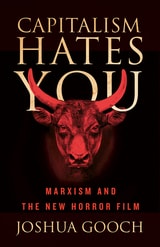
Capitalism Hates You
Marxism and the New Horror FilmJoshua Gooch
University of Minnesota Press, 2025
What contemporary horror films teach us about the cruelties of capitalist society
Capitalism Hates You uses the horror film genre as a tool to diagnose and expose the hostile conditions of life under capitalism. Through incisive critical analyses of popular films such as Get Out, Drag Me to Hell, Hereditary, The Babadook, and many others, Joshua Gooch draws connections between Marxist theory and contemporary narratives of psychological unease.
Gooch highlights the work of women, trans, and nonwhite filmmakers to show how the remarkable diversity of twenty-first-century horror cinema can provide an expansive catalog of capitalism’s varying forms of oppression. Studying films that interrogate such urgent topics as gentrification, climate change, and reproductive labor, he demonstrates how contemporary horror films give affective shape to the negative undercurrents of our present socioeconomic system.
Capitalism Hates You argues that these films and their material conditions can deepen our understanding of essential concepts in contemporary Marxism, from the theory of value and changing forms of commodification to the labor of social reproduction, the abolition of the family, and the necessity of ecosocialism. Synthesizing various strands of Marxist thought, Gooch sheds light on the growing field of socially conscious horror films, examining how they pinpoint and exaggerate latent feelings of dread and discomfort to reflect the ills of society.
Retail e-book files for this title are screen-reader friendly with images accompanied by short alt text and/or extended descriptions.
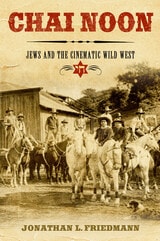
Chai Noon
Jews and the Cinematic Wild WestJonathan L. Friedmann
University of Wisconsin Press, 2025
This volume joins other reconsiderations of outsider and minority representations in Westerns to offer a more nuanced view of the genre. Friedmann engages with larger themes of Jewish identity in popular film, including depictions of race, ethnicity, and foreignness. He also identifies similar concerns within the invention and creation of the imaginary West writ large in American culture. The juxtapositions prove to be both unexpected and intuitively understandable.
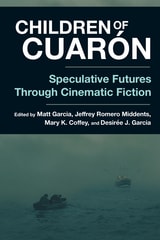
Children of Cuarón
Speculative Futures Through Cinematic FictionMatt Garcia
Rutgers University Press, 2027
Alfonso Cuarón’s Children of Men thrusts readers into a gripping near-future world where environmental collapse and global infertility have fortified borders and torn apart the fabric of society. Its stark depictions of mass deportation, lawless border zones, and the desperate fight for survival echo powerfully through Octavia Butler’s prophetic novels Parable of the Sower and Parable of the Talents, where environmental breakdown, migration, childbirth, and the resilience of women’s bodies form the core of her visionary storytelling. Remarkably, the futures imagined in these works are no longer distant—Butler’s 2024 has arrived, and Cuarón’s 2027 is nearly here. Children of Cuarón: Speculative Futures Through Cinematic Fiction ignites bold, necessary conversations about borders, immigration, and the urgent political, environmental, and social challenges facing our world today. By examining how speculative fiction dares to imagine what comes next, this book invites readers to confront the realities of our present—and the possibilities of our future—with fresh eyes and uncompromising clarity.
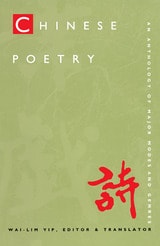
Chinese Poetry, 2nd ed., Revised
An Anthology of Major Modes and GenresWai-lim Yip, editor and translator
Duke University Press, 1997
Newly designed, the unique format of this volume will enhance its reputation as the definitive introduction to Chinese poetry, while its introductory essay on issues of Chinese aesthetics will continue to be an essential text on the problems of translating such works into English. Each poem is printed with the original Chinese characters in calligraphic form, coordinated with word-for-word annotations, and followed by an English translation. Correcting more than a century of distortion of the classical Chinese by translators unconcerned with the intricacies and aesthetics of the Chinese language, these masterful translations by Wai-lim Yip, a noted and honored translator and scholar, allow English readers to enter more easily into the dynamic of the original poems. Each section of the volume is introduced by a short essay on the mode or genre of poem about to be presented and is followed by a comprehensive bibliography.

Columbo
A Rhetoric of Inquiry with Resistant RespondersChristyne Berzsenyi
Intellect Books, 2019
An analysis of the hit television series Columbo and the investigative methods of its eponymous main character.
In the iconic detective show, which aired from 1968 to 2003, Lieutenant Columbo was known for his Socratic method of rhetorical inquiry. Feigning ignorance and employing a barrage of questions about minute details, the detective enacts a persona of “antipotency,” or counter authoritativeness, to affect the villains' underestimation of his attention to inconsistencies, abductive reasoning, and rhetorical efficacy. In his predominantly dialogue-based investigations, Columbo exhausts his suspects by asking a battery of questions concerning all minor details of the case—an aggravating, tedious provocation for the killer trying to maintain innocence.
In this engaging interdisciplinary study, Christyne Berzsenyi explores the character and his influences, dissects his methods of investigation, and assesses the show’s enduring legacy in academia and popular culture. While critical and theoretical, the text is also accessible to interdisciplinary readers, practical in application, and amusing for Columbo buffs.
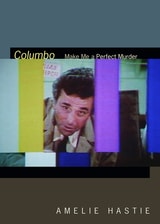
Columbo
Make Me a Perfect MurderAmelie Hastie
Duke University Press, 2024
Comic Book Movies
Davis, Blair
Rutgers University Press, 2018
Film scholar Blair Davis also considers how the genre’s visual style is equally important as its weighty themes, and he details how advances in digital effects have allowed filmmakers to incorporate elements of comic book art in innovative ways. As he reveals, comic book movies have inspired just as many innovations to Hollywood’s business model, with film franchises and transmedia storytelling helping to ensure that the genre will continue its reign over popular culture for years to come.
Constructions of the Real
Intersections of Documentary-based Film Practice and TheoryEdited by Christine Rogers, Kim Munro, Liz Burke, and Catherine Gough-Brady
Intellect Books, 2023
Constructions of the Real gathers a wide range of writing from nonfiction and documentary filmmakers from around the world who undertake theoretically informed practice and think through making. The filmmakers and writers featured here explore the rich space between the academy and industry, and they reflect on, interrogate, and explicate their filmmaking practices in relation to questions of form, content, and process. Engaging with current debates about the role of creative scholarship, the contributors make a powerful claim for nonfiction filmmaking as a knowledge-making practice for revealing, critiquing, and interpreting the world.
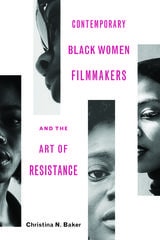
Contemporary Black Women Filmmakers and the Art of Resistance
Christina N. Baker
The Ohio State University Press, 2018
Analyzing the cultural texts of filmmakers such as Ava DuVernay, Tanya Hamilton, Kasi Lemmons, Gina Prince-Bythewood, and Dee Rees—and including interviews she conducted with three of the filmmakers—Baker emphasizes the importance of applying an intersectional perspective that centers on the shared experiences of Black women and the role of film as a form of artistic expression and a tool of social resistance.
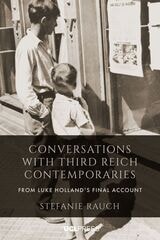
Conversations with Third Reich Contemporaries
From Luke Holland’s Final AccountStefanie Rauch
University College London, 2025
Conversations with Third Reich Contemporaries presents excerpts from filmed interviews conducted by British documentary filmmaker Luke Holland across a span of over a decade. These interviews were compiled into the German-language documentary film Final Account (2020), completed shortly before Holland’s death. Most interviewees were young adults when the war ended; some had benefited from Nazism, and others had directly enacted persecution or state violence. In addition to making this vital interview collection more widely accessible, the sourcebook raises critical awareness of issues around representation, authenticity, memory, and the co-production of narratives, reshaping discussions around the role of “ordinary” citizens under the Third Reich. It is the first sourcebook to engage directly with issues of representation and identity after 1945.