73 books match the query 'German literature' and 6 start with c
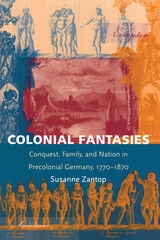
cover of Colonial Fantasies: Conquest, Family, and Nation in Precolonial Germany, 1770-1870

Colonial Fantasies

Conquest, Family, and Nation in Precolonial Germany, 1770-1870

Susanne Zantop

Duke University Press, 1997

Since Germany became a colonial power relatively late, postcolonial theorists and histories of colonialism have thus far paid little attention to it. Uncovering Germany’s colonial legacy and imagination, Susanne Zantop reveals the significance of colonial fantasies—a kind of colonialism without colonies—in the formation of German national identity. Through readings of historical, anthropological, literary, and popular texts, Zantop explores imaginary colonial encounters of "Germans" with "natives" in late-eighteenth- and early-nineteenth-century literature, and shows how these colonial fantasies acted as a rehearsal for actual colonial ventures in Africa, South America, and the Pacific.
From as early as the sixteenth century, Germans preoccupied themselves with an imaginary drive for colonial conquest and possession that eventually grew into a collective obsession. Zantop illustrates the gendered character of Germany’s colonial imagination through critical readings of popular novels, plays, and travel literature that imagine sexual conquest and surrender in colonial territory—or love and blissful domestic relations between colonizer and colonized. She looks at scientific articles, philosophical essays, and political pamphlets that helped create a racist colonial discourse and demonstrates that from its earliest manifestations, the German colonial imagination contained ideas about a specifically German national identity, different from, if not superior to, most others.

[more]
cover of Connected by the Ear: The Media, Pedagogy, and Politics of the Romantic Lecture

Connected by the Ear

The Media, Pedagogy, and Politics of the Romantic Lecture

Sean Franzel

Northwestern University Press, 2013

In this innovative new study, Sean Franzel charts the concurrent emergence of German Romantic pedagogy, the modern research university, and modern visions of the politically engaged scholar. At the heart of the pedagogy of Immanuel Kant, Johann Gottlieb Fichte, K. P. Moritz, A. W. Schlegel, Adam Müller, and others was the lecture, with its ability to attract listeners and to model an ideal discursive community, reflecting an era of revolution, reform, and literary, philosophical, and scientific innovation.

Along with exploring the striking preoccupation of Romantic thinkers with the lecture and with its reverberations in print, Franzel argues that accounts of scholarly speech from this period have had a lasting impact on how the pedagogy, institutions, and medial manifestations of modern scholarship continue to be understood.

"Sean Franzel’s archaeology illuminates both the bourgeois public sphere and discourse network 1800 by showing the romantic lecture to be the key cultural form in a pivotal moment of German intellectual history, a history long obsessed with the mediation of oral discourse and written text."—John Durham Peters, author of Speaking into the Air

[more]
cover of Contemporary German Editorial Theory

Contemporary German Editorial Theory

Hans Walter Gabler, George Bornstein, and Gillian Borland Pierce, Editors

University of Michigan Press, 1995
Over the past decade, Anglo-American notions of textual construction and editorial theory have begun major paradigm shifts. Many of the key emergent issues of Anglo-American debate -- such as theories of versions - -are already familiar in German theory. In other respects, including systematic reflection on the design and function of editorial apparatus, the German debate has already produced paradigms and procedures as yet unformulated in English. Contemporary German Editorial Theory makes available for the first time in English ten major essays by seven German theorists, together with an original introductory meditation by Hans Walter Gabler, editor of the celebrated edition of James Joyce's Ulysses. The volume thus participates in the paradigm shift in editorial theory that has led both to theoretical reconception of the field and to groundbreaking practical results. Topics discussed include the distinction between historical record and editor's interpretation, the display of multiple versions, concepts of authorization and intention, and the relations of textual theory to approaches like deconstruction and semiotics. The book also includes suggestions for further reading in both languages and a glossary of technical terms.Bringing together the heretofore separate Anglo-American and German approaches will strengthen each separately and prepare the way for a new hybrid combining the advantages of both orientations. Contributors are Hans Zeller, Miroslav Červenka, Elisabeth Höpker-Herberg, Gunter Martens, Henning Boetius, Siegfried Scheibe, and Gerhard Seidel.
[more]
cover of Cosmopolitan Parables: Trauma and Responsibility in Contemporary Germany

Cosmopolitan Parables

Trauma and Responsibility in Contemporary Germany

David D. Kim

Northwestern University Press, 2017

Cosmopolitan Parables explores the global rise of the heavily debated concept of cosmopolitanism from a unique German literary perspective. Since the early 1990s, the notion of cosmopolitanism has acquired a new salience because of an alarming rise in nationalism, xenophobia, migration, international war, and genocide. This upsurge has transformed how artists and scholars worldwide assess the power of international civil society and its moral obligation to unite regardless of cultural background, religious affiliation, or national citizenship. It rejuvenates an ancient yet timely framework within which contemporary political crises are to be overcome, especially after the collapse of communist states and the intersection of postwar and postcolonial trajectories.

To exemplify this global challenge, Kim examines three internationally acclaimed writers of German origin—Hans Christoph Buch, Michael Krüger, and W. G. Sebald—joined by their own harrowing experiences and stunning entanglements with Holocaust memory, postcolonial responsibility, and communist legacy. This bold new study is the first of its kind, interrogating transnational memories of trauma alongside globally shared responsibilities for justice. More important, it addresses the question of remembrance—whether the colonial past or the postwar legacy serves as a proper foundation upon which cosmopolitanism is to be pursued in today's era of globalization.

 
[more]
cover of Cosmopolitanisms and the Jews

Cosmopolitanisms and the Jews

Cathy S. Gelbin and Sander L. Gilman

University of Michigan Press, 2017
Cosmopolitanisms and the Jews adds significantly to contemporary scholarship on cosmopolitanism by making the experience of Jews central to the discussion, as it traces the evolution of Jewish cosmopolitanism over the last two centuries. The book sets out from an exploration of the nature and cultural-political implications of the shifting perceptions of Jewish mobility and fluidity around 1800, when modern cosmopolitanist discourse arose. Through a series of case studies, the authors analyze the historical and discursive junctures that mark the central paradigm shifts in the Jewish self-image, from the Wandering Jew to the rootless parasite, the cosmopolitan, and the socialist internationalist. Chapters analyze the tensions and dualisms in the constructed relationship between cosmopolitanism and the Jews at particular historical junctures between 1800 and the present, and probe into the relationship between earlier anti-Semitic discourses on Jewish cosmopolitanism and Stalinist rhetoric.

 
[more]
cover of Cosmopolitical Claims: Turkish-German Literatures from Nadolny to Pamuk

Cosmopolitical Claims

Turkish-German Literatures from Nadolny to Pamuk

B. Venkat Mani

University of Iowa Press, 2007

When both France and Holland rejected the proposed constitution for the European Union in 2005, the votes reflected popular anxieties about the entry of Turkey into the European Union as much as they did ambivalence over ceding national sovereignty. Indeed, the votes in France and Holland echoed long standing tensions between Europe and Turkey. If there was any question that tensions were high, the explosive reaction of Europe’s Muslim population to a series of cartoons of Mohammed in a Danish newspaper put them to rest. Cosmopolitical Claims is a profoundly original study of the works of Sten Nadonly, Emine Sevgi Özdamar, Feridun Zaimoglu, and 2006 Nobel prize in literature recipient Orhan Pamuk. Rather than using the proverbial hyphen in “Turkish-German” to indicate a culture caught between two nations, Venkat Mani is interested in how Turkish-German literature engages in a scrutiny of German and Turkish national identity.
    Moving deftly from the theoretical literature to the texts themselves, Mani’s groundbreaking study explores these conflicts and dialogues and the resulting cultural hybridization as they are expressed in four novels that document the complexity of Turkish-German cultural interactions in the late twentieth and early twenty-first centuries. His innovative readings will engage students of contemporary German literature as well as illuminate the discussion of minority literature in a multicultural setting.
    As Salman Rushdie said in the 2002 Tanner Lecture at Yale, “The frontier is an elusive line, visible and invisible, physical and metaphorical, amoral and moral. . . . To cross a frontier is to be transformed.” It is in this vein that Mani’s dynamic and subtle work posits a still evolving discourse between Turkish and German writers.
[more]