60 books match the query 'Ghana' and 3 start with c
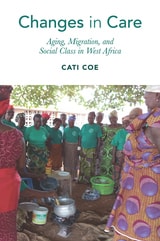
cover of Changes in Care: Aging, Migration, and Social Class in West Africa

Changes in Care

Aging, Migration, and Social Class in West Africa

Cati Coe

Rutgers University Press, 2022

Africa is known both for having a primarily youthful population and for its elders being held in high esteem. However, this situation is changing: people in Africa are living longer, some for many years with chronic, disabling illnesses. In Ghana, many older people, rather than experiencing a sense of security that they will be respected and cared for by the younger generations, feel anxious that they will be abandoned and neglected by their kin. In response to their concerns about care, they and their kin are exploring new kinds of support for aging adults, from paid caregivers to social groups and senior day centers. These innovations in care are happening in fits and starts, in episodic and scattered ways, visible in certain circles more than others. By examining emergent discourses and practices of aging in Ghana, Changes in Care makes an innovative argument about the uneven and fragile processes by which some social change occurs.

There is a short film that accompanies the book, “Making Happiness: Older People Organize Themselves” (2020), an 11-minute film by Cati Coe. Available at: https://doi.org/doi:10.7282/t3-thke-hp15

[more]
cover of Corruption, Class, and Politics in Ghana

Corruption, Class, and Politics in Ghana

Ernest Harsch

Ohio University Press, 2024
Ghana has long struggled against persistent corruption that has sapped state treasuries, distorted economic and social relationships, and undermined public confidence in government. In recent decades, concerns about corruption have become common in international policy circles, media, and academia. Ghanaians, however, began grappling with the issue long before outsiders expressed interest. From their indigenous precolonial societies through the decades of British rule to the various postindependence regimes, Ghanaians have aspired both to clean house at the top and to ensure that day-to-day affairs are managed honestly and with justice for ordinary citizens. Drawing on decades of research and interviews with Ghanaian officials and activists, Ernest Harsch focuses closely on corruption’s political implications: that is, how political actors use concerns about graft and related misdeeds to advance their own agendas. Harsch also considers social dimensions: class, ethnicity, gender, and other distinctions. While elite perspectives are well represented in official records, this book pays particular attention to voices from below, expressed through popular demonstrations, strikes, and other rebellious actions. In addition, activists have produced or collected hundreds of original protest declarations, petitions, reports, and letters. Those documents reveal that ordinary Ghanaians have opposed corruption not so much because it distorts markets—a central complaint of external and elite actors—but because it makes their daily living conditions so much harder and deepens inequities by disproportionately benefiting those with wealth and harming those without.
[more]
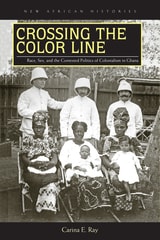
cover of Crossing the Color Line: Race, Sex, and the Contested Politics of Colonialism in Ghana

Crossing the Color Line

Race, Sex, and the Contested Politics of Colonialism in Ghana

Carina E. Ray

Ohio University Press, 2015

Winner of the 2017 Aidoo-Snyder Book Prize
Winner of the 2016 American Historical Association’s Wesley-Logan Prize in African diaspora
Finalist for the 2016 Fage and Oliver Prize from the African Studies Association of the UK

Interracial sex mattered to the British colonial state in West Africa. In Crossing the Color Line, Carina E. Ray goes beyond this fact to reveal how Ghanaians shaped and defined these powerfully charged relations. The interplay between African and European perspectives and practices, argues Ray, transformed these relationships into key sites for consolidating colonial rule and for contesting its hierarchies of power. With rigorous methodology and innovative analyses, Ray brings Ghana and Britain into a single analytic frame to show how intimate relations between black men and white women in the metropole became deeply entangled with those between black women and white men in the colony in ways that were profoundly consequential.

Based on rich archival evidence and original interviews, the book moves across different registers, shifting from the micropolitics of individual disciplinary cases brought against colonial officers who “kept” local women to transatlantic networks of family, empire, and anticolonial resistance. In this way, Ray cuts to the heart of how interracial sex became a source of colonial anxiety and nationalist agitation during the first half of the twentieth century.

[more]