Results by title
406 books match the query 'Greece' and 44 start with c
CP vol 110 num 1
The University of Chicago Press
University of Chicago Press Journals, 2015
Capturing Troy
The Narrative Functions of Landscape in Archaic and Early Classical Greek ArtGuy Hedreen
University of Michigan Press, 2002
Guy Michael Hedreen is Professor of Art, Williams College.
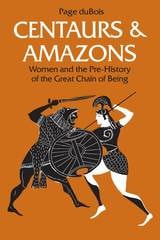
Centaurs and Amazons
Women and the Pre-History of the Great Chain of BeingPage duBois
University of Michigan Press, 1991
In Centaurs and Amazons, Page duBois offers a prehistory of hierarchy. Using structural anthropology, symbolic analysis, and recent literary theory, she demonstrates a shift in Greek thought from the fifth to the fourth century B.C. that had a profound influence upon subsequent Western culture and politics.
Through an analysis of mythology, drama, sculpture, architecture, and Greek vase painting, duBois documents the transition from a system of thought that organized the experience of difference in terms of polarity and analogy to one based upon a relatively rigid hierarchical scheme. This was the beginning of "the great chain of being," the philosophical construct that all life was organized in minute gradations of superiority and inferiority. This scheme, in various guises, has continued to influence philosophical and political thought.
The author's intelligent and discriminating use of scholarship from various fields makes Centaurs and Amazons an impressive interdisciplinary study of interest to classicists, feminist scholars, historians, art historians, anthropologists, and political scientists.
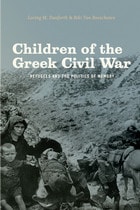
Children of the Greek Civil War
Refugees and the Politics of MemoryLoring M. Danforth and Riki Van Boeschoten
University of Chicago Press, 2011
Marshalling archival records, oral histories, and ethnographic fieldwork, the authors analyze the evacuation process, the political conflict surrounding it, the children’s upbringing, and their fates as adults cut off from their parents and their homeland. They also give voice to seven refugee children who poignantly recount their childhood experiences and heroic efforts to construct new lives in diaspora communities throughout the world. A much-needed corrective to previous historical accounts, Children of the Greek Civil War is also a searching examination of the enduring effects of displacement on the lives of refugee children.
Citizens on Stage
Comedy and Political Culture in the Athenian DemocracyJames F. McGlew
University of Michigan Press, 2002
Old Comedy gives Citizens on Stage its chronological backbone; the beginning and end of Aristophanes' career roughly define the period on which the book concentrates. Reading and interpreting comedy provides a model for reading Athenian politics itself. McGlew argues that the plays of Old Comedy, with their fantastic stories of common individuals triumphing over the various social and political dilemmas of democratic Athens, interpreted the relationship of private life and political activity for an Athenian audience, dramatically reaffirming the ties between citizens' personal desires and the will of the collective body. In particular, McGlew argues that comedy transforms private fantasies of personal power and pleasures--what seem most to keep the individual audience members apart--into a collective possession and touchstone of democratic citizen identity.
Citizens on Stage focuses primarily on the democratic citizen and on contemporary representations of him as a decision maker. McGlew shows that the democratic individual, sometimes idealized, sometimes despised, was a dominant concern of the literature and politics of late fifth- and early fourth-century Athens. This book will appeal to students of ancient theater and drama, Athenian politics and democracy, and the relationships between theater and politics. Social historians will also find it an invaluable resource.
James F. McGlew is Assistant Professor of Foreign Languages and Literatures and Classical Studies, Iowa State University.
City of Suppliants
Tragedy and the Athenian EmpireBy Angeliki Tzanetou
University of Texas Press, 2012
After fending off Persia in the fifth century BCE, Athens assumed a leadership position in the Aegean world. Initially it led the Delian League, a military alliance against the Persians, but eventually the league evolved into an empire with Athens in control and exacting tribute from its former allies. Athenians justified this subjection of their allies by emphasizing their fairness and benevolence towards them, which gave Athens the moral right to lead. But Athenians also believed that the strong rule over the weak and that dominating others allowed them to maintain their own freedom. These conflicting views about Athens’ imperial rule found expression in the theater, and this book probes how the three major playwrights dramatized Athenian imperial ideology.
Through close readings of Aeschylus’ Eumenides, Euripides’ Children of Heracles, and Sophocles’ Oedipus at Colonus, as well as other suppliant dramas, Angeliki Tzanetou argues that Athenian tragedy performed an important ideological function by representing Athens as a benevolent and moral ruler that treated foreign suppliants compassionately. She shows how memorable and disenfranchised figures of tragedy, such as Orestes and Oedipus, or the homeless and tyrant-pursued children of Heracles were generously incorporated into the public body of Athens, thus reinforcing Athenians’ sense of their civic magnanimity. This fresh reading of the Athenian suppliant plays deepens our understanding of how Athenians understood their political hegemony and reveals how core Athenian values such as justice, freedom, piety, and respect for the laws intersected with imperial ideology.
Classical Greek Theatre
New Views of an Old SubjectClifford Ashby
University of Iowa Press, 1998
Many dogmas regarding Greek theatre were established by researchers who lacked experience in the mounting of theatrical productions. In his wide-ranging and provocative study, Clifford Ashby, a theatre historian trained in the practical processes of play production as well as the methods of historical research, takes advantage of his understanding of technical elements to approach his ancient subject from a new perspective. In doing so he challenges many long-held views.
Archaeological and written sources relating to Greek classical theatre are diverse, scattered, and disconnected. Ashby's own (and memorable) fieldwork led him to more than one hundred theatre sites in Greece, southern Italy, Sicily, and Albania and as far into modern Turkey as Hellenic civilization had penetrated. From this extensive research, he draws a number of novel revisionist conclusions on the nature of classical theatre architecture and production.
The original orchestra shape, for example, was a rectangle or trapezoid rather than a circle. The altar sat along the edge of the orchestra, not at its middle. The scene house was originally designed for a performance event that did not use an up center door. The crane and ekkyklema were simple devices, while the periaktoi probably did not exist before the Renaissance. Greek theatres were not built with attention to Vitruvius' injunction against a southern orientation and were probably sun-sited on the basis of seasonal touring. The Greeks arrived at the theatre around mid-morning, not in the cold light of dawn. Only the three-actor rule emerges from this eclectic examination somewhat intact, but with the division of roles reconsidered upon the basis of the actors' performance needs. Ashby also proposes methods that can be employed in future studies of Greek theatre. Final chapters examine the three-actor production of Ion, how one should not approach theatre history, and a shining example of how one should.
Ashby's lengthy hands-on training and his knowledge of theatre history provide a broad understanding of the ways that theatre has operated through the ages as well as an ability to extrapolate from production techniques of other times and places.
Classical Myth
An IntroductionBarry B. Powell
University of Michigan Press, 2024
In Classical Myth: An Introduction, Barry B. Powell provides the historical and theoretical background necessary for us to understand not only the concept of what a myth is, but the cultural context of how it emerged, and the different approaches to interpreting myth that were put forward by ancient theorists and their more recent successors. Then he helps readers to understand classical myth as it is found in its primary sources: the works of Homer and Hesiod, and the Greek tragedians and historians, Ovid and Vergil. By examining a number of prominent themes in classical myth, this textbook explores the relationship between myth and art, politics, society, and history of the ancient world. This completely revised second edition features new illustrations and will help readers who want to understand myths or study their original sources.
Classical Philology, volume 116 number 4 (October 2021)
The University of Chicago Press
University of Chicago Press Journals, 2021
Classical Philology, volume 117 number 1 (January 2022)
The University of Chicago Press
University of Chicago Press Journals, 2022
Classical Philology, volume 117 number 2 (April 2022)
The University of Chicago Press
University of Chicago Press Journals, 2022
Classical Philology, volume 117 number 3 (July 2022)
The University of Chicago Press
University of Chicago Press Journals, 2022
Classical Philology, volume 117 number 4 (October 2022)
The University of Chicago Press
University of Chicago Press Journals, 2022
Classical Philology, volume 118 number 1 (January 2023)
The University of Chicago Press
University of Chicago Press Journals, 2023
Classical Philology, volume 118 number 2 (April 2023)
The University of Chicago Press
University of Chicago Press Journals, 2023
Classical Philology, volume 118 number 3 (July 2023)
The University of Chicago Press
University of Chicago Press Journals, 2023
Classical Philology, volume 119 number 1 (January 2024)
The University of Chicago Press
University of Chicago Press Journals, 2024
Classical Philology, volume 119 number 2 (April 2024)
The University of Chicago Press
University of Chicago Press Journals, 2024
Classical Philology, volume 119 number 3 (July 2024)
The University of Chicago Press
University of Chicago Press Journals, 2024
Classical Philology, volume 119 number 4 (October 2024)
The University of Chicago Press
University of Chicago Press Journals, 2024
Classical Philology, volume 120 number 1 (January 2025)
The University of Chicago Press
University of Chicago Press Journals, 2025
Classical Philology, volume 120 number 2 (April 2025)
The University of Chicago Press
University of Chicago Press Journals, 2025
Classical Philology, volume 120 number 3 (July 2025)
The University of Chicago Press
University of Chicago Press Journals, 2025
Classical Philology, volume 120 number 4 (October 2025)
The University of Chicago Press
University of Chicago Press Journals, 2025
Classical Philology, volume 121 number 1 (January 2026)
The University of Chicago Press
University of Chicago Press Journals, 2026
Classical Philology, volume 121 number 2 (April 2026)
The University of Chicago Press
University of Chicago Press Journals, 2026
Classical Philology, volume 121 number 3 (July 2026)
The University of Chicago Press
University of Chicago Press Journals, 2026
Classical Philology, volume 121 number 4 (October 2026)
The University of Chicago Press
University of Chicago Press Journals, 2026

Classical Reception in Asian American Literature
Christopher Waldo
University of Michigan Press, 2027
Troubled by the discipline’s historical relationship to white supremacy, classical scholars have begun to reexamine their fundamental assumptions about the relevance of ancient Greece and Rome to the modern world. After decades in which classical reception was relegated to the periphery of the discipline, a consensus has developed that the study of modern interactions with antiquity is inherently valuable. One of the newest branches of classical reception focuses on the cultural productions and political realities of Asian Americans. Contending that the Asian American authors discussed herein understand the ancient world as fundamentally unstable, Classical Reception in Asian American Literature interrogates this instability as manifested in fragmentation, violence, mythology, allusion, performance, and memory.
The study explores the written works of Theresa Hak Kyung Cha, Ocean Vuong, Quan Barry, Chang-rae Lee, David Lau, Sally Wen Mao, Johanna Hedva, Hoa Nguyen, and Vi Khi Nao. Via their written works, Christopher Waldo explores the bond between Demeter and Persephone, Telemachus’ identity as a fatherless son, the relationship between diasporic authors and Sappho, reinventions of mythology surrounding the Trojan War, and more. In Classical Reception in Asian American Literature, the literary traditions of the East and West collide to illuminate the threads of connection between the ancient and modern worlds.
Classical Receptions in the Struggle for Justice
Ellen Perry, Dominic Machado, Marina Haworth
University of Michigan Press, 2027
History is written and constructed by many, not just those few who proclaim themselves “the victors.” Classical Receptions in the Struggle for Justice examines how activists, artists, and writers of the past have found studying ancient Greece and Rome to be hopeful avenues for justice or personal liberation. These individuals, while sometimes critiquing the classical tradition, also saw in it ways to intervene in their contemporary reality for their struggle for justice.
Each contribution to this volume contains original research that highlights how ancient Greece or Rome informed and inspired an individual or movement between the eighteenth and twenty-first centuries, such as the struggles against structural racism, sexism, and homophobia. These engagements included visual arts, poetry, political activism, rhetoric, philosophy, environmentalism, and fiction. Individuals profiled in this volume include Mary Shelley, Henry David Thoreau, and Martin Luther King, Jr., as well as figures whose work remains underrepresented in the study of classical reception. Classical Receptions in the Struggle for Justice speaks to the enduring power of the humanities and the ancient world in difficult times.

Classical Spies
American Archaeologists with the OSS in World War II GreeceSusan Heuck Allen
University of Michigan Press, 2013
“Classical Spies will be a lasting contribution to the discipline and will stimulate further research. Susan Heuck Allen presents to a wide readership a topic of interest that is important and has been neglected.”
—William M. Calder III, University of Illinois, Urbana-Champaign
Classical Spies is the first insiders’ account of the operations of the American intelligence service in World War II Greece. Initiated by archaeologists in Greece and the eastern Mediterranean, the network drew on scholars’ personal contacts and knowledge of languages and terrain. While modern readers might think Indiana Jones is just a fantasy character, Classical Spies disclosesevents where even Indy would feel at home: burying Athenian dig records in an Egyptian tomb, activating prep-school connections to establish spies code-named Vulture and Chickadee, and organizing parachute drops.
Susan Heuck Allen reveals remarkable details about a remarkable group of individuals. Often mistaken for mild-mannered professors and scholars, such archaeologists as University of Pennsylvania’s Rodney Young, Cincinnati’s Jack Caskey and Carl Blegen, Yale’s Jerry Sperling and Dorothy Cox, and Bryn Mawr’s Virginia Grace proved their mettle as effective spies in an intriguing game of cat and mouse with their Nazi counterparts. Relying on interviews with individuals sharing their stories for the first time, previously unpublished secret documents, private diaries and letters, and personal photographs, Classical Spies offers an exciting and personal perspective on the history of World War II.
Clio's Other Sons
Berossus and ManethoJohn Dillery
University of Michigan Press, 2015
Commentary on Thucydides, Book 3
Rachel Bruzzone
University of Michigan Press, 2025
Commentary on Thucydides, Book 3 remedies this situation by offering detailed linguistic explanations and grammatical clarifications designed to appeal both to seasoned Classicists and to a broader group of non-specialist readers who may still be developing their Greek language skills. Starting with 428 BCE, Book 3 covers a critical period of the Peloponnesian War in which the conflict began to manifest its extraordinary violence and scale. The book contains influential and controversial discussions, including Thucydides’ own analysis of the nature of war and the ways that it teaches “lessons of violence” to individuals and states. Book 3 also features the famous Mytilenean Debate, an argument premised on the thesis that all international relations are, or should be, fundamentally amoral. Educated readers have always looked to Thucydides in turbulent times, and this commentary will open up his text to a wider audience.
Community Identity and Archaeology
Dynamic Communities at Aphrodisias and BeycesultanNaoíse Mac Sweeney
University of Michigan Press, 2011
Comparing Roman Hellenisms in Italy
Edited by Basil Dufallo and Riemer A. Faber
University of Michigan Press, 2023
The story of Roman Hellenism—defined as the imitation or adoption of something Greek by those subject to or operating under Roman power—begins not with Roman incursions into the Greek mainland, but in Italy, where our most plentiful and spectacular surviving evidence is concentrated. Think of the architecture of the Roman capital, the Campanian towns of Pompeii and Herculaneum buried by Vesuvius, and the Hellenic culture of the Etruscans. Perhaps “everybody knows” that Rome adapted Greek culture in a steadily more “sophisticated” way as its prosperity and might increased. This volume, however, argues that the assumption of smooth continuity, let alone steady “improvement,” in any aspect of Roman Hellenism can blind us to important aspects of what Roman Hellenism really is and how it functions in a given context.
As the first book to focus on the comparison of Roman Hellenisms per se, Comparing Roman Hellenisms in Italy shows that such comparison is especially valuable in revealing how any singular instance of the phenomenon is situated and specific, and has its own life, trajectory, circumstances, and afterlife. Roman Hellenism is always a work in progress, is often strategic, often falls prey to being forgotten, decontextualized, or reread in later periods, and thus is in important senses contingent. Further, what we may broadly identify as a Roman Hellenism need not imply Rome as the only center of influence. Roman Hellenism is often decentralized, and depends strongly on local agents, aesthetics, and materials. With this in mind, the essays concentrate geographically on Italy to lend both focus and breadth to our topic, as well as to emphasize the complex interrelation of Hellenism at Rome with Rome’s surroundings. Because Hellenism, whether as practiced by Romans or Rome’s subjects, is in fact widely diffused across far-flung geographical regions, the final part of the collection gestures to this broader context.
Confiscation or Coexistence
Egyptian Temples in the Age of AugustusAndrew Connor
University of Michigan Press, 2022
The interpretative consensus developed after the publication of a handful of key documents—P.Tebt. 2.302 especially, alongside BGU 4.1198 and 1200, and P.Berl.Leihg. 1.5. Connor offers a fundamentally revised interpretation of these texts, building from a fresh examination of the papyri themselves. The book frames the interpretation in a wider discussion of Roman interactions with Egyptian religion, including material from inside and outside Egypt, and locates the development of an interpretative consensus in early 20th-century scholarship within the wider context of empire and colonization at the time. In doing so, Connor explores these papyri through their historical, intellectual, and linguistic contexts, alongside a number of other important texts bearing on the relationship between the temples and the Roman state.
Constructions of the Classical Body
James I. Porter, Editor
University of Michigan Press, 2002
Classical scholarship has traditionally neglected the prominence of the body in antiquity. Constructions of the Classical Body theorizes that the study of antiquity is necessarily a study of the body, and that attention to this fact can lead to a much-needed shift in the way in which classical studies are approached today. This volume aims to reestablish the relevance of the problem of the body at the perimeters of several different kinds of inquiry, and, in this way, to help open up a field of possibilities for future study. The range covered by the essays in this volume is sweeping: from Corinthian vaseware to Athenian and Roman politics, poetry from Homer to Ovid, medical writers from the Hippocratic corpus to the diary of Aelius Aristides (second century c.e.), philosophy (Seneca, Porphyry), the Greek novel, Christian apocrypha, Ovid's medieval reception, and twentieth century film. This range is a consequence of the multidisciplinarity that any study of the body requires, and it attests to the particular richness of the body in classical antiquity and as an object for study today. The volume illustrates that body is located between traditional borders, not within them; the body dissolves traditional objects of study and joins areas usually kept apart. Retracing the fate of the body is thus a way of rendering antiquity truly strange again -- it allows us to see the past afresh, with open eyes. This volume includes essays by Carlin A. Barton, Anne Carson, Eric Downing, Catherine Edwards, Maud W. Gleason, John Henderson, Ralph Hexter, S. C. Humphreys, Helen King, Leslie Kurke, Robert Lamberton, David S. Potter, Amy Richlin, Giulia Sissa, Maria Wyke, and Froma I. Zeitlin, along with an introduction by James I. Porter. ". . . a superb collection, one that I know will be most welcome not only in the field of classical studies, but in the libraries of all those interested in the history and historicity of the body." --Page duBois, University of California, San Diego
Contemporary Athletics and Ancient Greek Ideals
Daniel A. Dombrowski
University of Chicago Press, 2009
Despite their influence in our culture, sports inspire dramatically less philosophical consideration than such ostensibly weightier topics as religion, politics, or science. Arguing that athletic playfulness coexists with serious underpinnings, and that both demand more substantive attention, Daniel Dombrowski harnesses the insights of ancient Greek thinkers to illuminate contemporary athletics.
Dombrowski contends that the ideas of Plato, Aristotle, and Plotinus shed important light on issues—such as the pursuit of excellence, the concept of play, and the power of accepting physical limitations while also improving one’s body—that remain just as relevant in our sports-obsessed age as they were in ancient Greece. Bringing these concepts to bear on contemporary concerns, Dombrowski considers such questions as whether athletic competition can be a moral substitute for war, whether it necessarily constitutes war by other means, and whether it encourages fascist tendencies or ethical virtue. The first volume to philosophically explore twenty-first-century sport in the context of its ancient predecessor, Contemporary Athletics and Ancient Greek Ideals reveals that their relationship has great and previously untapped potential to inform our understanding of human nature.
Contested Pasts
A Determinist History of Alexander the Great in the Roman EmpireJennifer Finn
University of Michigan Press, 2022
Corrupting Luxury in Ancient Greek Literature
Robert J. Gorman and Vanessa B. Gorman
University of Michigan Press, 2014
Courtesans and Fishcakes
The Consuming Passions of Classical AthensJames N. Davidson
University of Chicago Press, 2011
As any reader of the Symposium knows, the ancient Greek philosopher Socrates conversed over lavish banquets, kept watch on who was eating too much fish, and imbibed liberally without ever getting drunk. In other words, James Davidson writes, he reflected the culture of ancient Greece in which he lived, a culture of passions and pleasures, of food, drink, and sex before—and in concert with—politics and principles. Athenians, the richest and most powerful of the Greeks, were as skilled at consuming as their playwrights were at devising tragedies. Weaving together Greek texts, critical theory, and witty anecdotes, this compelling and accessible study teaches the reader a great deal, not only about the banquets and temptations of ancient Athens, but also about how to read Greek comedy and history.
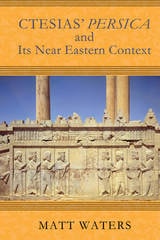
Ctesias’ Persica in Its Near Eastern Context
Matt Waters
University of Wisconsin Press, 2020
Waters, as a historian of Persia with command of Akkadian, Elamite, and Old Persian languages in addition to Latin and Greek, offers a fresh interdisciplinary analysis of the Persica. He shows in detail how Ctesias’ history, though written in a Greek literary style, was infused with two millennia of Mesopotamian and Persian motifs, legends, and traditions. This Hellenized version of Persian culture was enormously influential in antiquity, shaping Greek stereotypes of effeminate Persian monarchs, licentious and vengeful queens, and conniving eunuchs. Waters’ revealing study contributes significantly to knowledge of ancient historiography, Persian dynastic traditions and culture, and the influence of Near Eastern texts and oral tradition on Greek literature.
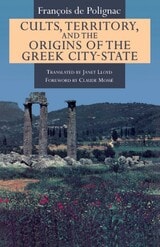
Cults, Territory, and the Origins of the Greek City-State
François de Polignac
University of Chicago Press, 1995
Combining archaeological and textual evidence, de Polignac argues that the eighth-century settlements that would become the city-states of classical Greece were defined as much by the boundaries of "civilized" space as by its urban centers. The city took shape through what de Polignac calls a "religious bipolarity," the cults operating both to organize social space and to articulate social relationships being not only at the heart of the inhabited area, but on the edges of the territory. Together with the urban cults, these sanctuaries "in the wild" identified the polis and its sphere of influence, giving rise to the concept of the state as a territorial unit distinct from its neighbors. Frontier sanctuaries were therefore often the focus of disputes between emerging communities. But in other instances, in particular in Greece's colonizing expeditions, these outer sanctuaries may have facilitated the relations between the indigenous populations and the settlers of the newly founded cities.
Featuring extensive revisions from the original French publication and an updated bibliography, this book is essential for anyone interested in the history and culture of ancient Greece.
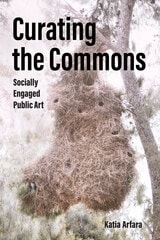
Curating the Commons
Socially Engaged Public ArtKatia Arfara
University of Michigan Press, 2025
By sharing critical insights, Arfara immerses the reader in the working processes of artists and collectives, showing how public art can address ecosocial concerns in aesthetic forms. Curating the Commons offers a grounded perspective on the making of cutting-edge, socially engaged public artworks and contributes to the larger effort to craft more-than-human narratives in response to global events.