Results by title
73 books match the query 'Health Care Delivery' and 9 start with c

Cancer Entangled
Anticipation, Acceleration, and the Danish StateRikke Sand Andersen
Rutgers University Press, 2023
Caring for Immigrants in the Twenty-First Century
Local Hospitals, Global HealthSusan E. Bell
Rutgers University Press, 2027
In Permeable Hospitals, medical sociologist Susan E. Bell makes an original contribution to understanding a complex and urgent global health issue – caring for an increasingly diverse and mobile patient population. Bell identifies the twenty-first-century hospital as the center of a complex network of social and health care interactions among patients and medical communities that are distinguished by transnational movement. She examines how culture and language are negotiated during face-to-face interactions in outpatient visits at one Maine hospital and shows how caring is done for refugee and immigrant patients. To capture this process, Bell advances a new theoretical framework, that twenty-first-century hospitals are nodes in transnational social networks. During appointments, temporary combinations of people, objects, practices, and ideas assemble at the hospital and disperse at the appointment’s end. Because the interactions take place in a teaching hospital, the thinking that underlies diagnosis and treatment is made explicit and evaluated in backstage teaching areas where residents report about their patients to senior physicians. Bell's landmark book is based on a qualitative study that included nine months at the hospital observing interactions among adult New Mainer patients and clinicians, interpreters, and staff.

Children's Mental Health
Problems and ServicesA Report by the Office of Technology Assessment
Duke University Press, 1987
This book was prepared by the Office of Technology Assessment at the request of Senators Mark Hatfield and Daniel Inouye. It acknowledges that there are no simple solutions to the problems we face or easy answers to questions concerning the best system of mental health service delivery. Yet Children's Mental Health makes it abundantly clear that there is a need for a mental health system response to these issues and that this response must be coordinated with other existing service systems.
This book should be of value to concerned parents and community leaders, health system planners, and health care practitioners involved with both the needs of children and mental illness.
Chinese Medicine in Contemporary China
Plurality and SynthesisVolker Scheid
Duke University Press, 2002
Scheid, a medical anthropologist and practitioner of Chinese medicine in practice since 1983, has produced an ethnography that accepts plurality as an intrinsic and nonreducible aspect of medical practice. It has been widely noted that a patient visiting ten different practitioners of Chinese medicine may receive ten different prescriptions for the same complaint, yet many of these various treatments may be effective. In attempting to illuminate the plurality in Chinese medical practice, Scheid redefines-and in some cases abandons-traditional anthropological concepts such as tradition, culture, and practice in favor of approaches from disciplines such as science and technology studies, social psychology, and Chinese philosophy. As a result, his book sheds light not only on Chinese medicine but also on the Western academic traditions used to examine it and presents us with new perspectives from which to deliberate the future of Chinese medicine in a global context.
Chinese Medicine in Contemporary China is the product of two decades of research including numerous interviews and case studies. It will appeal to a western academic audience as well as practitioners of Chinese medicine and other interested medical professionals, including those from western biomedicine.
Chronic Failures
Kidneys, Regimes of Care, and the Mexican StateCiara Kierans
Rutgers University Press, 2020
Community Health Centers
A Movement and the People Who Made It HappenLefkowitz, Bonnie
Rutgers University Press, 2007
This book tells the story of one groundbreaking approach to medicine that attacks the problem by focusing on the wellness of whole neighborhoods. Since their creation during the 1960s, community health centers have served the needs of the poor in the tenements of New York, the colonias of Texas, the working class neighborhoods of Boston, and the dirt farms of the South. As products of the civil rights movement, the early centers provided not only primary and preventive care, but also social and environmental services, economic development, and empowerment.
Bonnie Lefkowitz-herself a veteran of community health administration-explores the program's unlikely transformation from a small and beleaguered demonstration effort to a network of close to a thousand modern health care organizations serving nearly 15 million people. In a series of personal accounts and interviews with national leaders and dozens of health care workers, patients, and activists in five communities across the United States, she shows how health centers have endured despite cynicism and inertia, the vagaries of politics, and ongoing discrimination.
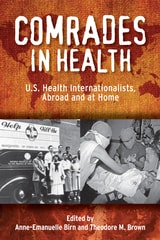
Comrades in Health
U.S. Health Internationalists, Abroad and at HomeEdited by Anne-Emanuelle Birn and Theodore M. Brown
Rutgers University Press, 0
Anne-Emanuelle Birn and Theodore M. Brown bring together a group of professionals and activists whose lives have been dedicated to health internationalism. By presenting a combination of historical accounts and first-hand reflections, this collection of essays aims to draw attention to the longstanding international activities of the American health left and the lessons they brought home. The involvement of these progressive U.S. health professionals is presented against the background of foreign and domestic policy, social movements, and global politics.
Conflicted Health Care
Professionalism and Caring in an Urban HospitalEster Carolina Apesoa-Varano
Vanderbilt University Press, 2014
From 3,200 hours of participant-observation and 500 hours of follow-up interviews with twenty-one doctors, thirty registered nurses, twenty-one respiratory therapists, twenty medical social workers, and eighteen occupational, physical, and speech therapists, the authors create a complex picture of the workplace conflicts that different types of health care practitioners face. Though all these groups espouse caring ideals, professional interests and a curative orientation dominate in patient care and interoccupational relations. Because emotive caring is not supported by the organization of health care in the hospital, it becomes an individual virtue that overworked staff find hard to perform, and it takes on an ideological form that obscures the status hierarchy among practitioners. Conflicts between practitioners rest upon the ranking of each group's knowledge base. They manifest in efforts to work as a team or set limits on practitioner responsibilities and in differing views on unionization.

Connective Tissue
Factory Accidents and Reconstructive Plastic Surgery in South IndiaLily N. Shapiro
Rutgers University Press, 2025
Connective Tissue revisits scholarship on factory labor by analyzing the accident as constitutive of the experience of work itself, and it refines existing conversations about the body, trauma, and care by introducing an analysis informed by theories of labor and production. Author Lily N. Shapiro argues that care does not happen in spite of or on the margins of capitalism, but rather that capitalism happens in and through care and caring relations. These experiences are intersected by identities of caste, class, and gender, and entangled in state discourse about labor rights, welfare, and industrial law.