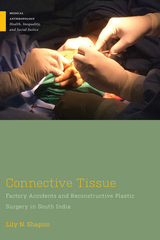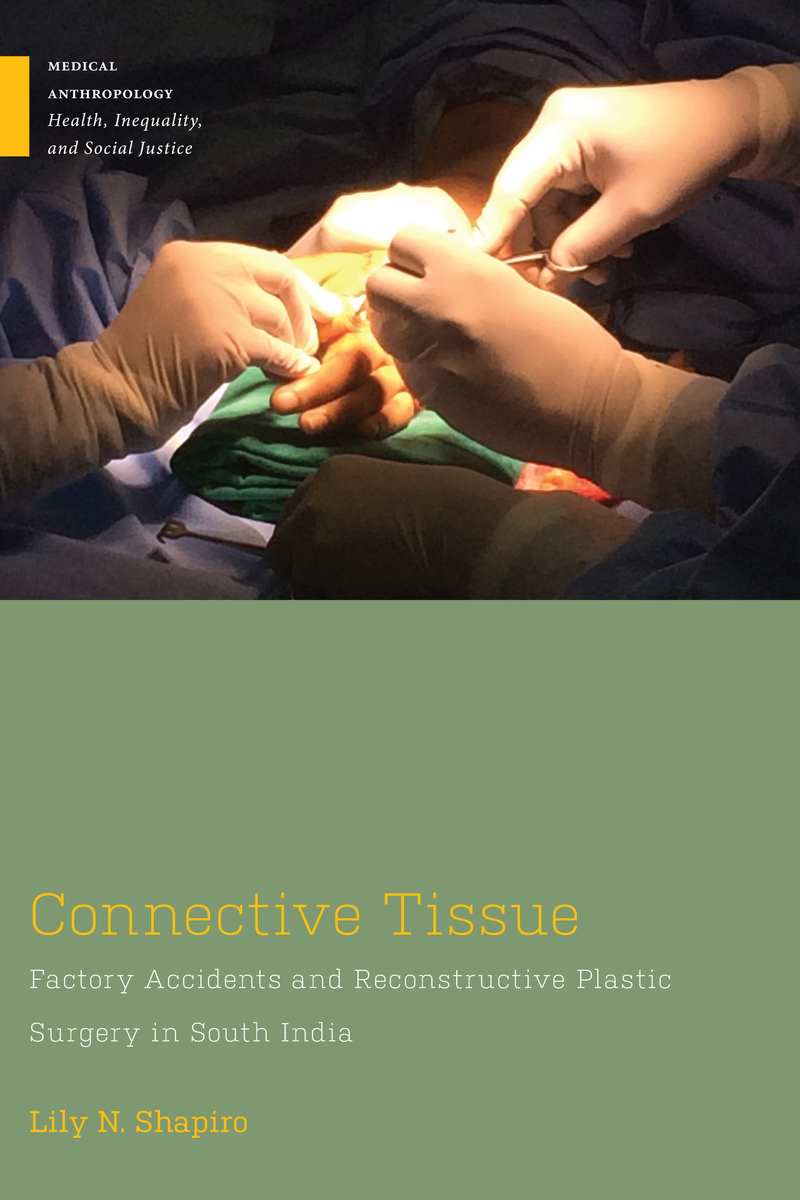
Connective Tissue: Factory Accidents and Reconstructive Plastic Surgery in South India
Rutgers University Press, 2025
Cloth: 978-1-9788-4153-6 | Paper: 978-1-9788-4152-9 | eISBN: 978-1-9788-4154-3 (ePub) | eISBN: 978-1-9788-4155-0 (PDF)
Library of Congress Classification HD7262.5.I5S53 2025
Dewey Decimal Classification 363.1109548
Cloth: 978-1-9788-4153-6 | Paper: 978-1-9788-4152-9 | eISBN: 978-1-9788-4154-3 (ePub) | eISBN: 978-1-9788-4155-0 (PDF)
Library of Congress Classification HD7262.5.I5S53 2025
Dewey Decimal Classification 363.1109548
ABOUT THIS BOOK | AUTHOR BIOGRAPHY | REVIEWS | TOC
ABOUT THIS BOOK
An ethnography of factory accidents and their attendant reconstructive plastic surgeries in Coimbatore, Tamil Nadu, Connective Tissue explores notions of risk, work and labor practices, and the way meaning is made from experiences of trauma, care, and recovery. The book charts a rough chronology of the accident—from the workspace that preceded it, the transformation of the workspace by the accident, through journeys to and treatment in the hospital, and then the various and complex ways in which the accident reverberates into the future during recovery.
Connective Tissue revisits scholarship on factory labor by analyzing the accident as constitutive of the experience of work itself, and it refines existing conversations about the body, trauma, and care by introducing an analysis informed by theories of labor and production. Author Lily N. Shapiro argues that care does not happen in spite of or on the margins of capitalism, but rather that capitalism happens in and through care and caring relations. These experiences are intersected by identities of caste, class, and gender, and entangled in state discourse about labor rights, welfare, and industrial law.
Connective Tissue revisits scholarship on factory labor by analyzing the accident as constitutive of the experience of work itself, and it refines existing conversations about the body, trauma, and care by introducing an analysis informed by theories of labor and production. Author Lily N. Shapiro argues that care does not happen in spite of or on the margins of capitalism, but rather that capitalism happens in and through care and caring relations. These experiences are intersected by identities of caste, class, and gender, and entangled in state discourse about labor rights, welfare, and industrial law.
See other books on: Health Care Delivery | Patients | People with disabilities | Rehabilitation | Surgery
See other titles from Rutgers University Press