Results by title
75 books match the query 'Historic Preservation' and 7 start with c

Chicago River Bridges
Patrick T. McBriarty
University of Illinois Press, 2013
The first comprehensive guidebook of these remarkable features of Chicago's urban landscape, Chicago River Bridges chronicles more than 175 bridges spanning 55 locations along the Main Channel, South Branch, and North Branch of the Chicago River. With new full-color photography of the existing bridges by Kevin Keeley and Laura Banick and more than one hundred black and white images of bridges past, the book unearths the rich history of Chicago's downtown bridges from the Michigan Avenue Bridge to the often forgotten bridges that once connected thoroughfares such as Rush, Erie, Taylor, and Polk Streets.
Throughout, McBriarty delivers new research into the bridges' architectural designs, engineering innovations, and their impact on Chicagoans' daily lives. Describing the structure and mechanics of various kinds of moveable bridges (including vertical-lift, Scherer rolling lift, and Strauss heel trunnion mechanisms) in a manner that is accessible and still satisfying to the bridge aficionado, he explains how the dominance of the "Chicago-style" bascule drawbridge influenced the style and mechanics of bridges worldwide. Interspersed throughout are the human dramas that played out on and around the bridges, such as the floods of 1849 and 1992, the cattle crossing collapse of the Rush Street Bridge, or Vincent "The Schemer" Drucci's Michigan Avenue Bridge jump.
A confluence of Chicago history, urban design, and engineering lore, Chicago River Bridges illustrates Chicago's significant contribution to drawbridge innovation and the city's emergence as the drawbridge capital of the world. It is perfect for any reader interested in learning more about the history and function of Chicago's many and varied bridges. The introduction won The Henry N. Barkhausen Award for original research in the field of Great Lakes maritime history sponsored by the Association for Great Lakes Maritime History.
Cinema Houston
From Nickelodeon to MegaplexBy David Welling
University of Texas Press, 2007
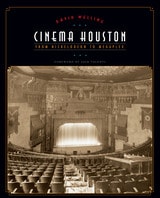
Cinema Houston celebrates a vibrant century of movie theatres and moviegoing in Texas's largest city. Illustrated with more than two hundred historical photographs, newspaper clippings, and advertisements, it traces the history of Houston movie theatres from their early twentieth-century beginnings in vaudeville and nickelodeon houses to the opulent downtown theatres built in the 1920s (the Majestic, Metropolitan, Kirby, and Loew's State). It also captures the excitement of the neighborhood theatres of the 1930s and 1940s, including the Alabama, Tower, and River Oaks; the theatres of the 1950s and early 1960s, including the Windsor and its Cinerama roadshows; and the multicinemas and megaplexes that have come to dominate the movie scene since the late 1960s.
While preserving the glories of Houston's lost movie palaces—only a few of these historic theatres still survive—Cinema Houston also vividly re-creates the moviegoing experience, chronicling midnight movie madness, summer nights at the drive-in, and, of course, all those tasty snacks at the concession stand. Sure to appeal to a wide audience, from movie fans to devotees of Houston's architectural history, Cinema Houston captures the bygone era of the city's movie houses, from the lowbrow to the sublime, the hi-tech sound of 70mm Dolby and THX to the crackle of a drive-in speaker on a cool spring evening.
Coal and Culture
Opera Houses in AppalachiaWilliam Faricy Condee
Ohio University Press, 2005
Opera houses were fixtures of Appalachian life from the end of the Civil War through the 1920s. Most towns and cities had at least one opera house during this golden age. Coal mining and railroads brought travelers, money, and change to the region. Many aspects of American life converged in the opera house.
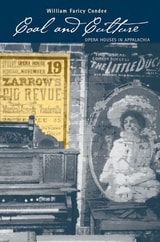
Coal and Culture: Opera Houses in Appalachia is a critical appreciation of the opera house in the coal-mining region of Appalachia from the mid-1860s to the early 1930s. Author William Faricy Condee demonstrates that these were multipurpose facilities that were central to the life of their communities. In the era before radio, movies, television, and malls, these buildings were essential. They housed little, if any, opera, but were used for almost everything else, including traveling theater, concerts, religious events, lectures, commencements, boxing matches, benefits, union meetings, and—if the auditorium had a flat floor—skating and basketball.
The only book on opera houses that stresses their cultural context, Condee’s unique study will interest cultural geographers, scholars of Appalachian studies, and all those who appreciate the gaudy diversity of the American scene.
Creating Old World Wisconsin
The Struggle to Build an Outdoor History Museum of Ethnic ArchitectureJohn D. Krugler
University of Wisconsin Press, 2013
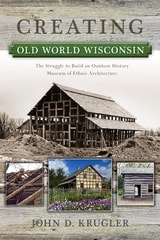
Visionaries, researchers, curators, and volunteers launched a massive preservation initiative to salvage fast-disappearing immigrant and migrant architecture. Dozens of historic buildings in the 1970s were transported from locations throughout the state to the Kettle Moraine State Forest. These buildings created a backdrop against which twenty-first-century interpreters demonstrate nineteenth- and early twentieth-century agricultural techniques and artisanal craftsmanship. The site, created and maintained by the Wisconsin Historical Society, offers visitors a unique opportunity to learn about the state’s rich and ethnically diverse past through depictions of the everyday lives of its Norwegian, Danish, Finnish, German, Polish, African American, and Yankee inhabitants.
Creating Old World Wisconsin chronicles the fascinating and complex origins of this outdoor museum, highlighting the struggles that faced its creators as they worked to achieve their vision. Even as Milwaukee architect and preservationist Richard W. E. Perrin, the Society's staff, and enthusiastic volunteers opened the museum in time for the national bicentennial in 1976, the site was plagued by limited funds, bureaucratic tangles, and problems associated with gaining public support. By documenting the engaging story of the challenges, roadblocks, false starts, and achievements of the site's founders, Krugler brings to life the history of the dedicated corps who collected and preserved Wisconsin's diverse social history and heritage.
Cultural Heritage and Mass Atrocities
James Cuno
J. Paul Getty Trust, The, 2022
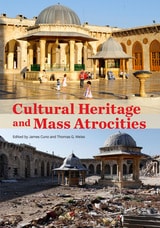
Intentional destruction of cultural heritage has a long history. Contemporary examples include the Bamiyan Buddhas in Afghanistan, mosques in Xinjiang, mausoleums in Timbuktu, and Greco-Roman remains in Syria. Cultural heritage destruction invariably accompanies assaults on civilians, making heritage attacks impossible to disentangle from the mass atrocities of genocide, war crimes, crimes against humanity, and ethnic cleansing. Both seek to eliminate people and the heritage with which they identify.
Cultural Heritage and Mass Atrocities assembles essays by thirty-eight experts from the heritage, social science, humanitarian, legal, and military communities. Focusing on immovable cultural heritage vulnerable to attack, the volume's guiding framework is the Responsibility to Protect (R2P), a United Nations resolution adopted unanimously in 2005 to permit international intervention against crimes of war or genocide. Based on the three pillars of prevent, react, and rebuild, R2P offers today's policymakers a set of existing laws and international norms that can and—as this book argues—must be extended to the protection of cultural heritage. Contributions consider the global value of cultural heritage and document recent attacks on people and sites in China, Guatemala, Iraq, Mali, Sri Lanka and Afghanistan, Syria, and Yemen. Comprehensive sections on vulnerable populations as well as the role of international law and the military offer readers critical insights and point toward research, policy, and action agendas to protect both people and cultural heritage. A concise abstract of each chapter is offered online in Arabic, Chinese, French, Russian, and Spanish to facilitate robust, global dissemination of the strategies and tactics offered in this pathbreaking call to action.
The free online edition of this publication is available at getty.edu/publications/cultural-heritage-mass-atrocities. Also available are free PDF, EPUB, and Kindle/MOBI downloads of the book.

Cultural Landscapes
Balancing Nature and Heritage in Preservation PracticeRichard Longstreth
University of Minnesota Press, 2008
Preservation has traditionally focused on saving prominent buildings of historical or architectural significance. Preserving cultural landscapes-the combined fabric of the natural and man-made environments-is a relatively new and often misunderstood idea among preservationists, but it is of increasing importance. The essays collected in this volume-case studies that include the Little Tokyo neighborhood in Los Angeles, the Cross Bronx Expressway, and a rural island in Puget Sound-underscore how this approach can be fruitfully applied. Together, they make clear that a cultural landscape perspective can be an essential underpinning for all historic preservation projects.
Contributors: Susan Calafate Boyle, National Park Service; Susan Buggey, U of Montreal; Michael Caratzas, Landmarks Preservation Commission (NYC); Courtney P. Fint, West Virginia Historic Preservation Office; Heidi Hohmann, Iowa State U; Hillary Jenks, USC; Randall Mason, U Penn; Robert Z. Melnick, U of Oregon; Nora Mitchell, National Park Service; Julie Riesenweber, U of Kentucky; Nancy Rottle, U of Washington; Bonnie Stepenoff, Southeast Missouri State U.
Richard Longstreth is professor of American civilization and director of the graduate program in historic preservation at George Washington University.
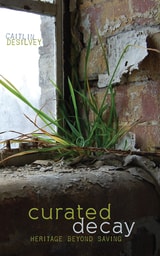
Curated Decay
Heritage beyond SavingCaitlin DeSilvey
University of Minnesota Press, 2017
Transporting readers from derelict homesteads to imperiled harbors, postindustrial ruins to Cold War test sites, Curated Decay presents an unparalleled provocation to conventional thinking on the conservation of cultural heritage. Caitlin DeSilvey proposes rethinking the care of certain vulnerable sites in terms of ecology and entropy, and explains how we must adopt an ethical stance that allows us to collaborate with—rather than defend against—natural processes.
Curated Decay chronicles DeSilvey’s travels to places where experiments in curated ruination and creative collapse are under way, or under consideration. It uses case studies from the United States, Europe, and elsewhere to explore how objects and structures produce meaning not only in their preservation and persistence, but also in their decay and disintegration. Through accessible and engaging discussion of specific places and their stories, it traces how cultural memory is generated in encounters with ephemeral artifacts and architectures.
An interdisciplinary reframing of the concept of the ruin that combines historical and philosophical depth with attentive storytelling, Curated Decay represents the first attempt to apply new theories of materiality and ecology to the concerns of critical heritage studies.