Results by title
71 books match the query 'Historical Events' and 5 start with c

Cannibal Translation
Literary Reciprocity in Contemporary Latin AmericaIsabel C. Gómez
Northwestern University Press, 2023
Winner of the 2024 ACLA Harry Levin Prize • Honorable Mention MLA Katherine Singer Kovacs Prize
A bold comparative study illustrating the creative potential of translations that embrace mutuality and resist assimilation
Cannibal translators digest, recombine, transform, and trouble their source materials. Isabel C. Gómez makes the case for this model of literary production by excavating a network of translation projects in Latin America that includes canonical writers of the twentieth century, such as Haroldo and Augusto de Campos, Rosario Castellanos, Clarice Lispector, José Emilio Pacheco, Octavio Paz, and Ángel Rama. Building on the avant-garde reclaiming of cannibalism as an Indigenous practice meant to honorably incorporate the other into the self, these authors took up Brazilian theories of translation in Spanish to fashion a distinctly Latin American literary exchange, one that rejected normative and Anglocentric approaches to translation and developed collaborative techniques to bring about a new understanding of world literature.
By shedding new light on the political and aesthetic pathways of translation movements beyond the Global North, Gómez offers an alternative conception of the theoretical and ethical challenges posed by this artistic practice. Cannibal Translation: Literary Reciprocity in Contemporary Latin America mobilizes a capacious archive of personal letters, publishers’ records, newspapers, and new media to illuminate inventive strategies of collectivity and process, such as untranslation, transcreation, intersectional autobiographical translation, and transpeaking. The book invites readers to find fresh meaning in other translational histories and question the practices that mediate literary circulation.
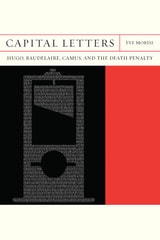
Capital Letters
Hugo, Baudelaire, Camus, and the Death PenaltyÈve Morisi
Northwestern University Press, 2020
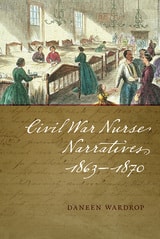
Civil War Nurse Narratives, 1863-1870
Daneen Wardrop
University of Iowa Press, 2015
As a subgenre of war literature, the Civil War nurse narrative offered realistic reportage of medical experiences and declined to engage with military strategies or Congressional politics. Instead, nurse narrators chronicled the details of attending wounded soldiers in the hospital, where a kind of microcosm of US democracy-in-progress emerged. As the war reshaped the social and political ideologies of the republic, nurses labored in a workplace that reflected cultural changes in ideas about gender, race, and class. Through interactions with surgeons and other officials they tested women’s rights convictions, and through interactions with formerly enslaved workers they wrestled with the need to live up to their own often abolitionist convictions and support social equality.
By putting these accounts in conversation with each other, Civil War Nurse Narratives productively explores a developing genre of war literature that has rarely been given its due and that offers refreshing insights into women’s contributions to the war effort. Taken together, these stories offer an impressive and important addition to the literary history of the Civil War.
Civilizing War
Imperial Politics and the Poetics of National RuptureNasser Mufti
Northwestern University Press, 2018
Honorable Mention for the 2019 Sonya Rudikoff Prize, awarded by the Northeast Victorian Studies Association
Civilizing War traces the historical transformation of civil war from a civil affair into an uncivil crisis. Civil war is today synonymous with the global refugee crisis, often serving as grounds for liberal-humanitarian intervention and nationalist protectionism.
In Civilizing War, Nasser Mufti situates this contemporary conjuncture in the long history of British imperialism, demonstrating how civil war has been and continues to be integral to the politics of empire. Through comparative readings of literature, criticism, historiography, and social analysis, Civilizing War shows how writers and intellectuals of Britain’s Anglophone empire articulated a “poetics of national rupture” that defined the metropolitan nation and its colonial others.
Mufti’s tour de force marshals a wealth of examples as diverse as Thomas Carlyle, Benjamin Disraeli, Friedrich Engels, Arthur Conan Doyle, Rudyard Kipling, Joseph Conrad, V. S. Naipaul, Nadine Gordimer, and Michael Ondaatje to examine the variety of forms this poetics takes—metaphors, figures, tropes, puns, and plot—all of which have played a central role in Britain’s civilizing mission and its afterlife. In doing so, Civilizing War shifts the terms of Edward Said’s influential Orientalism to suggest that imperialism was not only organized around the norms of civility but also around narratives of civil war.
Concepts of the World
The French Avant-Garde and the Idea of the International, 1910–1940Effie Rentzou
Northwestern University Press, 2022
The writers and artists of the French avant-garde aspired to reach a global audience that would be wholly transformed by their work. In this study, Effie Rentzou delves deep into their depictions of the interwar world as an international and modern landscape, one marked by a varied cosmopolitanism. The avant-garde’s conceptualization of the world paralleled, rejected, or expanded prevailing notions of the global sphere.
The historical avant garde—which encompassed movements like futurism, Dada, and surrealism—was self-consciously international, operating across global networks and developed with the whole world as its horizon and its public. In the heady period between the end of the Belle Époque and the tumult of World War II, both individual artists (including Guillaume Apollinaire, Blaise Cendrars, Francis Picabia, Louis Aragon, Leonora Carrington, and Nicolas Calas) and collective endeavors (such as surrealist magazines and exhibitions) grappled with contemporary anxieties about economic growth, imperialism, and colonialism, as well as various universalist, cosmopolitan, and internationalist visions. By probing these works, Concepts of the World offers an alternative narrative of globalization, one that integrates the avant-garde’s enthusiasm for, as well as resistance to, the process. Rentzou identifies within the avant-garde a powerful political language that expressed the ambivalence of living and creating in an increasingly globalized world—a language that profoundly shaped the way the world has been conceptualized and is experienced today.