Results by title
148 books match the query 'History, Military' and 8 start with c
Caesar in Gaul and Rome
War in WordsBy Andrew M. Riggsby
University of Texas Press, 2006
Winner, AAP/PSP Award for Excellence, Classics and Ancient History, 2006
Anyone who has even a passing acquaintance with Latin knows "Gallia est omnis divisa in partes tres" ("All Gaul is divided into three parts"), the opening line of De Bello Gallico, Julius Caesar's famous commentary on his campaigns against the Gauls in the 50s BC. But what did Caesar intend to accomplish by writing and publishing his commentaries, how did he go about it, and what potentially unforeseen consequences did his writing have? These are the questions that Andrew Riggsby pursues in this fresh interpretation of one of the masterworks of Latin prose.
Riggsby uses contemporary literary methods to examine the historical impact that the commentaries had on the Roman reading public. In the first part of his study, Riggsby considers how Caesar defined Roman identity and its relationship to non-Roman others. He shows how Caesar opens up a possible vision of the political future in which the distinction between Roman and non-Roman becomes less important because of their joint submission to a Caesar-like leader. In the second part, Riggsby analyzes Caesar's political self-fashioning and the potential effects of his writing and publishing the Gallic War. He reveals how Caesar presents himself as a subtly new kind of Roman general who deserves credit not only for his own virtues, but for those of his soldiers as well. Riggsby uses case studies of key topics (spatial representation, ethnography, virtus and technology, genre, and the just war), augmented by more synthetic discussions that bring in evidence from other Roman and Greek texts, to offer a broad picture of the themes of national identity and Caesar's self-presentation.

Clash of Loyalties
A Border County in the Civil WarJOHN W. SHAFFER
West Virginia University Press, 2003
A border county in a border state, Barbour County, West Virginia felt the full terror and tragedy of the Civil War. The wounds of the Civil War cut most bitterly in the border states, that strip of America from Maryland to Kansas, where conflicting loyalties and traditions ripped apart communities, institutions, and families. Barbour County, in the mountainous Northwest of (West) Virginia, is a telling microcosm of the deep divisions which both caused the war and were caused by it. By examining and interpreting long-ignored documents of the times and the personal accounts of the people who were there, Clash of Loyalties offers a startling new view of America's most bitter hour. Nearly half of the military-age men in the county served in the armed forces, almost perfectly divided between the Union and the Confederacy. After West Virginia split with Virginia to rejoin the Union, Confederate soldiers from the regions could not safely visit their homes on furlough, or even send letters to their families. The county's two leading political figures, Samuel Woods and Spencer Dayton, became leaders of the fight for and against secession, dissolved their close personal friendship, and never spoke to one another again. The two factions launched campaigns of terror and intimidation, leading to the burning of several homes, the kidnapping of a sheriff, the murder of a pacifist minister, and the self-imposed exile of many of the county's influential families. The conflicting loyalties crossed nearly all social and economic lines; even the county's slave owners were evenly divided between Union and Confederate sympathies. With a meticulous examination of census and military records, geneologies, period newspapers, tax rolls, eyewitness accounts, and other relevant documents, Clash of Loyalties presents a compelling account of the passion and violence which tore apart Barbour County and the nation.
Colonial Wars, 1689-1762
Howard H. Peckham
University of Chicago Press, 1965
Mr. Peckham chronicles the events of these wars, summarizing the struggle for empire in America among France, England, and Spain. He indicates how the colonists applied the experience they gained from fighting Indians to their engagements with European powers. And what they learned from the colonial wars they translated into a political philosophy that led to independence and self-government.
The ready involvement of the colonies in European ambitions, the success and failure of co-operation between colony and mother country, the efforts of the English colonies together, and the growing differences between them and Britain give the narrative continuity and rising excitement.
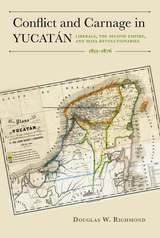
Conflict and Carnage in Yucatán
Liberals, the Second Empire, and Maya Revolutionaries, 1855–1876Douglas W. Richmond
University of Alabama Press, 2015
Synthesizing an extensive and heterogeneous range of sources, Douglas W. Richmond covers three tumultuous political upheavals of this period. First, Mexico’s fledgling republic attempted to impose a liberal ideology at odds with traditional Maya culture on Yucatán; then, the French-backed regime of Emperor Maximilian began to reform Yucatán; and, finally, the republican forces of Benito Juárez restored the liberal hegemony. Many issues spurred resistance to these liberal governments. Instillation of free trade policies, the suppression of civil rights, and persecution of the Roman Catholic Church mobilized white opposition to liberal governors. The Mayas fought the seizure of their communal properties. A long-standing desire for regional autonomy united virtually all Yucatecans. Richmond advances the thought-provoking argument that Yucatán both fared better under Maximilian’s Second Empire than under the liberal republic and would have thrived more had the Second Empire not collapsed.
The most violent and bloody manifestation of these broad conflicts was the Caste War (Guerra de Castas), the longest sustained peasant revolt in Latin American history. Where other scholars have advocated the simplistic position that the war was a Maya uprising designed to reestablish a mythical past civilization, Richmond’s sophisticated recounting of political developments from 1855 to 1876 restores nuance and complexity to this pivotal time in Yucatecan history.
Richmond’s Conflict and Carnage in Yucatán is a welcome addition to scholarship about Mexico and Yucatán as well as about state consolidation, empire, and regionalism.
Conquering the American Wilderness
The Triumph of European Warfare in the Colonial NortheastGuy Chet
University of Massachusetts Press, 2003
A study of military tactics and strategy before the War of Independence, this book reexamines the conquest of the North American wilderness and its native peoples by colonial settlers. Historians have long believed that the peculiar conditions of the New World, coupled with the success of Indians tactics, forced the colonists to abandon traditional European methods of warfare and to develop a new “American” style of combat. By combining firearms with guerrilla-like native tactics, colonial commanders were able not only to subdue their Indian adversaries but eventually to prevail against more conventionally trained British forces during the American Revolution. Yet upon closer scrutiny, this common understanding of early American warfare turns out to be more myth than reality.
As Guy Chet reveals, clashes between colonial and Indian forces during the seventeenth and eighteenth centuries did not lead to a reevaluation and transformation of conventional military doctrine. On the contrary, the poor performance of the settlers during King Philip's War (1675–76) and King William's War (1689–1697) prompted colonial magistrates to address the shortcomings of their military forces through a greater reliance on British troops and imperial administrators. Thus, as the eighteenth century wore on, growing military success in the New England colonies reflected an increasing degree of British planning, administration, participation, and command. The colonies' military and political leadership, Chet argues, never rejected the time-tested principles of European warfare, and even during the American War of Independence, the republic's military leadership looked to Europe for guidance in the art of combat.
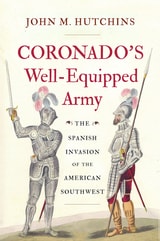
Coronado's Well-Equipped Army
The Spanish Invasion of the American SouthwestJohn M. Hutchins
Westholme Publishing, 2023
Winner of Two Colorado Book Awards
The historic 1540–1542 expedition of Captain-General Francisco Vasquez de Coronado is popularly remembered as a luckless party of exploration which wandered the American Southwest and then blundered onto the central Great Plains of Texas, Oklahoma, and Kansas. The expedition, as historian John M. Hutchins relates in Coronado’s Well-Equipped Army: The Spanish Invasion of the American Southwest, was a military force of about 1,500 individuals, made up of Spanish soldiers, Indian warrior allies, and camp followers. Despite the hopes for a peaceful conquest of new lands—including those of a legendary kingdom of Cibola—the expedition was obliged to fight a series of battles with the natives in present-day Sonora, California, Arizona, and New Mexico. The final phase of the invasion was less warlike, as the members of the expedition searched the Great Plains in vain for a wealthy civilization called Quivira.While much has been written about the march of Coronado and his men, this is the first book to address the endeavor as a military campaign of potential conquest like those conducted by other conquistadors. This helps to explain many of the previously misunderstood activities of the expedition. In addition, new light is cast on the non-Spanish participants, including Mexican Indian allies and African retainers, as well as the important roles of women.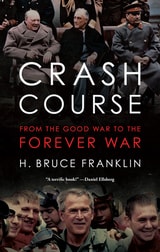
Crash Course
From the Good War to the Forever WarFranklin, H. Bruce
Rutgers University Press, 2024
Now, after fifty years as a renowned cultural historian, Franklin offers a set of hard-learned lessons about modern American history. Crash Course is essential reading for anyone who wonders how America ended up where it is today: with a deeply divided and disillusioned populace, led by a dysfunctional government, and mired in unwinnable wars. It also finds startling parallels between America’s foreign military exploits and the equally brutal tactics used on the home front to crush organized labor, antiwar, and civil rights movements.
More than just a memoir or a history book, Crash Course gives readers a unique firsthand look at the building of the American empire and the damage it has wrought. Shocking and gripping as any thriller, it exposes the endless deception of the American public, and reveals from inside how and why many millions of Americans have been struggling for decades against our own government in a fight for peace and justice.
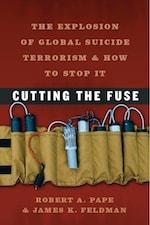
Cutting the Fuse
The Explosion of Global Suicide Terrorism and How to Stop ItRobert A. Pape and James K. Feldman
University of Chicago Press, 2012