Results by title
668 books match the query 'History & Surveys' and 25 start with c
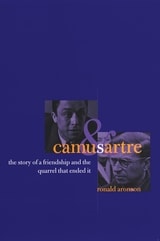
Camus and Sartre
The Story of a Friendship and the Quarrel that Ended ItRonald Aronson
University of Chicago Press, 2003
Albert Camus and Jean-Paul Sartre first met in 1943, during the German occupation of France. The two became fast friends. Intellectual as well as political allies, they grew famous overnight after Paris was liberated. As playwrights, novelists, philosophers, journalists, and editors, the two seemed to be everywhere and in command of every medium in post-war France. East-West tensions would put a strain on their friendship, however, as they evolved in opposing directions and began to disagree over philosophy, the responsibilities of intellectuals, and what sorts of political changes were necessary or possible.
As Camus, then Sartre adopted the mantle of public spokesperson for his side, a historic showdown seemed inevitable. Sartre embraced violence as a path to change and Camus sharply opposed it, leading to a bitter and very public falling out in 1952. They never spoke again, although they continued to disagree, in code, until Camus's death in 1960.
In a remarkably nuanced and balanced account, Aronson chronicles this riveting story while demonstrating how Camus and Sartre developed first in connection with and then against each other, each keeping the other in his sights long after their break. Combining biography and intellectual history, philosophical and political passion, Camus and Sartre will fascinate anyone interested in these great writers or the world-historical issues that tore them apart.
Capital Times
Tales from the Conquest of TimeEric Alliez
University of Minnesota Press, 1996
Cartesian Poetics
The Art of ThinkingAndrea Gadberry
University of Chicago Press, 2020
Gadberry’s approach to seventeenth-century writings poses questions urgent for the twenty-first. Bringing literature and philosophy into rich dialogue, Gadberry centers close reading as a method uniquely equipped to manage skepticism, tolerate critical ambivalence, and detect feeling in philosophy. Helping us read classic moments of philosophical argumentation in a new light, this elegant study also expands outward to redefine thinking in light of its poetic formations.
Cartesian Questions
Method and MetaphysicsJean-Luc Marion
University of Chicago Press, 1999
"Besides the impact of their content, the clarity and reach of these essays force one to consider foundational questions concerning philosophy and its history."—Richard Watson, Journal of the History of Philosophy
Chain of Gold
Greek Rhetoric in the Roman EmpireSusan C. Jarratt
Southern Illinois University Press, 2019
Through allusions to classical Greek literature, sophists such as Dio Chrysostom, Aelius Aristides, and Philostratus slipped oblique challenges to empire into otherwise innocuous works. Such figures protected their creators from the danger of direct confrontation but nonetheless would have been recognized by elite audiences, Roman and Greek alike, by virtue of their common education. Focusing on such moments, Jarratt presents close readings of city encomia, biography, and texts in hybrid genres from key second sophistic figures, setting each in its geographical context. Although all the authors considered are male, the analyses here bring to light reflections on gender, ethnicity, skin color, language differences, and sexuality, revealing an underrecognized diversity in the rhetorical activity of this period.
While US scholars of ancient rhetoric have focused largely on the pedagogical, Jarratt brings a geopolitical lens to her study of the subject. Her inclusion of fourth-century texts—the Greek novel Ethiopian Story, by Heliodorus, and the political orations of Libanius of Antioch—extends the temporal boundary of the period. She concludes with speculations about the pressures brought to bear on sophistic political subjectivity by the rise of Christianity and with ruminations on a third sophistic in ancient and contemporary eras of empire.
Chic Ironic Bitterness
R. Jay Magill, Jr.
University of Michigan Press, 2009
A brilliant and timely reflection on irony in contemporary American culture
“This book is a powerful and persuasive defense of sophisticated irony and subtle humor that contributes to the possibility of a genuine civic trust and democratic life. R. Jay Magill deserves our congratulations for a superb job!”
—Cornel West, University Professor, Princeton University
“A well-written, well-argued assessment of the importance of irony in contemporary American social life, along with the nature of recent misguided attacks and, happily, a deep conviction that irony is too important in our lives to succumb. The book reflects wide reading, varied experience, and real analytical prowess.”
—Peter Stearns, Provost, George Mason University
“Somehow, Americans—a pragmatic and colloquial lot, for the most part—are now supposed to speak the Word, without ironic embellishment, in order to rebuild the civic culture. So irony’s critics decide it has become ‘worthy of moral condemnation.’ Magill pushes back against this new conventional wisdom, eloquently defending a much livelier American sensibility than the many apologists for a somber ‘civic culture’ could ever acknowledge."
—William Chaloupka, Chair and Professor, Department of Political Science, Colorado State University
The events of 9/11 had many pundits on the left and right scrambling to declare an end to the Age of Irony. But six years on, we're as ironic as ever. From The Simpsons and Borat to The Daily Show and The Colbert Report, the ironic worldview measures out a certain cosmopolitan distance, keeping hypocrisy and threats to personal integrity at bay.
Chic Ironic Bitterness is a defense of this detachment, an attitude that helps us preserve values such as authenticity, sincerity, and seriousness that might otherwise be lost in a world filled with spin, marketing, and jargon. And it is an effective counterweight to the prevailing conservative view that irony is the first step toward cynicism and the breakdown of Western culture.
R. Jay Magill, Jr., is a writer and illustrator whose work has appeared in American Prospect, American Interest, Atlantic Monthly, Foreign Policy, International Herald Tribune, New York Times, Wall Street Journal, and Print, amongother periodicals and books. A former Harvard Teaching Fellow and Executive Editor of DoubleTake, he holds a Ph.D. in American Studies from the University of Hamburg in Germany. This is his first book.
Christianity and Philosophical Culture in the Fifth Century
The controversy about the Human Soul in the WestErnest Fortin
St. Augustine's Press, 2019
Cicero on the Emotions
Tusculan Disputations 3 and 4Marcus Tullius Cicero
University of Chicago Press, 2002
Margaret Graver's elegant and idiomatic translation makes Cicero's work accessible not just to classicists but to anyone interested in ancient philosophy and psychotherapy or in the philosophy of emotion. The accompanying commentary explains the philosophical concepts discussed in the text and supplies many helpful parallels from Greek sources.
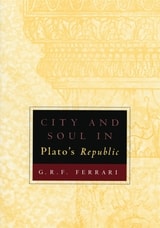
City and Soul in Plato's Republic
G. R. F. Ferrari
University of Chicago Press, 2005
In addition to acknowledging familiar themes in the interpretation of the Republic—the sincerity of its utopianism, the justice of the philosopher's return to the Cave—Ferrari provocatively engages secondary literature by Leo Strauss, Bernard Williams, and Jonathan Lear. With admirable clarity and insight, Ferrari conveys the relation between the city and the soul and the choice between tyranny and philosophy. City and Soul in Plato's Republic will be of value to students of classics, philosophy, and political theory alike.
Complementarity
Anti-Epistemology after Bohr and DerridaArkady Plotnitsky
Duke University Press, 1994
Bohr’s term complementarity describes a situation, unavoidable in quantum physics, in which two theories thought to be mutually exclusive are required to explain a single phenomenon. Light, for example, can only be explained as both wave and particle, but no synthesis of the two is possible. This theoretical transformation is then examined in relation to the ways that Derrida sets his work against or outside of Hegel, also resisting a similar kind of synthesis and enacting a transformation of its own.
Though concerned primarily with Bohr and Derrida, Plotnitsky also considers a wide range of anti-epistemological endeavors including the work of Nietzsche, Bataille, and the mathematician Kurt Gödel. Under the rubric of complementarity he develops a theoretical framework that raises new possiblilities for students and scholars of literary theory, philosophy, and philosophy of science.
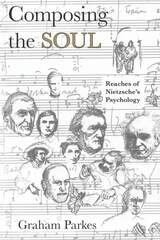
Composing the Soul
Reaches of Nietzsche's PsychologyGraham Parkes
University of Chicago Press, 1994
Composing the Soul is the first study to pay sustained attention to this pronouncement and to examine the contours of Nietzsche's psychology in the context of his life and psychological makeup. Beginning with essays from Nietzsche's youth, Graham Parkes shows the influence of such figures as Goethe, Byron, and Emerson on Nietzsche's formidable and multiple talents. Parkes goes on to chart the development of Nietzsche's psychological ideas in terms of the imagery, drawn from the dialogues of Plato as well as from Nietzsche's own quasi-mystical experiences of nature, in which he spoke of the soul. Finally, Parkes analyzes Nietzsche's most revolutionary idea—that the soul is composed of multiple "drives," or "persons," within the psyche. The task for Nietzsche's psychology, then, was to identify and order these multiple persons within the individual—to compose the soul.
Featuring all new translations of quotations from Nietzsche's writings, Composing the Soul reveals the profundity of Nietzsche's lifelong personal and intellectual struggles to come to grips with the soul. Extremely well-written, this landmark work makes Nietzsche's life and ideas accessible to any reader interested in this much misunderstood thinker.
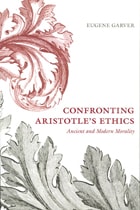
Confronting Aristotle's Ethics
Ancient and Modern MoralityEugene Garver
University of Chicago Press, 2006
What is the good life? Posing this question today would likely elicit very different answers. Some might say that the good life means doing good—improving one’s community and the lives of others. Others might respond that it means doing well—cultivating one’s own abilities in a meaningful way. But for Aristotle these two distinct ideas—doing good and doing well—were one and the same and could be realized in a single life. In Confronting Aristotle’s Ethics, Eugene Garver examines how we can draw this conclusion from Aristotle's works, while also studying how this conception of the good life relates to contemporary ideas of morality.
The key to Aristotle’s views on ethics, argues Garver, lies in the Metaphysics or, more specifically, in his thoughts on activities, actions, and capacities. For Aristotle, Garver shows, it is only possible to be truly active when acting for the common good, and it is only possible to be truly happy when active to the extent of one’s own powers. But does this mean we should aspire to Aristotle’s impossibly demanding vision of the good life? In a word, no. Garver stresses the enormous gap between life in Aristotle’s time and ours. As a result, this bookwill be a welcome rumination on not only Aristotle, but the relationship between the individual and society in everyday life.
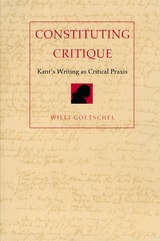
Constituting Critique
Kant's Writing as Critical PraxisWilli Goetschel. Translated by Eric J. Schwab
Duke University Press, 1994
Constituting Critique traces the stages in Kant’s development to reveal how he redefined philosophy as a critical task. Following the philosopher through the experiments of his early essays, Goetschel demonstrates how Kant tests, challenges, and transforms the philosophical essay in his pursuit of a new self-reflective literary genre. From these experiments, critique emerges as the philosophical form for the critical project of the Enlightenment. The imperatives of its transcendental style, Goetschel contends, not only constitute and inform the critical moment of Kant’s philosophical praxis, but also have an enduring place in post-Kantian philosophy and literature.
By situating the Critiques within the context of Kant’s early essays, this work will redirect the attention of Kant scholars to the origins of their form. It will also encourage contemporary critical theorists to reconsider their own practice through an engagement with its source in Kant.
Contemplation Of The World
Figures of Community StyleMichel Maffesoli
University of Minnesota Press, 1996
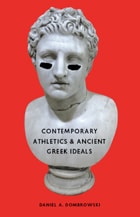
Contemporary Athletics and Ancient Greek Ideals
Daniel A. Dombrowski
University of Chicago Press, 2009
Despite their influence in our culture, sports inspire dramatically less philosophical consideration than such ostensibly weightier topics as religion, politics, or science. Arguing that athletic playfulness coexists with serious underpinnings, and that both demand more substantive attention, Daniel Dombrowski harnesses the insights of ancient Greek thinkers to illuminate contemporary athletics.
Dombrowski contends that the ideas of Plato, Aristotle, and Plotinus shed important light on issues—such as the pursuit of excellence, the concept of play, and the power of accepting physical limitations while also improving one’s body—that remain just as relevant in our sports-obsessed age as they were in ancient Greece. Bringing these concepts to bear on contemporary concerns, Dombrowski considers such questions as whether athletic competition can be a moral substitute for war, whether it necessarily constitutes war by other means, and whether it encourages fascist tendencies or ethical virtue. The first volume to philosophically explore twenty-first-century sport in the context of its ancient predecessor, Contemporary Athletics and Ancient Greek Ideals reveals that their relationship has great and previously untapped potential to inform our understanding of human nature.
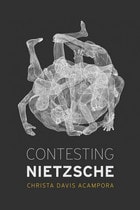
Contesting Nietzsche
Christa Davis Acampora
University of Chicago Press, 2013
In this groundbreaking work, Christa Davis Acampora offers a profound rethinking of Friedrich Nietzsche’s crucial notion of the agon. Analyzing an impressive array of primary and secondary sources and synthesizing decades of Nietzsche scholarship, she shows how the agon, or contest, organized core areas of Nietzsche’s philosophy, providing a new appreciation of the subtleties of his notorious views about power. By focusing so intensely on this particular guiding interest, she offers an exciting, original vantage from which to view this iconic thinker: Contesting Nietzsche.

Cool Memories II, 1987-1990
Jean Baudrillard
Duke University Press, 1996
In this wide-ranging discussion of events and ideas, Baudrillard moves between poetry and waterfalls, strikes and stealth bombers, Freud and La Cicciolina, shadows and simulacra, deconstruction and the zodiac, Reagan’s smile and Kennedy’s death, the “curse” on South America and the future of the West, the last tango of French intellectual life and the exemplary disappearing act of Italian politics. Writing at the site where the philosophic and the poetic merge, he once again offers us commentary in the form of the riveting insight, the short distillation of reality that establishes its truth with the force of recognition.
Cool Memories II, Baudrillard’s latest commentary on the technopresent and future, an installment of his reflections on the reality of contemporary western culture, will entice all readers concerned with postmodernism and the current state of theory.

Critical Theory to Structuralism
Philosophy, Politics, and the Human SciencesEdited by David Ingram
University of Chicago Press, 2010
From Kant to Kierkegaard, from Hegel to Heidegger, continental philosophers have indelibly shaped the trajectory of Western thought since the eighteenth century. Although much has been written about these monumental thinkers, students and scholars lack a definitive guide to the entire scope of the continental tradition. The most comprehensive reference work to date, this eight-volume History of Continental Philosophy will both encapsulate the subject and reorient our understanding of it. Beginning with an overview of Kant’s philosophy and its initial reception, the History traces the evolution of continental philosophy through major figures as well as movements such as existentialism, phenomenology, hermeneutics, and poststructuralism. The final volume outlines the current state of the field, bringing the work of both historical and modern thinkers to bear on such contemporary topics as feminism, globalization, and the environment. Throughout, the volumes examine important philosophical figures and developments in their historical, political, and cultural contexts.
The first reference of its kind, A History of Continental Philosophy has been written and edited by internationally recognized experts with a commitment to explaining complex thinkers, texts, and movements in rigorous yet jargon-free essays suitable for both undergraduates and seasoned specialists. These volumes also elucidate ongoing debates about the nature of continental and analytic philosophy, surveying the distinctive, sometimes overlapping characteristics and approaches of each tradition. Featuring helpful overviews of major topics and plotting road maps to their underlying contexts, A History of Continental Philosophy is destined to be the resource of first and last resort for students and scholars alike.
Critique Of Cynical Reason
Peter Sloterdijk
University of Minnesota Press, 1988
In 1983, two centuries after the publication of Kant's Critique of Pure Reason, another philosophical treatise-polemical in nature, with a title that conscious and disrespectfully alludes to the earlier work —appeared in West Germany. Pete Sloterdijk's Critique of Cynical Reason stirred both critical acclaim and consternation and attracted a wide readership, especially among those who had come of age in the 1960s. Sloterdijk finds cynicism the dominant mode in contemporary culture in personal and institutional settings; his book is less a history of the impulse than. an investigation of its role in the postmodern 1970s and 1980s, among those whose earlier hopes for social change had crumbled and faded away. Sloterdijk thus brings into cultural and political discourse an issue which, though central to the mood of a generation, has remained submerged throughout the current debate about modernity and postmodernity.
With Adorno and Horkeimer's Dialectic of Enlightenment as his primary jumping-off point, Sloterdijk also draws upon, and contends with, the poststructuralist concepts of Deleuze and Guattari. He defines cynicism as enlightened false consciousness—a sensibility "well off and miserable at the same time," able to function in the workaday world yet assailed by doubt and paralysis; and, as counterstrategy, proposes the kynicism of antiquity—the sensuality and loud, satiric laughter of Diogenes. Above all, Sloterdijk is determined to resist the amnesia inherent in cynicism. The twentieth-century German historical experience lies behind his work, which closes with a brilliant essay on the Weimar Republic —the fourteen years between a lost war and Hitler's ascent to power, and a time when the cynical mode first achieved cultural dominance.
Crossing the Postmodern Divide
Albert Borgmann
University of Chicago Press, 1993
"[This] thoughtful book is the first remotely realistic map out of the post modern labyrinth."—Joseph Coates, The Chicago Tribune
"Rather astoundingly large-minded vision of the nature of humanity, civilization and science."—Kirkus Reviews
Crossings
Nietzsche and the Space of TragedyJohn Sallis
University of Chicago Press, 1991
The Birth of Tragedy is a rethinking of art at the
limit of metaphysics. His close reading focuses on the
complexity of the Apollinian/Dionysian dyad and on the
crossing of these basic art impulses in tragedy.
"Sallis effectively calls into question some commonly
accepted and simplistic ideas about Nietzsche's early
thinking and its debt to Schopenhauer, and proposes
alternatives that are worth considering."—Richard
Schacht, Times Literary Supplement
Cultural Graphology
Writing after DerridaJuliet Fleming
University of Chicago Press, 2016
Fleming shows that the single most important lesson to survive from Derrida’s early work is that we do not know what writing is. Channeling Derrida’s thought into places it has not been seen before, she examines printed errors, spaces, and ornaments (topics that have hitherto been marginal to our accounts of print culture) and excavates the long-forgotten reading practice of cutting printed books. Proposing radical deformations to the meanings of fundamental and apparently simple terms such as “error,” “letter,” “surface,” and “cut,” Fleming opens up exciting new pathways into our understanding of writing all told.
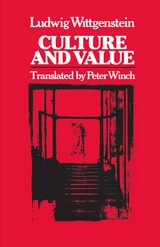
Culture and Value
Ludwig Wittgenstein
University of Chicago Press, 1980
Throughout his life, Ludwig Wittgenstein reliably set down his thoughts in notebooks. This volume offers a selection of the most interesting and important of the remarks from those notebooks that deal with matters other than technical philosophical issues. In these pages, Wittgenstein reflects on religion, the work of philosophy, genius, music, architecture, and much more. Peter Winch's translation of Wittgenstein's remarks on culture and value presents all entries chronologically, with the German text alongside the English and a subject index for reference.
Current Continental Theory and Modern Philosophy
Stephen Daniel
Northwestern University Press, 2006
What claims does the early modern period have on contemporary philosophy? How have recent theorists engaged this material, and why? In answer, some of these essays explore how major Continental theorists such as Derrida, Deleuze, Le Doeuff, Irigaray, Kristeva, and Althusser explicate the ideas of classical modern thinkers; others draw on recent Continental insights to examine the doctrines of modern philosophers beginning with Machiavelli and ending with Kant. Together they show how current Continental theory reinvigorates the study of the history of modern philosophers by transforming not only how we interpret their answers to certain questions, but also how we understand the very nature of these questions.
Cusanus Today
Thinking with Nicholas of Cusa Between Philosophy and TheologyDavid C. Albertson
Catholic University of America Press, 2024