Results by title
163 books match the query 'Homosexuality' and 13 start with c
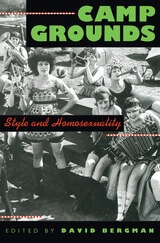
Camp Grounds
Style and HomosexualityEdited by David Bergman
University of Massachusetts Press, 1993
The concept of camp has never been easy to define. Derived from the French verb camper, “to pose,” it has been variously interpreted as a style that favors exaggeration, an ironic attitude toward the cultural mainstream, and a form of aestheticism that celebrates artifice over beauty. At the same time, camp has been long associated with homosexual culture, or at least with a self-conscious eroticism that questions traditional gender constructions.
The sixteen essays on camp included in this book explore further the relationship between style and homosexuality, showing how camp has made its way into every aspect of our cultural lives: theater, popular music, opera, film, and literature. Beginning with an overview of what camp is, where it came from, and how it operates, the chapter addresses topics ranging from the “high camp” of Whitman and Proust to the “low camp” of drag queen culture and gay fanzines. Together they carry forward a conversation that began more than twenty-five years ago, before Stonewall and AIDS, when Susan Sontag published her memorable “Notes on Camp.”
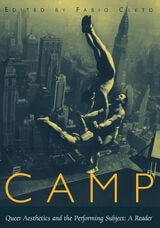
Camp
Queer Aesthetics and the Performing Subject--A ReaderFabio Cleto, Editor
University of Michigan Press, 1999
This groundbreaking collection addresses the multi-layered issue of camp, whose inexhaustible breadth of reference and theoretical relevance have made it one of the most salient and challenging issues on the contemporary critical stage. Reassessing the role and significance of the finest essays on camp written by leading intellectuals in cultural studies, lesbian and gay studies and queer theory, this critical anthology both "queers" camp as an issue and offers an excellent key to rethinking the history, theory, and practice of camp.
The anthology is divided into five thematic/historical sections: Tasting It; Flaunting the Closet; Gender, and Other Spectacles; Pop Camp, Surplus Counter-Value, or the Camp of Cultural Economy; and The Queer Issue. These groupings help the reader situate the critical debates around the subject. Fabio Cleto's introduction brings new theoretical insights to the subject of camp while tracing its history as an object of intellectual and cultural critique and analysis.
A comprehensive bibliography that traces the earliest use of the word 'camp' to the present completes this unique and exciting volume.
“Is ‘camp’ a kind of irony, an effect of one’s historic vantage point, an art form or an elitist aesthetic? … From landmark early works by Christopher Isherwood and Susan Sontag to influential contemporary pieces by Esther Newton, Andrew Ross and Judith Butler, this anthology encapsulates the philosophical discussion of this slippery postmodern concept.”
--Publishers Weekly
“As an object of critical inquiry, camp has proven notoriously difficult to define. Fabio Cleto takes this difficulty as his point of departure in the most recent anthology of a growing body of scholarly literature on the topic…Cleto resists defining camp [but] does not abandon the task of framing, in a coherent but flexible way, camp as a problematic.”
--Semiotica
“Fabio Cleto’s collection variously associates ‘camp’ with the 1960s, aestheticism, androgyny, cross-dressing, the cultural figure of the dandy, decadence, drag, exaggeration, kitsch, parody, pastiche, postmodernism, the sentimental, and the transvestite… The essayists in Camp disagree freely and fiercely over definitions. This is to be expected in a queer reader, one whose contributors endeavor to ‘read across’ the meanings of camp.”
--The Gay & Lesbian Review
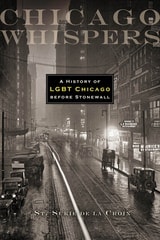
Chicago Whispers
A History of LGBT Chicago before StonewallSt. Sukie de la Croix; Foreword by John D’Emilio
University of Wisconsin Press, 2012
Chicago Whispers illuminates a colorful and vibrant record of lesbian, gay, bisexual, and transgendered people who lived and loved in Chicago from the city’s beginnings in the 1670s as a fur-trading post to the end of the 1960s. Journalist St. Sukie de la Croix, drawing on years of archival research and personal interviews, reclaims Chicago’s LGBT past that had been forgotten, suppressed, or overlooked.
Included here are Jane Addams, the pioneer of American social work; blues legend Ma Rainey, who recorded “Sissy Blues” in Chicago in 1926; commercial artist J. C. Leyendecker, who used his lover as the model for “The Arrow Collar Man” advertisements; and celebrated playwright Lorraine Hansberry, author of A Raisin in the Sun. Here, too, are accounts of vice dens during the Civil War and classy gentlemen’s clubs; the wild and gaudy First Ward Ball that was held annually from 1896 to 1908; gender-crossing performers in cabarets and at carnival sideshows; rights activists like Henry Gerber in the 1920s; authors of lesbian pulp novels and publishers of “physique magazines”; and evidence of thousands of nameless queer Chicagoans who worked as artists and musicians, in the factories, offices, and shops, at theaters and in hotels. Chicago Whispers offers a diverse collection of alternately hip and heart-wrenching accounts that crackle with vitality.
Christianity, Social Tolerance, and Homosexuality
Gay People in Western Europe from the Beginning of the Christian Era to the Fourteenth CenturyJohn Boswell
University of Chicago Press, 1981
John Boswell's National Book Award-winning study of the history of attitudes toward homosexuality in the early Christian West was a groundbreaking work that challenged preconceptions about the Church's past relationship to its gay members—among them priests, bishops, and even saints—when it was first published twenty-five years ago. The historical breadth of Boswell's research (from the Greeks to Aquinas) and the variety of sources consulted make this one of the most extensive treatments of any single aspect of Western social history. Christianity, Social Tolerance, and Homosexuality, still fiercely relevant today, helped form the disciplines of gay and gender studies, and it continues to illuminate the origins and operations of intolerance as a social force.
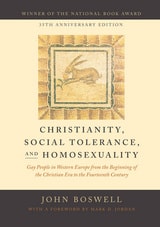
Christianity, Social Tolerance, and Homosexuality
Gay People in Western Europe from the Beginning of the Christian Era to the Fourteenth CenturyJohn Boswell
University of Chicago Press, 2015
John Boswell’s National Book Award–winning study of the history of attitudes toward homosexuality in the early Christian West was a groundbreaking work that challenged preconceptions about the Church’s past relationship to its gay members—among them priests, bishops, and even saints—when it was first published in 1980. The historical breadth of Boswell’s research (from the Greeks to Aquinas) and the variety of sources consulted make this one of the most extensive treatments of any single aspect of Western social history.
This edition offers a new foreword by leading queer and religious studies scholar Mark D. Jordan that reminds current readers, scholars, and students that Christianity, Social Tolerance, and Homosexuality is still fiercely relevant. This landmark book helped form the disciplines of gay and gender studies, and it continues to illuminate the origins and operations of intolerance as a social force.
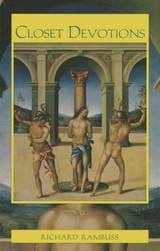
Closet Devotions
Richard Rambuss
Duke University Press, 1998
Through startling rereadings of works ranging from the devotional verse of the metaphysical poets (Donne, Herbert, Crashaw, and Traherne) to photographer Andres Serrano’s controversial “Piss Christ,” from Renaissance religious iconography to contemporary gay porn, Rambuss uncovers the highly charged erotic imagery that suffuses religious devotional art and literature. And he explores one of Christian culture’s most guarded (and literal) closets—the prayer closet itself, a privileged space where the vectors of same-sex desire can travel privately between the worshiper and his or her God.
Elegantly written and theoretically astute, Closet Devotions illuminates the ways in which sacred Christian devotion is homoeroticized, a phenomenon that until now has gone unexplored in current scholarship on religion, the body, and its passions. This book will attract readers across a wide array of disciplines, including gay and lesbian studies, literary theory and criticism, Renaissance studies, and religion.
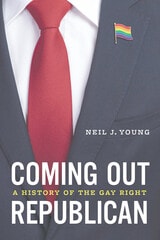
Coming Out Republican
A History of the Gay RightNeil J. Young
University of Chicago Press, 2024
One of the most maligned, misunderstood, and even mocked constituencies in American politics, gay Republicans regularly face condemnation from both the LGBTQ+ community and their own political party. Yet they’ve been active and influential for decades. Gay conservatives were instrumental, for example, in ending “Don’t Ask, Don’t Tell” and securing the legalization of same-sex marriage—but they also helped lay the groundwork for the rise of Donald Trump.
In Coming Out Republican, political historian and commentator Neil J. Young provides the first comprehensive history of the gay Right. From the 1950s up to the present day, Young excavates the multifarious origins, motivations, and evolutions of LGBTQ+ people who found their way to the institutions and networks of modern conservatism. Many on the gay Right have championed conservative values—like free markets, a strong national defense, and individual liberty—and believed that the Republican Party therefore offered LGBTQ+ people the best pathway to freedom. Meanwhile, that same party has actively and repeatedly demonized them. With his precise and provocative voice, Young details the complicated dynamics of being in—and yet never fully accepted into—the Republican Party.
Coming Out Republican provides striking insight into who LGBTQ+ conservatives are, what they want, and why many of them continue to align with a party whose rank and file largely seem to hate them. As the Republican Party renews its assaults on LGBTQ+ rights, understanding the significant history of the gay Right has never been more critical.
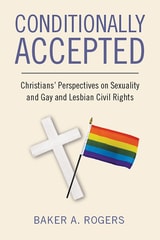
Conditionally Accepted
Christians' Perspectives on Sexuality and Gay and Lesbian Civil RightsBaker A. Rogers
Rutgers University Press, 2020
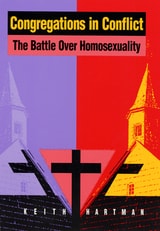
Congregations in Conflict
The Battle over HomosexualityHartman, Keith
Rutgers University Press, 1996
A Methodist church puts its minister on trial after he marches in a gay rights parade. A Quaker meeting struggles to decide whether to marry a lesbian couple. An entire congregation is thrown out of the Southern Baptist Convention for deciding that a gay divinity student had a sincere calling to the ministry, and an order of celibate monks comes out of the closet. An Episcopal priest blesses two same-sex relationships--then a closeted gay lawyer leads the charge to have him fired.
Homosexuality is the most divisive issue facing churches today. Like the issue of slavery 150 years ago, it is a matter that ignites passionate convictions on both sides, a matter that threatens to turn members of the same faith against each other, to divide congregations, and possibly even to fragment several denominations. Like slavery, it is an issue that calls up basic questions about what it means to be a Christian. How does one know right from wrong? Is the Bible fallible? Do good Christians always follow their church's teachings, or are they allowed to think for themselves on moral issues? And to what source does one finally look to determine what God really wants?
While many books have been written analyzing the scriptural and theological dimensions of the conflict, none has yet shown how it is being played out in the pews. Congregations in Conflict examines nine churches that were split by disagreements over gay and lesbian issues, and how the congregations resolved them.
Hartman explores in very readable prose how different denominations have handled their conflicts and what it says about the nature of their faith. He shows some churches coming through their struggles stronger and more unified, while others irrevocably split. Most importantly, he illuminates how people with a passionate clash of beliefs can still function together as a community of faith.
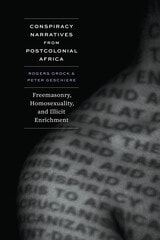
Conspiracy Narratives from Postcolonial Africa
Freemasonry, Homosexuality, and Illicit EnrichmentRogers Orock and Peter Geschiere
University of Chicago Press, 2024
In this book, anthropologists Rogers Orock and Peter Geschiere examine the moral panic over a perceived rise in homosexuality that engulfed Cameroon and Gabon beginning in the early twenty-first century. As they uncover the origins of the conspiratorial narratives that fed this obsession, they argue that the public’s fears were grounded in historically situated assumptions about the entanglement of same-sex practices, Freemasonry, and illicit enrichment.
This specific panic in postcolonial Central Africa fixated on high-ranking Masonic figures thought to lure younger men into sex in exchange for professional advancement. The authors’ thorough account shows how attacks on elites as homosexual predators corrupting the nation became a powerful outlet for mounting populist anger against the excesses and corruption of the national regimes. Unraveling these tensions, Orock and Geschiere present a genealogy of Freemasonry, taking readers from London through Paris to francophone Africa and revealing along the way how the colonial past shapes present-day anxieties linking same-sex practices to enrichment.
Courts Liberalism And Rights
Gay Law And Politics In The United States and CanadaJason Pierceson
Temple University Press, 2005
At a time when most gay and lesbian politics focuses only on the issue of gay marriage, Courts, Liberalism, and Rights guides readers through a nuanced discussion of liberalism, court rulings on sodomy laws and same-sex marriage, and the comparative progress gays and lesbians have made via the courts in Canada.
As debates continue about the ability of courts to affect social change, Jason Pierceson argues that this is possible. He claims that the greatest opportunity for reform via the judiciary exists when a judiciary with broad interpretive powers encounters a political culture that endorses a form of liberalism based on broadly conceived individual rights; not a negative set of rights to be held against the state, but a set of rights that recognizes the inherent dignity and worth of every individual.
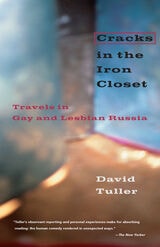
Cracks in the Iron Closet
Travels in Gay and Lesbian RussiaDavid Tuller
University of Chicago Press, 1997
"Tuller's observant reporting and personal experiences make for absorbing reading: the human comedy rendered in unexpected ways."—New Yorker
"Anyone who thinks San Francisco is the world capital of sexual polymorphism should read this book."—Adam Goodheart, Washington Post
"[This book is] is profoundly moving."—Jim Van Buskirk, San Francisco Chronicle
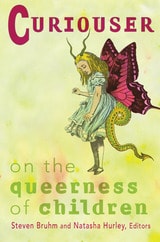
Curiouser
On The Queerness Of ChildrenSteven Bruhm
University of Minnesota Press, 2004
Classic essays and new work on the issue of childhood sexuality and its “queer resonances”
Our culture has a dominant narrative about children: they are (and should stay) innocent of sexual desires and intentions. At the same time, children are officially, tacitly, assumed to be heterosexual. Curiouser is a book about this narrative and what happens when it takes an unexpected, or queer, turn—when the stories of childhood must confront a child whose play does not conform to the ideal of child (a)sexuality.
The contributors to Curiouser examine the ostensibly simple representations of children that circulate through visual images, life narrative, children’s literature, film, and novels. At issue in these essays are the stories we tell to children, the stories we tell about children, and the stories we tell ourselves as children—stories that ultimately frame what is normative and what is queer. From the fiction of Horatio Alger, Henry James, Djuna Barnes, and Guy Davenport to the spectacles of Michael Jackson, Calvin Klein, and The Exorcist; from the narrative structure of pedophilia to evangelical Christianity; from punk tomboyism to queer girl-scouting: these scholars of childhood and sexuality scrutinize queer childhood energies in an impressive range of cultural forms. Contributors: Lauren Berlant, U of Chicago; Andre Furlani, Concordia U; Judith Halberstam, U of California, San Diego; Ellis Hanson, Cornell U; Paul Kelleher; Kathryn R. Kent, Williams College; James R. Kincaid, U of Southern California; Richard D. Mohr, U of Illinois, Urbana; Michael Moon, Johns Hopkins U; Kevin Ohi, Boston College; Eric Savoy, U of Montreal; Eve Kosofsky Sedgwick, CUNY Graduate Center; Kathryn Bond Stockton, U of Utah; Michael Warner, Rutgers U.