58 books match the query 'Identity (Psychology) in literature' and 4 start with c
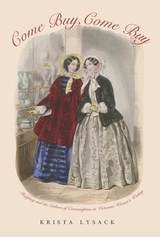
cover of Come Buy, Come Buy: Shopping and the Culture of Consumption in Victorian Women’s Writing

Come Buy, Come Buy

Shopping and the Culture of Consumption in Victorian Women’s Writing

Krista Lysack

Ohio University Press, 2008

From the 1860s through the early twentieth century, Great Britain saw the rise of the department store and the institutionalization of a gendered sphere of consumption. Come Buy, Come Buy considers representations of the female shopper in British women’s writing and demonstrates how women’s shopping practices are materialized as forms of narrative, poetic, and cultural inscription, showing how women writers emphasize consumerism as productive of pleasure rather than the condition of seduction or loss. Krista Lysack examines works by Christina Rossetti, Mary Elizabeth Braddon, George Eliot, and Michael Field, as well as the suffragette newspaper Votes for Women, in order to challenge the dominant construction of Victorian femininity as characterized by self-renunciation and the regulation of appetite.

Come Buy, Come Buy considers not only literary works, but also a variety of archival sources (shopping guides, women’s fashion magazines, household management guides, newspapers, and advertisements) and cultural practices (department store shopping, shoplifting and kleptomania, domestic economy, and suffragette shopkeeping). With this wealth of sources, Lysack traces a genealogy of the woman shopper from dissident domestic spender to aesthetic connoisseur, from curious shop-gazer to political radical.

[more]
cover of Conspicuous Bodies: Provincial Belief and the Making of Joyce and Rushdie

Conspicuous Bodies

Provincial Belief and the Making of Joyce and Rushdie

Jean Kane

The Ohio State University Press, 2014

In Conspicuous Bodies: Provincial Belief and the Making of Joyce and Rushdie, Jean Kane re-examines the literature of James Joyce and Salman Rushdie from a post-secularist perspective, arguing that their respective religions hold critical importance in their works. Though Joyce and Rushdie were initially received as cosmopolitans, both authors subsequently reframed their public images and aligned themselves instead with a provincial religious identity, which emphasized the interconnections between religious devotion and embodiment. At the same time, both Joyce and Rushdie managed to resist the doctrinal content of their religions.
 
Conspicuous Bodies presents Joyce as a founder and Rushdie as an inheritor of a distinctive discourse of belief about the importance of physical bodies and knowledge in religious practice. In doing so, it moves the reception of Joyce and Rushdie away from what previous critics have emphasized—away from questions of aesthetics and from  a narrow understanding of belief—and instead questions the assumption that belief should be segregated from matters of physicality and knowledge. Kane reintroduces the concept of spiritual embodiment in order to expand our understanding of what counts as spiritual agency in non-western and minority literatures.
[more]
cover of Creating Identity in the Victorian Fictional Autobiography

Creating Identity in the Victorian Fictional Autobiography

Heidi L. Pennington

University of Missouri Press, 2018

This is the first book-length study of the fictional autobiography, a subgenre that is at once widely recognizable and rarely examined as a literary form with its own history and dynamics of interpretation. Heidi L. Pennington shows that the narrative form and genre expectations associated with the fictional autobiography in the Victorian period engages readers in a sustained meditation on the fictional processes that construct selfhood both in and beyond the text. Through close readings of Jane Eyre, David Copperfield, and other well-known examples of the subgenre, Pennington shows how the Victorian fictional autobiography subtly but persistently illustrates that all identities are fictions.

Despite the subgenre’s radical implications regarding the nature of personal identity, fictional autobiographies were popular in their own time and continue to inspire devotion in readers. This study sheds new light on what makes this subgenre so compelling, up to and including in the present historical moment of precipitous social and technological change. As we continue to grapple with the existential question of what determines “who we really are,” this book explores the risks and rewards of embracing conscious acts of fictional self-production in an unstable world.
[more]
cover of Crossing Cultures: Creating Identity in Chinese and Jewish American Literature

Crossing Cultures

Creating Identity in Chinese and Jewish American Literature

Judith Oster

University of Missouri Press, 2003

In this important new study, Judith Oster looks at the literature of Chinese Americans and Jewish Americans in relation to each other. Examining what is most at issue for both groups as they live between two cultures, languages, and environments, Oster focuses on the struggles of protagonists to form identities that are necessarily bicultural and always in process. Recognizing what poststructuralism has demonstrated regarding the instability of the subject and the impossibility of a unitary identity, Oster contends that the writers of these works are attempting to shore up the fragments, to construct, through their texts, some sort of wholeness and to answer at least partially the questions Who am I? and Where do I belong?
            Oster also examines the relationship of the reader to these texts. When encountering texts written by and about “others,” readers enter a world different from their own, only to find that the book has become mirrorlike, reflecting aspects of themselves: they encounter identity struggles that are familiar but writ large, more dramatic, and set in alien environments.
            Among the figures Oster considers are writers of autobiographical works like Maxine Hong Kingston and Eva Hoffman and writers of fiction: Amy Tan, Anzia Yezierska, Henry Roth, Philip Roth, Cynthia Ozick, Lan Samantha Chang, and Frank Chin. In explicating their work, Oster uses Lacan’s idea of the “mirror stage,” research in language acquisition and bilingualism, the reader-response theories of Iser and Wimmers, and the identity theories of Charles Taylor, Emile Benveniste, and others.
            Oster provides detailed analyses of mirrors and doubling in bicultural texts; the relationships between language and identity and between language and culture; and code-switching and interlanguage (English expressed in a foreign syntax). She discusses food and hunger as metaphors that express the urgent need to hear and tell stories on the part of those forging a bicultural identity. She also shows how American schooling can undermine the home culture’s deepest values, exacerbating children’s conflicts within their families and within themselves. In a chapter on theories of autobiography, Oster looks at the act of writing and how the page becomes a home that bicultural writers create for themselves. Written in an engaging, readable style, this is a valuable contribution to the field of multicultural literary criticism.
[more]