Results by title
84 books match the query 'In motion pictures' and 7 start with c
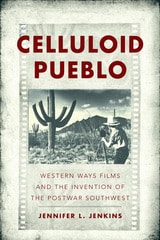
Celluloid Pueblo
Western Ways Films and the Invention of the Postwar SouthwestJennifer L. Jenkins
University of Arizona Press, 2016
Celluloid Pueblo tells the story of Western Ways Features and its role in the invention of the Southwest of the imagination. Active during a thirty-year period of profound growth and transformation, the Herberts created a dynamic visual record of the region, and their archival films now serve as a time capsule of the Sunbelt in the mid-twentieth century. Drawing upon a ten-year career with Fox, Western Ways owner-operator Charles Herbert brought a newshound’s sensibility and acute skill at in-camera editing to his southwestern subjects. The Western Ways films provided counternarratives to Hollywood representations of the West and established the regional identity of Tucson and the borderlands.
Jennifer L. Jenkins’s broad-sweeping book examines the Herberts’ work on some of the first sound films in the Arizona borderlands and their ongoing promotion of the Southwest. The book covers the filmic representation of Native and Mexican lifeways, Anglo ranching and leisure, Mexican missions and tourism, and postwar borderlands prosperity and progressivism. The story of Western Ways closely follows the boom-and-bust arc of the midcentury Southwest and the constantly evolving representations of an exotic—but safe and domesticated—frontier.
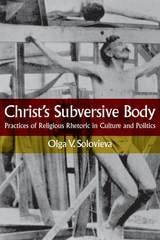
Christ's Subversive Body
Practices of Religious Rhetoric in Culture and PoliticsOlga V. Solovieva; Foreword by Haun Saussy
Northwestern University Press, 2018
Solovieva’s survey includes the iconoclastic polemics of Epiphanius at the moment of struggles for supremacy between the Roman state and the Christian church, the mystical theologico-political alchemy of an anonymous treatise circulated at the Council of Constance, Lavater’s counter-Enlightenment visions of the afterlife expressd through physiognomy, Dostoevsky’s refashioning of ethical communities, Pier Paolo Pasolini’s attempts to provoke the “scandal” of Jesus’s mission once more in the modern world, and the elaboration of a political theology subordinating democratic dissent to the higher unity of a corporately conceived “unitary executive” in early twenty-first-century America.
Solovieva presents her findings not as an entry into theological or Christological debates but rather as a study in comparative discourse analysis. She demonstrates how these uses of Christ’s body are triggered by moments of epistemological, political, and representational crisis in the history of Western civilization.
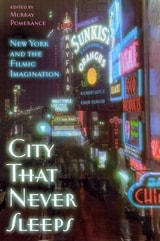
City That Never Sleeps
New York and the Filmic ImaginationPomerance, Murray
Rutgers University Press, 2007
The glittering skyscrapers of such films as On the Town have shadowed the characteristic seedy streets in which desperate, passionate stories have played out-as in Scandal Sheet and The Pawnbroker. In other films, the city is a cauldron of bright lights, technology, empire, egotism, fear, hunger, and change--the scenic epitome of America in the modern age.
From Street Scene and Breakfast at Tiffany's to Rosemary's Baby, The Warriors, and 25th Hour, the sixteen essays in this book explore the cinematic representation of New York as a city of experience, as a locus of ideographic characters and spaces, as a city of moves and traps, and as a site of allurement and danger. Contributors consider the work of Woody Allen, Blake Edwards, Alfred Hitchcock, Gregory La Cava, Spike Lee, Sidney Lumet, Vincente Minnelli, Roman Polanski, Martin Scorsese, Andy Warhol, and numerous others.
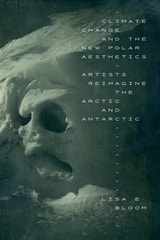
Climate Change and the New Polar Aesthetics
Artists Reimagine the Arctic and AntarcticLisa E. Bloom
Duke University Press, 2022
Close Encounters between Bible and Film
An Interdisciplinary EngagementLaura Copier
SBL Press, 2016
Explore new routes into the burgeoning field of biblical literature and film theory
The present collection of essays is a sequel to the groundbreaking Semeia 74 issue, published in 1996, entitled Biblical Glamour and Hollywood Glitz. These new essays showcase the divergent approaches from film studies and cultural studies that can be used in the visual analysis of biblical and religious themes, narratives, and characters in cinema. It is the first volume that specifically addresses issues of methodology, theory, and analysis in the study between bible and film. As such, this collection is of interest to scholars in film studies and theology/religion/biblical studies, who are invested in doing interdisciplinary research in the expanding field of religion and film.
Features
- Specific focus on methods of film analysis, rather than the more common focus on thematic analysis in the study of religion, Bible, and film.
- Visual analysis in the encounter between Bible and film
- Fourteen essays and an introduction by top scholars in the field
Colonial Itineraries of Contemporary Mexico
Literary and Cultural InquiriesEdited by Oswaldo Estrada and Anna M. Nogar
University of Arizona Press, 2014
Through a transformative interdisciplinary lens, this book studies the ultra-contemporary chronicles of Carlos Monsiváis, the poetry of Carmen Boullosa and Luis Felipe Fabre, and the novels of Enrique Serna, Héctor de Mauleón, Mónica Lavín, and Pablo Soler Frost, among others. The book also pays close attention to a good sample of recent children’s literature that revisit Mexico’s colonia. It includes the transatlantic perspective of Spanish novelist Inma Chacón, and a detailed analysis of the strategies employed by Laura Esquivel in the creation of a best seller. Other chapters are devoted to the study of transnational film productions, a play by Flavio González Mello, and a set of novels set in the nineteenth-century colonia that problematize static notions of both personal and national identity within specific cultural palimpsests. Taken together, these incisive readings open broader conversations about Mexican coloniality as it continues well into the twenty-first century.
Crime Fiction and Film in the Southwest
Bad Boys and Bad Girls in the BadlandsEdited by Steve Glassman and Maurice O'Sullivan
University of Wisconsin Press, 2001
When Joe Leaphorn and Jim Chee, Tony Hillerman’s oddly matched tribal police officers, patrol the mesas and canyons of their Navajo reservation, they join a rich traditon of Southwestern detectives. In Crime Fiction and Film in the Southwest, a group of literary critics tracks the mystery and crime novel from the Painted Desert to Death Valley and Salt Lake City. In addition, the book includes the first comprehensive bibliography of mysteries set in the Southwest and a chapter on Southwest film noir from Humphrey Bogart’s tough hood in The Petrified Forest to Russell Crowe’s hard-nosed cop in L.A. Confidential.