Results by title
358 books match the query 'Labor & Industrial Relations' and 23 start with c
Care Activism
Migrant Domestic Workers, Movement-Building, and Communities of CareEthel Tungohan
University of Illinois Press, 2023
Catholic Labor Movements in Europe
Paul Misner
Catholic University of America Press, 2015
Chicago in the Age of Capital
Class, Politics, and Democracy during the Civil War and ReconstructionJohn B. Jentz and Richard Schneirov
University of Illinois Press, 2015
Chinese in the Woods
Logging and Lumbering in the American WestSue Fawn Chung
University of Illinois Press, 2015
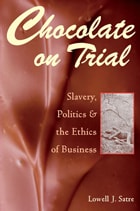
Chocolate on Trial
Slavery, Politics, and the Ethics of BusinessLowell J. Satre
Ohio University Press, 2005
Chocolate on Trial: Cadbury, Slavery and the Economics of Virtue in Imperial Britain gives a lively and highly readable account of the events surrounding the libel trial in which Cadbury Bros. Ltd. sued the London Standard, following the newspaper's accusation that the firm was hypocritical in its use of slave-grown cocoa. As compelling now as at the turn of the previous century, the issues probed by Lowell J. Satre give invaluable historical background to contemporary issues of business ethics, corporate social responsibility, and globalization. The story Satre tells illuminates what a stubbornly persistent institution slavery was and shows how Cadbury, a company with a well-regarded brand name and logo, endured ethical dilemmas and challenges to its record for social responsibility. Chocolate on Trial brings to life the age-old conflict between economic interests and the value of human life.
Satre illuminates the stubborn persistence of the institution of slavery and shows how Cadbury, a company with a well-regarded brand name from the nineteenth century, faced ethical dilemmas and challenges to its record for social responsibility. Chocolate on Trial brings to life the age-old conflict between economic interests and regard for the dignity of human life.

Circus World
Roustabouts, Animals, and the Work of Putting on the Big ShowAndrea Ringer
University of Illinois Press, 2024
Andrea Ringer examines the industry-wide circus world--the collection of shows that traveled by rail, wagon, steamboat, and car--and the traditional and nontraditional laborers who created it. Performers and their onstage labor played an integral part in the popularity of the circus. But behind the scenes, other laborers performed the endless menial tasks that kept the show on the road. Circus operators regulated employee behavior both inside and outside the tent even as the employees themselves blurred the line between leisure and labor until, in all parts of the show, the workers could not escape their work.
Illuminating and vivid, Circus World delves into the gender, class, and even species concerns within an extinct way of life.
Civic Labors
Scholar Activism and Working-Class StudiesEdited by Dennis Deslippe, Eric Fure-Slocum, and John W. McKerley
University of Illinois Press, 2016
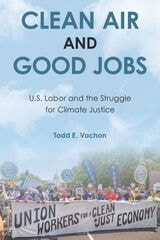
Clean Air and Good Jobs
U.S. Labor and the Struggle for Climate JusticeTodd E. Vachon
Temple University Press, 2023
The labor–climate movement in the U.S. laid the groundwork for the Green New Deal by building a base within labor for supporting climate protection as a vehicle for good jobs. But as we confront the climate crisis and seek environmental justice, a “jobs vs. environment” discourse often pits workers against climate activists. How can we make a “just transition” moving away from fossil fuels, while also compensating for the human cost when jobs are lost or displaced?
In his timely book, Clean Air and Good Jobs, Todd Vachon examines the labor–climate movement and demonstrates what can be envisioned and accomplished when climate justice is on labor’s agenda and unions work together with other social movements to formulate bold solutions to the climate crisis. Vachon profiles the workers and union leaders who have been waging a slow, but steadily growing revolution within their unions to make labor as a whole an active and progressive champion for both workers and the environment.
Clean Air and Good Jobs examines the “movement within the movement” offering useful solutions to the dual crises of climate and inequality.
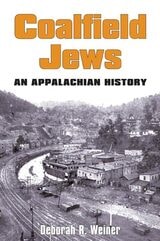
Coalfield Jews
An Appalachian HistoryDeborah R. Weiner
University of Illinois Press, 2006
The stories of vibrant eastern European Jewish communities in the Appalachian coalfields
Coalfield Jews explores the intersection of two simultaneous historic events: central Appalachia’s transformative coal boom (1880s-1920), and the mass migration of eastern European Jews to America. Traveling to southern West Virginia, eastern Kentucky, and southwestern Virginia to investigate the coal boom’s opportunities, some Jewish immigrants found success as retailers and established numerous small but flourishing Jewish communities.
Deborah R. Weiner’s Coalfield Jews provides the first extended study of Jews in Appalachia, exploring where they settled, how they made their place within a surprisingly receptive dominant culture, how they competed with coal company stores, interacted with their non-Jewish neighbors, and maintained a strong Jewish identity deep in the heart of the Appalachian mountains. To tell this story, Weiner draws on a wide range of primary sources in social, cultural, religious, labor, economic, and regional history. She also includes moving personal statements, from oral histories as well as archival sources, to create a holistic portrayal of Jewish life that will challenge commonly held views of Appalachia as well as the American Jewish experience.
Colonialism in the Congo Basin, 1880–1940
Samuel H. Nelson
Ohio University Press, 1993
Commonwealth of Toil
Chapters in the History of Massachusetts Workers and Their UnionsThomas Juravich
University of Massachusetts Press, 1996
Over the past two centuries, Massachusetts workers have fought for many important advances that would later be enjoyed by other Americans. The right to organize, restrictions on work hours and child labor, and workers' compensation were all pioneered in the Commonwealth. From the 1825 strike of Boston carpenters for a ten-hour day to recent victories in hospitals and universities, Massachusetts workers and their unions have been in the forefront of the battle for dignity and justice.
This book tells their story. In eighteen chapters, beginning with the first industrial workers in the nation—the Lowell “mill girls”—the authors describe the struggles of working men and women to improve their lives. In the process, the book provides a valuable perspective on the development of the American labor movement.
Communities of Ludlow
Collaborative Stewardship and the Ludlow Centennial Commemoration CommissionFawn-Amber Montoya
University Press of Colorado, 2021
The history of the Ludlow Massacre encompasses the stories of immigrant groups, women, the working-class, and people of color as much as the story of that tragedy, and the continued relevance of these issues creates a need for remembrance and discussion of how to make the events of the Ludlow Massacre available to contemporary society. The book outlines recent efforts to remember and commemorate this important historical event, documenting the unique collaborations in public scholarship and outreach among the diverse group of people involved in marking the 100-year anniversary of the Ludlow Massacre. The chapters relate the tales of the stewards of the Ludlow Massacre—the various communities that rallied together to keep this history alive and show its relevance, including lineal descendants, members of the United Mine Workers of America, historians, archaeologists, scholars, artists, interpreters, authors, playwrights, and politicians. The book also offers tips, strategies, and cautionary tales for practicing engaged public scholarship.
The history of the Ludlow Massacre has been told as a tragedy of striking miners in the West that occurred during a turbulent time in US labor relations, but it is so much more than that. Communities of Ludlow explores the intersections of public scholarship, advocacy, and personal experience, weaving these perspectives together with models for practicing public scholarship to illustrate the power of creating spaces for sharing ideas and information in an environment that encourages creativity, open dialogue, public outreach, political action, and alternative narratives.
Contributors: Robert Butero, Robin Henry, Michael Jacobson, Elizabeth Jameson, Linda Linville, Matthew Maher, Yolanda Romero
Community in Conflict
A Working-class History of the 1913-14 Michigan Copper Strike and the Italian Hall TragedyGary Kaunonen
Michigan State University Press, 2013
A mirror of great changes that were occurring on the national labor rights scene, the 1913–14 Michigan Copper Strike was a time of unprecedented social upheaval in Michigan’s Upper Peninsula. With organized labor taking an aggressive stance against the excesses of unfettered capitalism, the stage was set for a major struggle between labor and management. The Michigan Copper Strike received national attention and garnered the support of luminaries in organized labor like Mother Jones, John Mitchell, Clarence Darrow, and Charles Moyer. The hope of victory was overshadowed, however, by violent incidents like the shooting of striking workers and their family members, and the bitterness of a community divided. No other event came to symbolize or memorialize the strike more than the Italian Hall tragedy, in which dozens of workers and working-class children died. In Community in Conflict, the efforts of working people to gain a voice on the job and in their community through their unions, and the efforts of employers to crush those unions, take center stage. Previously untapped historical sources such as labor spy reports, union newspapers, coded messages, and artifacts shine new light on this epic, and ultimately tragic, period in American labor history.
Confronting American Labor
The New Left DilemmaJeffrey W. Coker
University of Missouri Press, 2002

Consensual Policy-making in the Nordic World
Peter Munk Christiansen
University of Wisconsin Press, 2023
The preconditions for these policies are strong civil societies, that is, strong capacities for collective mobilization and collective action among groups, relatively strong unitary states, and high levels of generalized trust. The institutional apparatus of these consensual policies has been labeled corporatism. Scandinavian corporatism has implied consent to a norm of affected interests. Groups that are supposedly affected by state policies have access to the processes leading up to political decision-making and are involved in the implementation of policies. This access often has public commissions or committees charged with preparing political decisions and delivering advice, as well as policy implementation committees.
Corporatist and consensual policymaking come at a price. The exchange between interest groups (in pursuit of policy influence) and state actors (in pursuit of information and political support from groups) tends to be time-consuming and confined to solutions that are accepted by all actors. Corporatist policies are consequently not very conducive to more radical reforms. After the heyday of corporatist policymaking in the 1970s, all the Scandinavian countries have loosened their corporatist structures to pave the way for reforms.

Conservative Counterrevolution
Challenging Liberalism in 1950s MilwaukeeTula A. Connell
University of Illinois Press, 2016

Consuming Work
Youth Labor in AmericaYasemin Besen-Cassino
Temple University Press, 2014
Contested Communities
Class, Gender, and Politics in Chile’s El Teniente Copper Mine, 1904-1951Thomas Miller Klubock
Duke University Press, 1998
Klubock shows how a militant working-class community was established through the interplay between capitalist development, state formation, and the ideologies of gender. In describing how the North American copper company attempted to reconfigure and reform the work and social-cultural lives of men and women who migrated to the mine, Klubock demonstrates how struggles between labor and capital took place on a gendered field of power and reconstituted social constructions of masculinity and femininity. As a result, Contested Communities describes more accurately than any previous study the nature of grassroots labor militancy, working-class culture, and everyday politics of gender relations during crucial years of the Chilean Popular Front in the 1930s and 1940s.
Contested and Dangerous Seas
North Atlantic Fishermen, Their Wives, Unions, and the Politics of ExclusionColin J. Davis
University of Massachusetts Press, 2019
During the 1960s and 1970s, these seafaring workers experienced new hardships. As modern fleets from many nations intensified their hunt for fish, they found themselves in increasing competition for disappearing prey. Colin J. Davis details the unfolding drama as New England and British fishermen and their wives, partners, and families reacted to this competition. Rather than acting as bystanders to these crises, the men and women chronicled in Contested and Dangerous Seas became fierce advocates for the health of the Atlantic Ocean fisheries and for their families' livelihoods.
Contingent Faculty and the Remaking of Higher Education
A Labor HistoryEdited by Eric Fure-Slocum and Claire Goldstene
University of Illinois Press, 2024
In the United States today, almost three-quarters of the people teaching in two- and four-year colleges and universities work as contingent faculty. They share the hardships endemic in the gig economy: lack of job security and health care, professional disrespect, and poverty wages that require them to juggle multiple jobs.
This collection draws on a wide range of perspectives to examine the realities of the contingent faculty system through the lens of labor history. Essayists investigate structural changes that have caused the use of contingent faculty to skyrocket and illuminate how precarity shapes day-to-day experiences in the academic workplace. Other essays delve into the ways contingent faculty engage in collective action and other means to resist austerity measures, improve their working conditions, and instigate reforms in higher education. By challenging contingency, this volume issues a clear call to reclaim higher education’s public purpose.
Interdisciplinary in approach and multifaceted in perspective, Contingent Faculty and the Remaking of Higher Education surveys the adjunct system and its costs.
Contributors: Gwendolyn Alker, Diane Angell, Joe Berry, Sue Doe, Eric Fure-Slocum, Claire Goldstene, Trevor Griffey, Erin Hatton, William A. Herbert, Elizabeth Hohl, Miguel Juárez, Aimee Loiselle, Maria C. Maisto, Anne McLeer, Steven Parfitt, Jiyoon Park, Claire Raymond, Gary Rhoades, Jeff Schuhrke, Elizabeth Tandy Shermer, Steven Shulman, Joseph van der Naald, Anne Wiegard, Naomi R Williams, and Helena Worthen
Created Unequal
The Crisis in American PayJames K. Galbraith
University of Chicago Press, 2000
"Created Unequal is not light reading, but Galbraith's elegant arguments, passionate exposition, and profound conclusions make it worth the trouble. . . . [Galbraith] remind[s] us that the economy is and ought to be run by humans, not humans by the economy."—Joanna Ciulla, Los Angeles Times Book Review
"Created Unequal is a lucid and wise explanation of why America seems to be prospering while most Americans aren't. James Galbraith takes steady aim at a variety of widely accepted economic myths and hits most of them dead center. This book will tell you a lot about the way your economic world really works."—Jeff Faux, President of the Economic Policy Institute
"[A] brilliant and iconoclastic examination of the major social trend of our time."—Michael Lind, Washington Monthly
Crippled Justice
The History of Modern Disability Policy in the WorkplaceRuth O'Brien
University of Chicago Press, 2001
O'Brien shows how the remnants of postwar cultural values bogged down the rights-oriented policy in the 1970s and how they continue to permeate judicial interpretations of provisions under the Americans with Disabilities Act. In effect, O'Brien argues, these decisions have created a lose/lose situation for the very people the act was meant to protect. Covering developments up to the present, Crippled Justice is an eye-opening story of government officials and influential experts, and how our legislative and judicial institutions have responded to them.
Cutover Capitalism
The Industrialization of the Northern ForestJason L. Newton
West Virginia University Press, 2024
2024 George Perkins Marsh Prize Runner-up
What happened to the loggers of America’s past when lumbermen moved west and south in the late nineteenth and early twentieth centuries? How did these communities continue to create value and meaning in these marginal lands? Cutover Capitalism: The Industrialization of the Northern Forest provides a new perspective on the process of industrialization in America through the study of rural workers in a cutover landscape.
Back when resources started running scarce, the environment of the forest and bodies of workers became the natural resources from which mills and landowners extracted. Bodies and cutover landscapes were mobilized in new ways to increase the scale and efficiency of production—a brutal process for workers, human and animal alike. In the Northern Forest, an industrial working class formed in relation to the unique ways that workers' bodies were used to produce value and in relation to the seasonal cycles of the forest environment.
Cutover Capitalism is an innovative historical study that combines methodological approaches from labor history, environmental history, and the new history of capitalism. The book tells a character-driven yet theoretically sophisticated story about what it was like to live through this process of industrialization.