169 books match the query 'Land' and 6 start with c
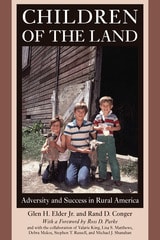
cover of Children of the Land: Adversity and Success in Rural America

Children of the Land

Adversity and Success in Rural America

Glen H. Elder Jr. and Rand D. Conger

University of Chicago Press, 2000

A century ago, most Americans had ties to the land. Now only one in fifty is engaged in farming and little more than a fourth live in rural communities. Though not new, this exodus from the land represents one of the great social movements of our age and is also symptomatic of an unparalleled transformation of our society.

In Children of the Land, the authors ask whether traditional observations about farm families—strong intergenerational ties, productive roles for youth in work and social leadership, dedicated parents and a network of positive engagement in church, school, and community life—apply to three hundred Iowa children who have grown up with some tie to the land. The answer, as this study shows, is a resounding yes. In spite of the hardships they faced during the agricultural crisis of the 1980s, these children, whose lives we follow from the seventh grade to after high school graduation, proved to be remarkably successful, both academically and socially.

A moving testament to the distinctly positive lifestyle of Iowa families with connections to the land, this uplifting book also suggests important routes to success for youths in other high risk settings.
[more]
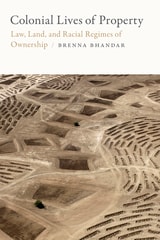
cover of Colonial Lives of Property: Law, Land, and Racial Regimes of Ownership

Colonial Lives of Property

Law, Land, and Racial Regimes of Ownership

Brenna Bhandar

Duke University Press, 2018
In Colonial Lives of Property Brenna Bhandar examines how modern property law contributes to the formation of racial subjects in settler colonies and to the development of racial capitalism. Examining both historical cases and ongoing processes of settler colonialism in Canada, Australia, and Israel and Palestine, Bhandar shows how the colonial appropriation of indigenous lands depends upon ideologies of European racial superiority as well as upon legal narratives that equate civilized life with English concepts of property. In this way, property law legitimates and rationalizes settler colonial practices while it racializes those deemed unfit to own property. The solution to these enduring racial and economic inequities, Bhandar demonstrates, requires developing a new political imaginary of property in which freedom is connected to shared practices of use and community rather than individual possession.
[more]
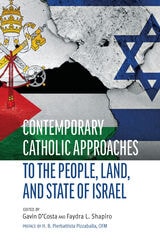
cover of Contemporary Catholic Approaches to the People, State, and Land of Israel

Contemporary Catholic Approaches to the People, State, and Land of Israel

Gavin D'Costa

Catholic University of America Press, 2021
After Vatican II, the Roman Catholic Church began a process of stripping away anti-Jewish sentiments within its theological culture. One question that has arisen and received very scant attention regards the theological significance of the founding of the state of Israel in 1948 – and the attendant nakba, the plight of the Palestinian people. Some American evangelical Christians have developed a theology around the state of Israel, associating themselves with Zionism. Some Christian groups have developed a theology around the suffering of the Palestinian people and demand resistance to Zionism. This unique collection of essays from leading Catholic theologians from the United States, Germany, France, Italy, Switzerland, England, and the Middle East reflect on the theological status of the land of Israel. These essays represent an exhaustive range of views. None avoid the new Catholic theology regarding the Jewish people. Some contributors see this as leading towards a positive theological affirmation of the state of Israel, while distancing themselves from Christian Zionists. All contributors are committed to rights of the Palestinian people. Some affirm the need for strong diplomatic and political support for Israel along with equal support for Palestinians, arguing that this is as far as the Church can go. Others argue that the Church’s emerging theology represents the guilt conscience of Europe at the cost of the Palestinian people. None deny the right of Jews to live in the land. Two Jewish scholars respond to the essays creating an atmosphere of genuine interfaith dialogue which serves Catholics to think further through these issues.
[more]
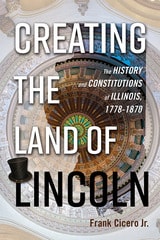
cover of Creating the Land of Lincoln: The History and Constitutions of Illinois, 1778-1870

Creating the Land of Lincoln

The History and Constitutions of Illinois, 1778-1870

Frank Cicero Jr.

University of Illinois Press, 2018
In its early days, Illinois seemed destined to extend the American South. Its population of transplants lived an upland southern culture and in some cases owned slaves. Yet the nineteenth century and three constitutions recast Illinois as a crucible of northern strength and American progress. Frank Cicero Jr. provides an appealing new history of Illinois as expressed by the state's constitutions—and the lively conventions that led to each one. In Creating the Land of Lincoln, Cicero sheds light on the vital debates of delegates who, freed from electoral necessity, revealed the opinions, prejudices, sentiments, and dreams of Illinoisans at critical junctures in state history. Cicero simultaneously analyzes decisions large and small that fostered momentous social and political changes. The addition of northern land in the 1818 constitution, for instance, opened up the state to immigrant populations that reoriented Illinois to the north. Legislative abuses and rancor over free blacks influenced the 1848 document and the subsequent rise of a Republican Party that gave the nation Abraham Lincoln as its president. Cicero concludes with the 1870 constitution, revealing how its dialogues and resolutions set the state on the modern course that still endures today.
[more]
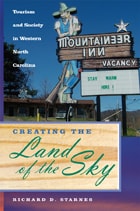
cover of Creating the Land of the Sky: Tourism and Society in Western North Carolina

Creating the Land of the Sky

Tourism and Society in Western North Carolina

Richard D. Starnes

University of Alabama Press, 2005

A sophisticated inquiry into tourism's social and economic power across the South.

In the early 19th century, planter families from South Carolina, Georgia, and eastern North Carolina left their low-country estates during the summer to relocate their households to vacation homes in the mountains of western North Carolina. Those unable to afford the expense of a second home relaxed at the hotels that emerged to meet their needs. This early tourist activity set the stage for tourism to become the region's New South industry. After 1865, the development of railroads and the bugeoning consumer culture led to the expansion of tourism across the whole region.

Richard Starnes argues that western North Carolina benefited from the romanticized image of Appalachia in the post-Civil War American consciousness. This image transformed the southern highlands into an exotic travel destination, a place where both climate and culture offered visitors a myriad of diversions. This depiction was futher bolstered by partnerships between state and federal agencies, local boosters, and outside developers to create the atrtactions necessary to lure tourists to the region.

As tourism grew, so did the tension between leaders in the industry and local residents. The commodification of regional culture, low-wage tourism jobs, inflated land prices, and negative personal experiences bred no small degree of animosity among mountain residents toward visitors. Starnes's study provides a better understanding of the significant role that tourism played in shaping communities across the South.

[more]
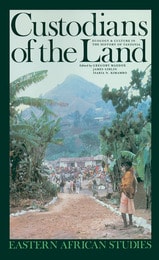
cover of Custodians of the Land: Ecology and Culture in the History of Tanzania

Custodians of the Land

Ecology and Culture in the History of Tanzania

Gregory H. Maddox

Ohio University Press, 1995

Farming and pastoral societies inhabit ever-changing environments. This relationship between environment and rural culture, politics and economy in Tanzania is the subject of this volume which will be valuable in reopening debates on Tanzanian history.

In his conclusion, Isaria N. Kimambo, a founding father of Tanzanian history, reflects on the efforts of successive historians to strike a balance between external causes of change and local initiative in their interpretations of Tanzanian history.

He shows that nationalist and Marxist historians of Tanzanian history, understandably preoccupied through the first quarter-century of the country's post-colonial history with the impact of imperialism and capitalism on East Africa, tended to overlook the initiatives taken by rural societies to transform themselves.

Yet there is good reason for historians to think about the causes of change and innovation in the rural communities of Tanzania, because farming and pastoral people have constantly changed as they adjusted to shifting environmental conditions.

[more]