Results by title
71 books match the query 'Language and culture' and 7 start with c
Changing the Subject in English Class
Discourse and the Constructions of DesiresMarshall W. Alcorn Jr.
Southern Illinois University Press, 2002
Drawing on the theoretical work of Jacques Lacan, Marshall W. Alcorn Jr. formulates a systematic explanation of the function and value of desire in writing instruction.
Alcorn argues that in changing the subject matter of writing instruction in order to change student opinions, composition instructors have come to adopt an insufficiently complex understanding of subjectivity. This oversimplification hinders attempts to foster cultural change. Alcorn proposes an alternative mode of instruction that makes effective use of students’ knowledge and desire. The resulting freedom in expression—personal as well as political—engenders the recognition, circulation, and elaboration of desire necessary for both human communication and effective politics.
Responding to James Berlin’s reconception of praxis in the classroom, Theresa Ebert’s espousal of disciplined instructions, and Lester Faigley’s introduction of a postmodern theory of subjectivity, Alcorn follows both Lacan and Slavoj Žižek in insisting desire be given free voice and serious recognition. In composition as in politics, desire is the ground of agency. Competing expressions of desire should generate a dialectic in social-epistemic discourse that encourages enlightenment over cynicism and social development over authoritarian demands.
With clarity and personal voice, Alcorn explains how discourse is rooted in primitive psychological functions of desire and responds to complex cultural needs. In its theoretical scope this book describes a new pedagogy that links thought to emotion and the personal to the social.
Cicero, Catullus, and the Language of Social Performance
Brian A. Krostenko
University of Chicago Press, 2001
As Krostenko demonstrates, a key feature of this language is its capacity to express both approval and disdain—an artifact of its origins at a time when the "style" and "charm" of imported Greek cultural practices were greeted with both enthusiasm and hostility. Cicero played on that ambiguity, for example, by chastising lepidus ("fine") boys in the "Second Oration against Catiline" as degenerates, then arguing in his De Oratore that the successful speaker must have a certain charming lepos ("wit"). Catullus, in turn, exploited and inverted the political subtexts of this language for innovative poetic and erotic idioms.
Color and Cognition in Mesoamerica
Constructing Categories as VantagesBy Robert E. MacLaury
University of Texas Press, 1996
More than 100 indigenous languages are spoken in Mexico and Central America. Each language partitions the color spectrum according to a pattern that is unique in some way. But every local system of color categories also shares characteristics with the systems of other Mesoamerican languages and of languages elsewhere in the world.
This book presents the results of the Mesoamerican Color Survey, which Robert E. MacLaury conducted in 1978-1981. Drawn from interviews with 900 speakers of some 116 Mesoamerican languages, the book provides a sweeping overview of the organization and semantics of color categorization in modern Mesoamerica.
Extensive analysis and MacLaury's use of vantage theory reveal complex and often surprising interrelationships among the ways languages categorize colors. His findings offer valuable cross-cultural data for all students of Mesoamerica. They will also be of interest to all linguists and cognitive scientists working on theories of categorization more generally.
Cosmopolitan English and Transliteracy
Xiaoye You
Southern Illinois University Press, 2016
Despite the vast number of multilingual speakers in the United States and the pervasive influence of globalization, writing studies in this country is still inextricably linked to a nationalistic, monolingual English ideology. In Cosmopolitan English and Transliteracy, Xiaoye You addresses this issue by proposing that writing studies programs adopt a cosmopolitan perspective. Emphasizing local and global forms of citizenship and identification, You merges a humanistic vision with the rigor of social science, arguing that linguistic and cultural differences can be explored to recover human connections normally severed by geographical and semiotic borders.
You examines several areas of writing affected by globalization. He then turns to the composition classroom, highlighting the challenges and possibilities of crossing cultural boundaries in academic discourse before introducing a pedagogy aimed at fostering American students’ translingual and transcultural sensibilities. Included is a model for training writing teachers in the context of globalization, which aims to help instructors gain practical knowledge about the needs and resources of multilingual writers through communication technologies and cross-cultural partnerships.
By introducing cosmopolitan perspectives into the composition classroom, You challenges traditional assumptions about language, identity, and literacy as they relate to writing studies. Innovative and provocative, Cosmopolitan English and Transliteracy charts a new way forward for writing programs, with a call to focus on global rather than national identity.
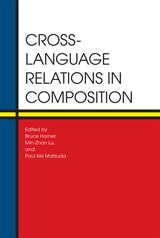
Cross-Language Relations in Composition
Edited by Bruce Horner, Min-Zhan Lu, and Paul Kei Matsuda
Southern Illinois University Press, 2010
Cross-Language Relations in Composition brings together the foremost scholars in the fields of composition, second language writing, education, and literacy studies to address the limitations of the tacit English-only policy prevalent in composition pedagogy and research and to suggest changes for the benefit of writing students and instructors throughout the United States. Recognizing the growing linguistic diversity of students and faculty, the ongoing changes in the English language as a result of globalization, and the increasingly blurred categories of native, foreign, and second language English speakers, editors Bruce Horner, Min-Zhan Lu, and Paul Kei Matsuda have compiled a groundbreaking anthology of essays that contest the dominance of English monolingualism in the study and teaching of composition and encourage the pursuit of approaches that embrace multilingualism and cross-language writing as the norm for teaching and research.
The nine chapters comprising part 1 of the collection focus on the origins of the “English only” bias dominating U.S. composition classes and present alternative methods of teaching and research that challenge this monolingualism. In part 2, nine composition teachers and scholars representing a variety of theoretical, institutional, and professional perspectives propose new, compelling, and concrete ways to understand and teach composition to students of a “global,” plural English, a language evolving in a multilingual world.
Drawing on recent theoretical work on genre, complexity, performance and identity, as well as postcolonialism, Cross-Language Relations in Composition offers a radically new approach to composition teaching and research, one that will prove invaluable to all who teach writing in today’s multilingual college classroom.
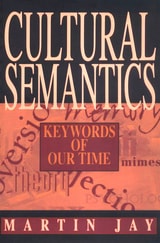
Cultural Semantics
Keywords of Our TimeMartin Jay
University of Massachusetts Press, 1998
A selection of Martin Jay's recent writings on contemporary thought and culture, this is a book about ideas that matter—and about why ideas matter. Borrowing from Flaubert's notion of a dictionary of “received ideas” and Raymond Williams's explorations of the “keywords” of the modern age, Jay investigates some of the central concepts by which we currently organize our thoughts and lives. His topics range from “theory” and “experience” to the meaning of “multiculturalism” and the dynamics of cultural “subversion.” Among the thinkers he engages are Bataille and Foucault, Adorno and Lacoue-Labarthe, Walter Benjamin, Christa Wolf, and Jean-François Lyotard.
By looking closely at what “words do and perform,” Jay makes us aware of the extent to which the language we use mediates and shapes our experience. By helping to distance us from much that we now take for granted, he makes it difficult for us to remain comfortably certain about what we think we know.
Elegantly written and richly insightful, this is a work of cultural criticism and intellectual analysis of the first order.
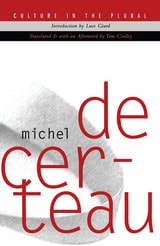
Culture In The Plural
Michel De Certeau
University of Minnesota Press, 1997