Results by title
112 books match the query 'Languages' and 5 start with c
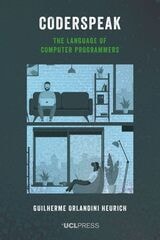
Coderspeak
The Language of Computer ProgrammersGuilherme Orlandini Heurich
University College London, 2024
Software applications have taken over our lives. We use and are used by software many times a day. Nevertheless, we know very little about the invisibly ubiquitous workers who write software. Who are they and how do they perceive their practice? How does that shape how they collaborate to build the myriad of apps that we use every day? And how does that impact the users of apps?
Coderspeak provides a critical approach to the digital transformation of our world through an engaging and thoughtful analysis of the people who write software applications. It is a focused and in-depth look at one programming language and its community, Ruby, based on ethnographic research at a London company and conversations with members of the wider Ruby community in Europe, the Americas, and Japan.
This book shows that the place where people write code, the language they write it in, and the stories shared by that community are crucial in questioning and unpacking what it means to be a coder. Understanding this social group is essential if we are to grasp a future (and a present) in which computer programming increasingly dominates our lives.
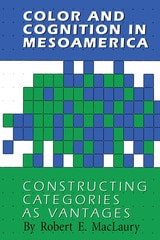
Color and Cognition in Mesoamerica
Constructing Categories as VantagesBy Robert E. MacLaury
University of Texas Press, 1996
More than 100 indigenous languages are spoken in Mexico and Central America. Each language partitions the color spectrum according to a pattern that is unique in some way. But every local system of color categories also shares characteristics with the systems of other Mesoamerican languages and of languages elsewhere in the world.
This book presents the results of the Mesoamerican Color Survey, which Robert E. MacLaury conducted in 1978-1981. Drawn from interviews with 900 speakers of some 116 Mesoamerican languages, the book provides a sweeping overview of the organization and semantics of color categorization in modern Mesoamerica.
Extensive analysis and MacLaury's use of vantage theory reveal complex and often surprising interrelationships among the ways languages categorize colors. His findings offer valuable cross-cultural data for all students of Mesoamerica. They will also be of interest to all linguists and cognitive scientists working on theories of categorization more generally.
Communities of Practice
An Alaskan Native Model for Language Teaching and LearningEdited by Patrick E. Marlow and Sabine Siekmann
University of Arizona Press, 2013
In Alaska, the Second Language Acquisition Teacher Education (SLATE) project was designed to enable Indigenous communities and schools to improve the quality of native-language and English-language instruction and assessment by focusing on the elimination of barriers that have historically hindered degree completion for Indigenous and rural teachers. The Guided Research Collaborative (GRC) model, was employed to support the development of communities of practice through near-peer mentoring and mutual scaffolding. Through this important new model, teachers of both the heritage language, in this case Central Yup’ik, and English were able to situate their professional development into a larger global context based on current notions of multilingualism.
In Communities of Practice contributors show how the SLATE program was developed and implemented, providing an important model for improving second-language instruction and assessment. Through an in-depth analysis of the program, contributors show how this project can be successfully adapted in other communities via its commitment to local control in language programming and a model based on community-driven research.
Communities of Practice demonstrates how an initial cohort of Yup’ik- and English-language teachers collaborated to negotiate and ultimately completed the SLATE program. In so doing, these educators enhanced the program and their own effectiveness as teachers through a greater understanding of language learning. It is these understandings that will ultimately allow heritage- and English-language teachers to work together to foster their students’ success in any language.

Contact, Structure, and Change
A Festschrift in Honor of Sarah G. ThomasonEdited by Anna M. Babel and Mark A. Sicoli
Michigan Publishing Services, 2021

Cultural Erotics in Cuban America
Ricardo L. Ortíz
University of Minnesota Press, 2006
In this wide-ranging work Ortíz argues for the authentically diasporic quality of postrevolutionary, off-island Cuban experience. Highlighting various forms of cultural expression, Cultural Erotics in Cuban America traces underrepresented communities’ responses to the threat of cultural disappearance in an overwhelming and hegemonic U.S. culture. Ortíz shows how the work of Cuban-American writers and artists challenges the heteronormativity of both home and host culture. Focusing on artists who have had an ambivalent, indirect, or nonexistent connection to Miami, he presents close readings of such novelists as Reinaldo Arenas, Roberto G. Fernández, Achy Obejas, and Cristina García, the playwright Eduardo Machado, the poet Rafael Campo, and musical performers Albita Rodríguez and Celia Cruz.
Ortíz charts the legacies of sexism and homophobia in patriarchal Cuban culture, as well as their influence on Cuban-revolutionary and Cuban-exile ideologies. Moving beyond the outdated cultural terms of the Cold War, he looks forward to envision queer futures for Cuban-American culture free from the ties to restrictive—indeed, oppressive—constructions of nation, place, language, and desire.
Ricardo L. Ortíz is associate professor of English at Georgetown University.