Results by title
1228 books match the query 'Library & Information Science' and 111 start with c

Caldecott Fun
Poems, Songs, and Games with Caldecott WinnersNancy Polette
American Library Association, 2013
Cart's Top 200 Adult Books for Young Adults
Two Decades in ReviewMichael Cart
American Library Association, 2013
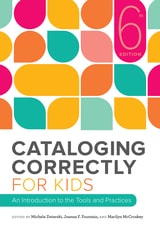
Cataloging Correctly for Kids
Michele Zwierski, Marilyn McCroskey, and Joanna F. Fountain
American Library Association, 2021
Cataloging library materials for children in the internet age has never been as challenging or as important. RDA: Resource Description and Access is now the descriptive standard, there are new ways to find materials using classifications, and subject heading access has been greatly enhanced by the keyword capabilities of today’s online catalogs. It’s the perfect moment to present a completely overhauled edition of this acclaimed bestseller. The new sixth edition guides catalogers, children’s librarians, and LIS students in taking an effective approach towards materials intended for children and young adults. Informed by recent studies of how children search, this handbook’s top-to-bottom revisions address areas such as
- how RDA applies to a variety of children’s materials, with examples provided;
- authority control, bibliographic description, subject access, and linked data;
- electronic resources and other non-book materials; and
- cataloging for non-English-speaking and preliterate children.
Cataloging Correctly for Kids
An Introduction to the ToolsSheila S. Intner
American Library Association, 2011
Cataloging Cultural Objects
A Guide to Describing Cultural Works and Their ImagesMurtha Baca
American Library Association, 2006
Cataloging and Managing Film and Video Collections
Colin Higgins
American Library Association, 2015
Censorship and Selection
Issues and Answers for SchoolsHenry Reichman
American Library Association, 2001

Centers for Learning
Writing Centers and Libraries in CollaborationJames K. Elmborg
Assoc of College & Research Libraries, 2011
Changing Academic Library
Operations, Culture, EnvironmentsJohn Budd
Assoc of College & Research Libraries, 2012
Changing Academic Library
Operations, Culture, EnvironmentsJohn Budd
Assoc of College & Research Libraries, 2012
Charleston Conference Proceedings 2023
Edited by Beth Bernhardt, Leah Hinds, and Lars Meyer
Against the Grain, LLC, 2024
With strong numbers for 2023, conference attendees continue to remark on the informative and thought‐provoking sessions. The conference provides a casual, collegial atmosphere where librarians, publishers, and vendors talk freely and directly about issues facing their libraries and information providers. All of this interaction occurs in the beautiful city of Charleston, South Carolina. The proceedings continue to be edited by: Beth R. Bernhardt, Consortia Account Manager at Oxford University Press; Leah Hinds, Executive Director of the Charleston Hub; and Lars Meyer, Associate University Librarian for Access and Resource Services, Emory University Libraries. We are pleased to share some of the learning experiences that we and other attendees had at the conference.
Charleston Conference Proceedings 2024
Edited by Beth Bernhardt, Leah Hinds, and Lars Meyer
Against the Grain, LLC, 2025
The Charleston Conference remains a leading international gathering for the exchange of ideas among librarians, publishers, and vendors. Now in its forty-fourth year, the conference continues to thrive as one of the most dynamic and engaging events in the library and information community. Building on the momentum of 2023, when the Charleston Hub joined nonprofit science publisher Annual Reviews, the 2024 conference marked the first full year of this exciting collaboration. The partnership has strengthened Charleston’s mission to foster open dialogue, innovation, and collaboration across all sectors of scholarly communication while preserving the collegial, independent spirit that makes Charleston unique.
The 2024 meeting once again delivered strong participation and rich discussion on emerging issues shaping libraries, publishing, and research. Attendees consistently highlight the Charleston Conference’s relaxed, inclusive atmosphere, where professionals from all corners of the information world come together to share insights and challenge assumptions. Set against the historic and welcoming backdrop of Charleston, South Carolina, the event continues to inspire and connect our global community.
The proceedings are edited by Beth R. Bernhardt, Consortia Account Manager at Oxford University Press; Leah Hinds, Executive Director of the Charleston Hub; and Lars Meyer, Associate University Librarian for Access and Resource Services at Emory University Libraries. We are pleased to share highlights, key themes, and reflections from another memorable year of learning and exchange at the Charleston Conference.
Charleston Conference Proceedings, 2020
Lars Meyer
Against the Grain, LLC, 2020
The Charleston Conference continues to be a major event for information and idea exchange among librarians, vendors, and publishers. 2020 was a year for the history books in every way, with a global pandemic shutting down the world for most of the year. Events pivoted from in-person to virtual in record-breaking times and the Charleston Conference was no exception. The Conference saw a surge in attendance with an almost 150% increase from 2019, and Conference attendees continued to remark on the informative and thought‐ provoking sessions in a virtual environment.
This is the sixteenth year that Beth R. Bernhardt, Consortia Account Manager at Oxford University Press, has put together the proceedings from the Conference. It’s the twelfth year for Leah Hinds, Executive Director, and the fourth year that we are joined by Lars Meyer, Director, Access & Resource Services, Library & Information Technology Services at Emory University. We are pleased to share some of the learning experiences that we, and other attendees, had at the conference.
Charleston Proceedings 2021
Lars Meyer
Against the Grain, LLC, 2022
This is the seventeenth year that Beth R. Bernhardt, Consortia Account Manager at Oxford University Press, has put together the proceedings from the Conference. It’s the thirteenth year for Leah Hinds, Executive Director, and the fifth year that we are joined by Lars Meyer, Associate University Librarian, Access and Resource Services at Emory University. We are pleased to share some of the learning experiences that we, and other attendees, had at the conference.
With contributions from: Brent Appling, Scott D. Bacon, Sarah Rachel Benson, Gaëlle Béquet, Vida Damijonaitis, Denis Galvin, Alicia Wise, Bradley Wade Bishop, David Eby, Claire Jordan, Katerina Ozment, Rebecca Blakiston, Shelby Carroll, Sarah Guy, Angela Carreño, Travis Clamon, Jennifer Young, Ashley Sergiadis, Michelle E. Colquitt, Jennifer A. Mezick, Steve M. Cramer, Summer Krstevska, Corey Seeman, Sara F. Hess, Jill Dawson, Laurel Crawford Claire, Sara Duff, Bob Nardini, Pamela Smith, Emily Tufts, Susan Garrison, Dan Hawkins, Shawn Hendrikx, David McCord, Sara F. Ashley Hosbach, Brittany Kester, Mihoko Hosoi, Sarah Philbrick Hunter, Maridath Wilson, Marc Jaffy, Maureen James, Carol Macheak, Donna Rose, Charlotte M. Johnson, Boaz Nadav Manes, Linda Wobbe, Heather McMullen, Annie Johnson, Jillian Kehoe, Michael Levine-Clark, Tim Lloyd, Tricia Miller, Sara Scheib, Arielle Lomness, Rob Tiessen, Dean Smith, Michael Zeoli, Elizabeth Lorbeer, Karen Gau, Tim Butzen-Cahill, Lindsay Barnett, Daniel C. Mack, Maggie Z. Saponaro, Leigh Ann DePope, Alexis Smith Macklin, Tim Schlak, Jennifer Matthews, Christine Davidian, Antje Mays, Brittany Haynes, Rachelle McLain, Hannah McKelvey, Wendy Michelle Moore, Ida Sofie Reher, James G. Rhoades, Rob Tench, Sion Patrick Romaine, Barbara Albee, Laura A. Sill, George Stachokas, Rebekah Lahue, David Stern Sandy Stift, Roxy M. Garstad, Matthew Torrence, Cory Tucker, Chris Vidas, Bobby Hollandsworth Maureen P. Walsh, Gene R. Springs, Anita K. Foster, Mary Wegmann, Laura Krier, Hilary Smith, George Wrenn, and Angelina Zaytsev.
Charleston Voices
Perspectives from the 2017 ConferenceEdited by Lars Meyer
Against the Grain, LLC, 2018
TESTIMONIALS
“The best library gathering around. I look forward to it.”
“The Charleston Conference is an incredibly stimulating venue. I am tired afterwards, but get so many great ideas, network with my colleagues, and learn what is going on. I recommend it highly.”
“Charleston is the only conference that is worth attending.”
https://www.charlestonlibraryconference.com/about/
Charleston Voices
Perspectives from the 2018 ConferenceEdited by Lars Meyer
Against the Grain, LLC, 2019
TESTIMONIALS
“The best library gathering around. I look forward to it.”
“The Charleston Conference is an incredibly stimulating venue. I am tired afterwards, but get so many great ideas, network with my colleagues, and learn what is going on. I recommend it highly.”
“Charleston is the only conference that is worth attending.”
https://www.charlestonlibraryconference.com/about/
Charleston Voices
Perspectives from the 2019 ConferenceEdited by Lars Meyer
Against the Grain, LLC, 2020
TESTIMONIALS
“The best library gathering around. I look forward to it.”
“The Charleston Conference is an incredibly stimulating venue. I am tired afterwards, but get so many great ideas, network with my colleagues, and learn what is going on. I recommend it highly.”
“Charleston is the only conference that is worth attending.”
https://www.charlestonlibraryconference.com/about/
Checklist of Library Building Design Considerations
William W. Sannwald
American Library Association, 2016
Children's Literature Gems
Choosing and Using Them in Your Library CareerElizabeth American Library Association
American Library Association, 2009
Children's Services
Betsy Diamant-Cohen
American Library Association, 2010

Choosing Books for Children
A COMMONSENSE GUIDEBetsy Hearne with Deborah Stevenson
University of Illinois Press, 1999
If you have ever stood in the children's section of a bookstore or library wondering how to go about matching a book to the age, abilities, and interests of a particular child, Choosing Children's Books is for you. Renowned children's librarian and children's book review editor Betsy Hearne offers practical guidance on sorting through the bewildering array of picture books, pop-up books, books for beginning readers, young adult titles, classics, poetry, folktales, and factual books. Each chapter includes an annotated list of recommended titles.
A gold mine of commonsense, sound advice, this newly revised and completely updated edition of Betsy Hearne's classic guide is an indispensable tool for choosing books for children of all ages.
Newly available in paperback, this revised and updated third edition of Betsy Hearne's classic guide stands as the lodestar for navigating through the bewildering array of books for young readers. Hearne surveys everything from picture books, pop-up books, classics, and books for beginning readers to young adult titles, poetry, folktales, and factual books, with an annotated list of recommended titles accompanying each chapter. A gold mine of common sense and sound advice, her guide remains an indispensable tool for choosing books for children of all ages.
Classroom Assessment Techniques For Librarians
Melissa Bowles-Terry
Assoc of College & Research Libraries, 2015
Classroom Assessment Techniques for Librarians
Melissa Bowles-Terry
Assoc of College & Research Libraries, 2015
Classroom Management for School Librarians
Hilda K. Weisburg
American Library Association, 2020
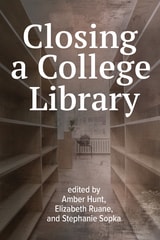
Closing a College Library
Amber Hunt
Assoc of College & Research Libraries, 2024
Closing a College Library offers firsthand accounts of closing a library from different institutions of higher education, with practical tips, checklists, and sample documents, questions to ask yourself as you move through the process, and lessons learned. It provides effective practices for the immediate needs that arise when a library is facing closure, from preparing the building to rehoming special collections and archives to transferring electronic resources.
There is much unfamiliar work that comes with a closure or merger, work that can happen concurrently with your regular duties and while you’re handling the emotions of your team, students, alumni, faculty, and staff. Closing a College Library offers tools and support in making difficult decisions.
Cloud-Based Services for Your Library
A LITA GuideErik T. American Library Association
American Library Association, 2013
Club Programs for Teens
100 Activities for the Entire YearAmy Alessio
American Library Association, 2015
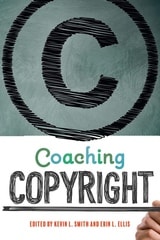
Coaching Copyright
Erin L. Ellis
American Library Association, 2019
From researching to remixing, library users need your guidance on a wide range of copyright topics. The way to move beyond “yes, you can” or “no, you can’t” is to become a copyright coach. In this collection librarian and attorney Smith teams up with information literacy expert Ellis to offer a framework for coaching copyright, empowering users to take a practical approach to specific situations. Complete with in-depth case studies, this collection provides valuable information rooted in pragmatic techniques, including
- in-depth discussion of the five questions that will help you clarify any copyright situation;
- storytelling techniques to enliven copyright presentations, plus ways to use music or YouTube to hook students into copyright topics;
- three coaching scenarios that tie into ACRL’s Framework for Information Literacy for Higher Education and bring real-world applications to your library instruction;
- how-to guidance on leading mock negotiations over real journal publishing agreements;
- a 90-minute lesson plan on author rights for writers in a student journal;
- tips for teaching instructional designers how to apply copyright and fair use principles to course management systems; and
- an LIS copyright course assessment model.
This resource will help you become a copyright coach by showing you how to discern the most important issues in a situation, determine which questions you need to ask, and give a response that is targeted to the specific need.
Coaching in the Library
A Management Strategy for Achieving ExcellenceRuth F. Metz
American Library Association, 2010
Coaching in the Library
A Management Strategy for Achieving ExcellenceAmerican Library Association, 2001
Collaborate
Mary Catherine Coleman
American Library Association, 2022
Collaborating For Impact
Spec Ial Collections AndKristen Totleben
Assoc of College & Research Libraries, 2016
Collaborating with Strangers
Facilitating Workshops in Libraries, Classes, and NonprofitsBess G. de Farber
American Library Association, 2017
Collaborative Strategies for Teaching Reading Comprehension
Judi Moreillon
American Library Association, 2007
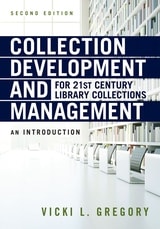
Collection Development and Management for 21st Century Library Collections
An IntroductionVicki L. Gregory
American Library Association, 2019
Packed with discussion questions, activities, suggested additional references, selected readings, and many other features that speak directly to students and library professionals, Gregory’s Collection Development and Management for 21st Century Library Collections is a comprehensive handbook that also shares myriad insightful ideas and approaches valuable to experienced practitioners. This new second edition brings an already stellar text fully up to date, presenting top-to-bottom coverage of
- the impact of new technologies and developments on the discipline, including discussion of e-books, open access, globalization, self-publishing, and other trends;
- needs assessment, policies, and selection sources and processes;
- budgeting and fiscal management;
- collection assessment and evaluation;
- weeding, with special attention paid to electronic materials;
- collaborative collection development and resource sharing;
- marketing and outreach;
- self-censorship as a component of intellectual freedom, professional ethics, and other legal issues;
- diversity and ADA issues;
- preservation; and
- the future of the field.
Additional features include updated vendor lists, samples of a needs assessment report, a collection development policy, an approval plan, and an electronic materials license.
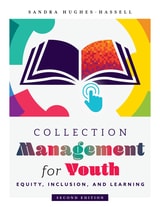
Collection Management for Youth
Equity, Inclusion, and LearningSandra Hughes-Hassell
American Library Association, 2020
With a renewed emphasis on facilitating learning, supporting multiple literacies, and advancing equity and inclusion, the thoroughly updated and revised second edition of this trusted text provides models and tools that will enable library staff who serve youth to create and maintain collections that provide equitable access to all youth. And as Hughes-Hassell demonstrates, the only way to do this is for collection managers to be learner-centered, confidently acting as information guides, change agents, and leaders. Based on the latest educational theory and research, this book
- presents the argument for why collection management decisions and practices should focus on equity, exploring systemic inequities, educational paradigm shifts, developments in the information environment, and other key factors;
- lays out the theoretical foundation for developing and managing a library collection that facilitates learning, supports the development of multiple literacies, and provides equitable access to an increasingly diverse group of young learners;
- touches upon current competencies and standards by AASL, YALSA, and ALSC;
- uses a learner-centered and equity perspective to cover core issues and criteria such as selection and removal of materials, budgeting, and cooperation among libraries;
- shows how a business viewpoint can assist the learner-centered collector in articulating the central significance of the collection to learning;
- discusses how library staff can work collaboratively to create policy and negotiate budgets; and
- includes customizable tools and templates, including a Stakeholder Contact/SWOT Analysis, Decision-Making Model for Selecting Resources and Access Points that Support Learning and Advance Equity, and Collection Development Analysis Worksheet.
This resource will be as useful to current school librarians and supervisors, youth librarians in public libraries, and educators as it will to LIS students.
College Libraries and Student Culture
What We Now KnowLynda M. Duke
American Library Association, 2012
College and University Archives
Christopher J. Prom
American Library Association, 2009
College and University Archives
Christopher J. Prom
Society of American Archivists, 0
Comic Books, Special Collections, and the Academic Library
Brian Flota
Assoc of College & Research Libraries, 2023
Comic Books, Special Collections, and the Academic Library collects best practices for the acquisition, preservation, storage, and cataloging of comics, particularly single-issue (or floppy) comics, within the special collections units of academic library collections. Four sections answer:
- Why Should Your Institution Collect Comics?
- Your Library Collects or Wants to Collect Comics. Now What?
- How Do You Engage in Library Instruction and Outreach with Your Comics Collection?
- How Can Comics Be Used as Primary and Secondary Source Material by Students and Faculty?
Common Ground At The Nexus Of Information Literacy And
Merinda Hensley
Assoc of College & Research Libraries, 2013
Common Ground at the Nexus of Information Literacy and Scholarly Communication
Stephanie Davis-Kahl
Assoc of College & Research Libraries, 2013
Communicating Professionally
A How-To-Do-It Manual for LibrariansCatherine Sheldrick Ross
American Library Association, 2013
Community Technology Projects
Making Them WorkMargaret Heller
American Library Association, 2019
Compact Copyright
Quick Answers to Common QuestionsSara R. Benson
American Library Association, 2021
Included in Choice's Top 75 Titles and Resources for Community College Libraries
Faculty, students, and colleagues come to you with copyright questions, both simple and complex. And they all want reliable answers—as fast as you can get them. With this guide, designed for ready access, you’ll be prepared to deliver. Lawyer, copyright librarian, and iSchool instructor Benson presents succinct explanations ideal for both on-the-fly reference and staff training. Copyright specialists will appreciate excerpts from the law itself alongside tools and resources for digging deeper. Practical discussions of key legal concepts, illustrated using 52 scenarios, will lead you to fast, accurate answers on a range of topics, such as
- barriers to using the TEACH Act provisions in content for online teaching;
- showing a full-length movie in a university class;
- public domain and the 1998 Sonny Bono Copyright Term Extension Act;
- your legal options when receiving a DMCA take-down notice;
- court interpretations of fair use in three key recent cases;
- Creative Commons licenses, complete with a quick reference chart;
- library rights to license photographs in a digital collection;
- using letters under copyright in a special collections display case;
- a grad student’s right to use in a thesis writing published in their professor’s journal article;
- applying the implied license option to post historical student dissertations in institutional repositories;
- the Marrakesh Treaty provision supporting transfer of accessible works internationally; and
- limiting factors for interlibrary loan.
Compact Copyright
Quick Answers to Common Questions, Second EditionSara R. Benson
American Library Association, 2026
When faculty, students, and colleagues come to you with legal questions and you suddenly find yourself in the thick of a copyright conundrum, you don’t need pages of historical background information and long-winded legal explanations — you need answers, fast. Previously included in Choice's Top 75 Titles and Resources for Community College Libraries, this bestselling book gives you just that, succinctly addressing common head-scratchers and scenarios in a way that you will lead you to accurate answers quickly. Ideal for on-the-fly reference, staff training, and LIS instruction, Benson’s guide provides excerpts from the law itself alongside tools and suggested additional resources for digging deeper. Compact Copyright
- skillfully explains legal principles in plain language for more than 50 of the most common real-life scenarios library workers face;
- includes new chapters on cutting-edge developments such as AI, separability, and copyright and data;
- provides a primer on contracts and licensing basics, including Creative Commons licensing;
- explores key topics like the First Sale doctrine, Fair Use, public domain, making copies for preservation, the TEACH Act, interlibrary loan, sovereign immunity, and the Digital Millennium Copyright Act (DCMA);
- offers pointers on access to copyrighted material for patrons with disabilities and other concepts related to accessibility;
- discusses select international copyright library issues; and
- includes a Fair Use checklist, copyright and film screening best practices, and additional recommended reading and materials.
Competency-Based Career Planning for Reference and User Services Professionals
Jo Bell Whitlatch
American Library Association, 2020
Reference and user services librarians need to be in charge of their own careers. And when it comes to their own professional development, that means being proactive. This resource will enable professionals at every stage of their careers to honestly assess their skills and knowledge. Utilizing the RUSA (Reference and User Services Association) Professional Competencies as a framework for reflecting on strengths as well as gaps in expertise, it guides readers through developing strategies to enhance their professional standing and potential, thereby leading to a more satisfying career. In this book former RUSA president Whitlatch, who chaired the initial committee establishing the Competencies, teams up with expert trainer Woodard to
- introduce the seven categories of the RUSA Professional Competencies, explaining the ways in which each is important to both practitioner and institution;
- demonstrate how to create a personal development plan that focuses on development priorities;
- discuss the Association for Talent Development (ATD) Competency Development Model and other action plans;
- offer guidance for setting goals and measuring progress;
- share information on a variety of development activities that readers can undertake to maintain and enhance professional competencies, including formal training opportunities, on-the-job experiences, and self-directed initiatives; and
- provide recommended self-evaluation techniques such as writing up notes from group discussions, exercises, short verbal and written reports, crafting presentations on a topic, and sharing concrete examples of how skills were applied in the workplace.
Complete Copyright for K12 Librarians and Educators
Carrie Russell
American Library Association, 2023
- the reasons librarians and teachers have so many misconceptions about copyright, and why understanding copyright is a process, not a one-time event;
- recent legislative and policy developments that impact schools and libraries;
- situations often encountered by educators, such as using copyrighted material in class assignments, digital lesson plans, bulletin board displays, social media, school plays, and band performances and talent shows;
- the use of licensed content in a variety of settings;
- what constitutes "fair use," so that you can be empowered by knowing exactly what's possible within the law; and
- guidance on making long-term strategic decisions and developing copyright policies.
Complete Copyright for K–12 Librarians and Educators
Carrie Russell
American Library Association, 2012
Comprehensive Guide To Emergency And Disaster Prepar
Frances Wilkinson
Assoc of College & Research Libraries, 2010