Results by title
10 books match the query 'Enemies'

Children with Enemies
Stuart Dischell
University of Chicago Press, 2017
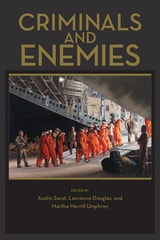
Criminals and Enemies
Austin Sarat
University of Massachusetts Press, 2019
The editors' introduction situates criminals and enemies in a theoretical context, focusing on the work of Thomas Hobbes and Carl Schmitt, while other essays consider topics ranging from Germany's denazification project to South Africa's pre- and post-apartheid legal regime to the complicating factors introduced by the war on terror. In addition to the editors, the contributors include Stephen Clingman, Jennifer Daskal, Sara Kendall, Devin Pendas, and Annette Weinke.
Enemies from the East?
V. S. Soloviev on Paganism, Asian Civilizations, and IslamEdited by Vladimir Wozniuk
Northwestern University Press, 2007
The six essays comprising this book span Soloviev’s publishing career, beginning with “The Mythological Process in Ancient Paganism,” written at the age of twenty, and ending with “Muhammad, His Life and Religious Teaching,” which appeared four years before Soloviev’s death at forty-seven. Throughout, Soloviev grapples with commonalities and differences apparent in the moral frameworks of civilizations since antiquity; and in religious and cultural practices, from Europe through the Middle East to Asia. His probing of the sources of religious morality and political authority in human history reinvigorated Russian intellectual interest in the East/West question in his time and still resonates powerfully in our own.
Enemies of All Humankind
Fictions of Legitimate ViolenceSonja Schillings
Dartmouth College Press, 2016
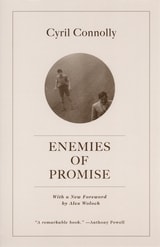
Enemies of Promise
Cyril Connolly
University of Chicago Press, 2008
“Whom the gods wish to destroy,” writes Cyril Connolly, “they first call promising.” First published in 1938 and long out of print, Enemies of Promise, an “inquiry into the problem of how to write a book that lasts ten years,” tests the boundaries of criticism, journalism, and autobiography with the blistering prose that became Connolly’s trademark. Connolly here confronts the evils of domesticity, politics, drink, and advertising as well as novelists such as Joyce, Proust, Hemingway, and Faulkner in essays that remain fresh and penetrating to this day.
“A fine critic, compulsive traveler, and candid autobiographer. . . . [Connolly] lays down the law for all writers who wanted to count. . . . He had imagination and decisive images flashed with the speed of wit in his mind.”—V. S. Pritchett, New York Review of Books
“Anyone who writes, or wants to write, will find something on just about every single page that either endorses a long-held prejudice or outrages, and that makes it a pretty compelling read. . . . You end up muttering back at just about every ornately constructed pensée that Connolly utters, but that’s one of the joys of this book.”—Nick Hornby, The Believer
“A remarkable book.”—Anthony Powell
Enemies of the People
The Destruction of Soviet Literary, Theater, and FKatherine Bliss Eaton
Northwestern University Press, 2002
Enemies to Their Country
The Marblehead Addressers and Consensus in the American RevolutionNicholas W. Gentile
University of Massachusetts Press, 2025
Runner-up, 2025 Journal of the American Revolution Book of the Year Award
Complicating the American Revolution through a microhistory of one Massachusetts town
In 1774, a group of elite men in the town of Marblehead, Massachusetts, just outside Salem, wrote an address to the royal governor thanking him for his service to the colony, even as town residents began demanding independence from Great Britain. Town meeting records reveal how the town’s patriot majority pressured the signers to withdraw their support for the governor and demanded public recantations and issued damning reports, even forcing some of the signers into exile.
Enemies to Their Country tells the story of the year following the Address, chronicling the town’s struggle to achieve consensus even as the war for American independence started. This microhistory of one vitally important town, the second largest in Massachusetts at the time, with a thriving local economy based on fishing and a robust community of religious and civically engaged citizens, complicates simplistic ideas of the American Revolution. Through compelling stories of neighboring individuals and families, many of which have not been told, it also provides an example of a politically polarized constituency struggling to find consensus at a time of great conflict.
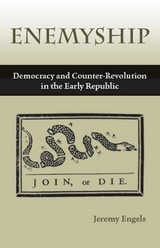
Enemyship
Democracy and Counter-Revolution in the Early RepublicJeremy Engels
Michigan State University Press, 2010
The Declaration of Independence is usually celebrated as a radical document that inspired revolution in the English colonies, in France, and elsewhere. In Enemyship, however, Jeremy Engels views the Declaration as a rhetorical strategy that outlined wildly effective arguments justifying revolution against a colonial authority—and then threatened political stability once independence was finally achieved.
Enemyship examines what happened during the latter years of the Revolutionary War and in the immediate post-Revolutionary period, when the rhetorics and energies of revolution began to seem problematic to many wealthy and powerful Americans.
To mitigate this threat, says Engles, the founders of the United States deployed the rhetorics of what he calls "enemyship," calling upon Americans to unite in opposition to their shared national enemies.
Our Veterans
Winners, Losers, Friends, and Enemies on the New Terrain of Veterans AffairsSuzane Gordon, Steve Early, and Jasper Craven
Duke University Press, 2022
Valorizing the Barbarians
Enemy Speeches in Roman HistoriographyBy Eric Adler
University of Texas Press, 2011
With the growth of postcolonial theory in recent decades, scholarly views of Roman imperialism and colonialism have been evolving and shifting. Much recent discussion of the topic has centered on the ways in which ancient Roman historians consciously or unconsciously denigrated non-Romans. Similarly, contemporary scholars have downplayed Roman elite anxiety about their empire's expansion.
In this groundbreaking new work, Eric Adler explores the degree to which ancient historians of Rome were capable of valorizing foreigners and presenting criticisms of their own society. By examining speeches put into the mouths of barbarian leaders by a variety of writers, he investigates how critical of the empire these historians could be.
Adler examines pairs of speeches purportedly delivered by non-Roman leaders so that the contrast between them might elucidate each writer's sense of imperialism. Analyses of Sallust's and Trogus's treatments of the Eastern ruler Mithradates, Polybius's and Livy's speeches from Carthage's Hannibal, and Tacitus's and Cassius Dio's accounts of the oratory of the Celtic warrior queen Boudica form the core of this study. Adler supplements these with examinations of speeches from other characters, as well as contextual narrative from the historians. Throughout, Adler wrestles with broader issues of Roman imperialism and historiography, including administrative greed and corruption in the provinces, the treatment of gender and sexuality, and ethnic stereotyping.