Results by title
102 books match the query 'Limits' and 6 start with c
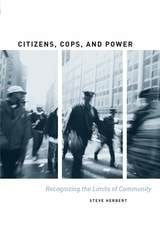
Citizens, Cops, and Power
Recognizing the Limits of CommunitySteve Herbert
University of Chicago Press, 2006
Politicians, citizens, and police agencies have long embraced community policing, hoping to reduce crime and disorder by strengthening the ties between urban residents and the officers entrusted with their protection.
That strategy seems to make sense, but in Citizens, Cops, and Power, Steve Herbert reveals the reasons why it rarely, if ever, works. Drawing on data he collected in diverse Seattle neighborhoods from interviews with residents, observation of police officers, and attendance at community-police meetings, Herbert identifies the many obstacles that make effective collaboration between city dwellers and the police so unlikely to succeed. At the same time, he shows that residents’ pragmatic ideas about the role of community differ dramatically from those held by social theorists.
Surprising and provocative, Citizens, Cops, and Power provides a critical perspective not only on the future of community policing, but on the nature of state-society relations as well.
[more]
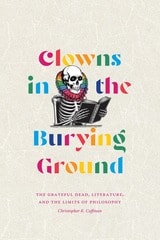
Clowns in the Burying Ground
The Grateful Dead, Literature, and the Limits of PhilosophyChristopher K. Coffman
Duke University Press, 2026
In Clowns in the Burying Ground, Christopher K. Coffman presents intertextual readings of the Grateful Dead and their lyrics to argue that the band’s lyricists were deeply and significantly engaged with the literary tradition. Through an analysis of their music, lyrics, and biographies, Coffman shows how the group and its individual members drew on the canons of European and American literature to shape both the form and content of their creative work. Coffman draws on the language of the “literary fragment,” as conceived by German Romantic philosophers and their intellectual heirs, to identify how the Grateful Dead’s lyricists employed intertextuality, allusion, and other strategies to explore how meaning takes shape at the boundary between poetry and philosophy. From Shakespeare to “Shakedown Street,” Clowns in the Burying Ground demonstrates the Dead’s literary depth and how their most successful lyrics and performances walk the line between creation and chaos.
[more]
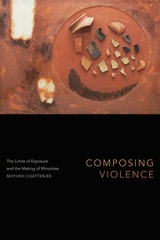
Composing Violence
The Limits of Exposure and the Making of MinoritiesMoyukh Chatterjee
Duke University Press, 2023
In 2002, armed Hindu mobs attacked Muslims in broad daylight in the west Indian state of Gujarat. The pogrom, which was widely seen over television, left more than one thousand dead. In Composing Violence Moyukh Chatterjee examines how highly visible political violence against minorities acts as a catalyst for radical changes in law, public culture, and power. He shows that, far from being quashed through its exposure by activists, media, and politicians, state-sanctioned anti-Muslim violence set the stage for transforming India into a Hindu supremacist state. The state's and civil society’s responses to the violence, Chatterjee contends, reveal the constitutive features of modern democracy in which riots and pogroms are techniques to produce a form of society based on a killable minority and a triumphant majority. Focusing on courtroom procedures, police archives, legal activism, and mainstream media coverage, Chatterjee theorizes violence as a form of governance that creates minority populations. By tracing the composition of anti-Muslim violence and the legal structures that transform that violence into the making of minorities and majorities, Chatterjee demonstrates that violence is intrinsic to liberal democracy.
[more]
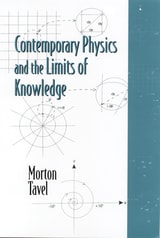
Contemporary Physics and the Limits of Knowledge
Tavel, Morton
Rutgers University Press, 2002
"An elegant read for anyone interested in understanding modern physics. Tavel has a genuine knack for making the difficult and obscure clear and exciting." --Joseph C. Pitt, author of Thinking about Technology "You will never look at scientific theories in the same way again." --John Hubiscz, North Carolina State University Introductory physics is not often a popular class among liberal arts majors. With its lively prose and analogies from the arts, humanities, and social sciences, however, Contemporary Physics and the Limits of Knowledge is guaranteed to enlighten and delight nonscience majors. Morton Tavel contends that every one of the six topics that he explores--symmetry, special and general relativity, statistical physics, quantum mechanics, and chaos--has played a role in telling us what we are unable to know about the physical world. He explains what each of the topics reveals about our attempts to pinpoint reality, and how each scientific revelation forces us to acknowledge a narrowing rather than a broadening of our knowledge. Chaos theory, for example, reveals a way to understand the randomness that seems so prevalent in natural phenomena such as weather. This development unifies our understanding of many phenomena that had been previously thought unrelated. Yet, chaos represents a significant diminution in what we can hope to predict about the course of natural events. It has increased our knowledge or understanding of a phenomena, but has seriously eroded our long-held, Newtonian vision of prediction and control. Tavel emphasizes the features of physics that make it a very human endeavor and serve to build bridges to all other intellectual disciplicnes.
[more]
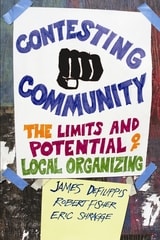
Contesting Community
The Limits and Potential of Local OrganizingDeFilippis, James
Rutgers University Press, 2010
What do community organizations and organizers do, and what should they do? For the past thirty years politicians, academics, advocates, and activists have heralded community as a site and strategy for social change. In contrast, Contesting Community paints a more critical picture of community work which, according to the authors--in both theory and practice--has amounted to less than the sum of its parts. Their comparative study of efforts in the United States, the United Kingdom, and Canada describes and analyzes the limits and potential of this work.
Covering dozens of groups, including ACORN, Brooklyn's Fifth Avenue Committee, and the Immigrant Workers Centre in Montreal, and discussing alternative models, this book is at once historical and contemporary, global and local. Contesting Community addresses one of the vital issues of our day--the role and meaning of community in people's lives and in the larger political economy.
Covering dozens of groups, including ACORN, Brooklyn's Fifth Avenue Committee, and the Immigrant Workers Centre in Montreal, and discussing alternative models, this book is at once historical and contemporary, global and local. Contesting Community addresses one of the vital issues of our day--the role and meaning of community in people's lives and in the larger political economy.
[more]
Critical Understanding
The Powers and Limits of PluralismWayne C. Booth
University of Chicago Press, 1979
Critics will always disagree, but, maintains Wayne Booth, their disagreement need not result in critical chaos. In Critical Understanding, Booth argues for a reasoned pluralism—a criticism more various and resourceful than can be caught in any one critic's net. He relates three noted pluralists—Ronald Crane, Kenneth Burke, and M. H. Abrams—to various currently popular critical approaches. Throughout, Booth tests the abstractions of metacriticism against particular literary works, devoting a substantial portion of his discussion to works by W. H. Auden, Henry James, Oliver Goldsmith, and Anatole France.
[more]