Results by title
52 books match the query 'Lincoln' and 3 start with c
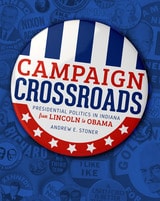
Campaign Crossroads
Presidential Politics in Indiana from Lincoln to ObamaAndrew E. Stoner
Indiana Historical Society Press, 2017
Campaign Crossroads looks back over the varied, sometimes important, sometimes irrelevant, but always interesting presidential campaign cycles in Indiana’s history. By taking in the influences of technology, transportation and communication itself, we see an evolution in the political process that is not only altogether Hoosier, but also altogether American in its quality and importance.
Using a narrative approach with a mix of primary and secondary sources, the work examines not only the rhetoric of presidents and presidential hopefuls, but also the nature of campaigns and their impact on Indiana communities. While Indiana enjoyed the position of being a battleground state for the better part of a century from the 1870s until the 1960s, it has also been ignored, dismissed, and has on occasion created unexpected political drama.
[more]
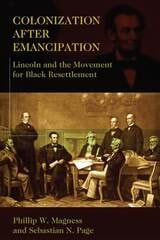
Colonization After Emancipation
Lincoln and the Movement for Black ResettlementPhillip W. Magness and Sebastian N. Page
University of Missouri Press, 2011
History has long acknowledged that President Abraham Lincoln, the Great Emancipator, had considered other approaches to rectifying the problem of slavery during his administration. Prior to Emancipation, Lincoln was a proponent of colonization: the idea of sending African American slaves to another land to live as free people. Lincoln supported resettlement schemes in Panama and Haiti early in his presidency and openly advocated the idea through the fall of 1862. But the bigoted, flawed concept of colonization never became a permanent fixture of U.S. policy, and by the time Lincoln had signed the Emancipation Proclamation on January 1, 1863, the word “colonization” had disappeared from his public lexicon. As such, history remembers Lincoln as having abandoned his support of colonization when he signed the proclamation. Documents exist, however, that tell another story.
Colonization after Emancipation: Lincoln and the Movement for Black Resettlement explores the previously unknown truth about Lincoln’s attitude toward colonization. Scholars Phillip W. Magness and Sebastian N. Page combed through extensive archival materials, finding evidence, particularly within British Colonial and Foreign Office documents, which exposes what history has neglected to reveal—that Lincoln continued to pursue colonization for close to a year after emancipation. Their research even shows that Lincoln may have been attempting to revive this policy at the time of his assassination.
Using long-forgotten records scattered across three continents—many of them untouched since the Civil War—the authors show that Lincoln continued his search for a freedmen’s colony much longer than previously thought. Colonization after Emancipation reveals Lincoln’s highly secretive negotiations with the British government to find suitable lands for colonization in the West Indies and depicts how the U.S. government worked with British agents and leaders in the free black community to recruit emigrants for the proposed colonies. The book shows that the scheme was never very popular within Lincoln’s administration and even became a subject of subversion when the president’s subordinates began battling for control over a lucrative “colonization fund” established by Congress.
Colonization after Emancipation reveals an unexplored chapter of the emancipation story. A valuable contribution to Lincoln studies and Civil War history, this book unearths the facts about an ill-fated project and illuminates just how complex, and even convoluted, Abraham Lincoln’s ideas about the end of slavery really were.
[more]
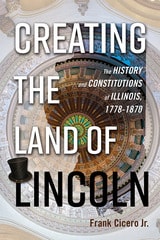
Creating the Land of Lincoln
The History and Constitutions of Illinois, 1778-1870Frank Cicero Jr.
University of Illinois Press, 2018
In its early days, Illinois seemed destined to extend the American South. Its population of transplants lived an upland southern culture and in some cases owned slaves. Yet the nineteenth century and three constitutions recast Illinois as a crucible of northern strength and American progress. Frank Cicero Jr. provides an appealing new history of Illinois as expressed by the state's constitutions—and the lively conventions that led to each one. In Creating the Land of Lincoln, Cicero sheds light on the vital debates of delegates who, freed from electoral necessity, revealed the opinions, prejudices, sentiments, and dreams of Illinoisans at critical junctures in state history. Cicero simultaneously analyzes decisions large and small that fostered momentous social and political changes. The addition of northern land in the 1818 constitution, for instance, opened up the state to immigrant populations that reoriented Illinois to the north. Legislative abuses and rancor over free blacks influenced the 1848 document and the subsequent rise of a Republican Party that gave the nation Abraham Lincoln as its president. Cicero concludes with the 1870 constitution, revealing how its dialogues and resolutions set the state on the modern course that still endures today.
[more]