Results by title
328 books match the query 'Literature and society' and 30 start with c
Can Literature Promote Justice?
Trauma Narrative and Social Action in Latin American TestimonioKimberly A. Nance
Vanderbilt University Press, 2006
The advent of the testimonio--loosely, a political autobiography of a Latin American activist who hopes, through the telling of her life story, to bring about change--was met with a great deal of excitement by scholars who posited it as a radical new form of literature. Those accolades were almost immediately followed by a series of critical problems. In what sense were testimonios "true"? What right did privileged scholars in the U.S. have to engage accounts of suffering with traditional modes of criticism? Were questions of veracity or aesthetics more important? Were these texts autobiography or political screeds? It seemed critics didn't know quite what to make of the testimonio and so, after a brief bout of engagement, disregarded it.
Nance, however, argues that any form as prolific as the testimonio is well worth examining and that these questions, rather than being insurmountable, are exactly the questions with which scholars ought to be wrestling. If, as critics claim, that the testimonio is one of the most pervasive contemporary Latin American cultural genres, then it is high time for a comprehensive study of the genre such as Nance's.

Canaan Bound
The African-American Great Migration NovelLawrence R. Rodgers
University of Illinois Press, 1997
The Great Migration--the exodus of more than six million blacks from
their southern homes hoping for better lives in the North--is a defining
event of post-emancipation African-American life and a central feature
of twentieth-century black literature. Lawrence Rodgers explores the historical
and literary significance of this event and in the process identifies
the Great Migration novel as a literary form that intertwines geography
and identity.
Drawing on a wide range of major literary voices, including Richard Wright,
Ralph Ellison, and Toni Morrison, as well as lesser-known writers such
as William Attaway (Blood on the Forge) and Dorothy West (The Living Is
Easy), Rodgers conducts a kind of literary archaeology of the Great Migration.
He mines the writers' biographical connections to migration and teases
apart the ways in which individual novels relate to one another, to the
historical situation of black America, and to African-American literature
as a whole.
In reading migration novels in relation to African-American literary
texts such as slave narratives, folk tales, and urban fiction, Rodgers
affirms the southern folk roots of African-American culture and argues
for a need to stem the erosion of southern memory.
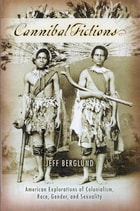
Cannibal Fictions
American Explorations of Colonialism, Race, Gender, and SexualityJeff Berglund
University of Wisconsin Press, 2006
Cannibal Fictions brings together two discrete periods in U.S. history: the years between the Civil War and World War I, the high-water mark in America's imperial presence, and the post-Vietnam era, when the nation was beginning to seriously question its own global agenda. Berglund shows how P. T. Barnum, in a traveling exhibit featuring so-called "Fiji cannibals," served up an alien "other" for popular consumption, while Edgar Rice Burroughs in his Tarzan of the Apes series tapped into similar anxieties about the eruption of foreign elements into a homogeneous culture. Turning to the last decades of the twentieth century, Berglund considers how treatments of cannibalism variously perpetuated or subverted racist, sexist, and homophobic ideologies rooted in earlier times. Fannie Flagg's novel Fried Green Tomatoes invokes cannibalism to new effect, offering an explicit critique of racial, gender, and sexual politics (an element to a large extent suppressed in the movie adaptation). Recurring motifs in contemporary Native American writing suggest how Western expansion has, cannibalistically, laid the seeds of its own destruction. And James Dobson's recent efforts to link the pro-life agenda to allegations of cannibalism in China testify still further to the currency and pervasiveness of this powerful trope.
By highlighting practices that preclude the many from becoming one, these representations of cannibalism, Berglund argues, call into question the comforting national narrative of e pluribus unum.
Capital Letters
Authorship in the Antebellum Literary MarketDavid Dowling
University of Iowa Press, 2009
In the 1840s and 1850s, as the market revolution swept the United States, the world of literature confronted for the first time the gaudy glare of commercial culture. Amid growing technological sophistication and mounting artistic rejection of the soullessness of materialism, authorship passed from an era of patronage and entered the clamoring free market. In this setting, romantic notions of what it meant to be an author came under attack, and authors became professionals.
In lively and provocative writing, David Dowling moves beyond a study of the emotional toll that this crisis in self-definition had on writers to examine how three sets of authors—in pairings of men and women: Harriet Wilson and Henry David Thoreau, Fanny Fern and Walt Whitman, and Rebecca Harding Davis and Herman Melville—engaged with and transformed the book market. What were their critiques of the capitalism that was transforming the world around them? How did they respond to the changing marketplace that came to define their very success as authors? How was the role of women influenced by these conditions?
Capital Letters concludes with a fascinating and daring transhistorical comparison of how two superstar authors—Herman Melville in the nineteenth century and Stephen King today—have negotiated the shifty terrain of the literary marketplace. The result is an important contribution to our understanding of print culture and literary work.

Captains of Charity
The Writing and Wages of Postrevolutionary Atlantic BenevolenceMary Kathleen Eyring
University of New Hampshire Press, 2017
According to Eyring, the men and women who most successfully wrote about and engaged in benevolent work strategically connected their work with the affluence generated by maritime commerce. The water trades supported the growth of the American publishing industry, but they also generated both vast inequities in wealth and physically and economically hazardous conditions that, in the absence of a welfare state, required the intervention of benevolent societies. Laborers in Atlantic port cities barred from lucrative professions by gender, race, physical ability, or social status found a way to make a living wage by conjoining the literary with the charitable—and attaching both to a profit structure. In so doing, they transformed the nature of American benevolence and gave rise to the nonprofit sector, which has since its inception provided discontented laborers with a forum in which to express their critique of for-profit American enterprise, by imitating it.
In Captains of Charity, Eyring looks at writers who overcame their marginalized status by bringing together the strands of maritime industry, publishing, and benevolence. These include Richard Allen and Absalom Jones, two black clergymen who managed a massive relief effort when refugees fleeing revolution in Haiti transported the yellow fever virus to Philadelphia in 1793; Nancy Prince, a free woman of color who sought her livelihood in the Protestant missions of Jamaica in the years immediately following Britain's emancipation of laborers in its Caribbean colonies; Sarah Josepha Hale, who parlayed the social influence she had gained as the founder of a seaman's aid society in Boston into a role as editor of the hugely popular periodical Godey's Lady's Book; and Sarah Pogson Smith, who donated the proceeds of her writing to such prominent charitable causes as the New York Institution for the Instruction of the Deaf and Dumb and then capitalized on the goodwill this charity work generated among her wealthy friends in New York City, Philadelphia, and Charleston.
Hardcover is un-jacketed.
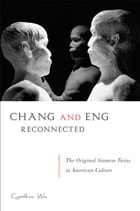
Chang and Eng Reconnected
The Original Siamese Twins in American CultureCynthia Wu
Temple University Press, 2012
Conjoined twins Chang and Eng Bunker have fascinated the world since the nineteenth century. In her captivating book, Chang and Eng Reconnected, Cynthia Wu traces the “Original Siamese Twins” through the terrain of American culture, showing how their inseparability underscored tensions between individuality and collectivity in the American popular imagination.
Using letters, medical documents and exhibits, literature, art, film, and family lore, Wu provides a trans-historical analysis that presents the Bunkers as both a material presence and as metaphor. She also shows how the twins figure in representations of race, disability, and science in fictional narratives about nation building.
As astute entrepreneurs, the twins managed their own lives; nonetheless, as Chang and Eng Reconnected shows, American culture has always viewed them through the multiple lenses of difference.
Changing Hands
Industry, Evolution, and the Reconfiguration of the Victorian BodyPeter J. Capuano
University of Michigan Press, 2015
Charity and Condescension
Victorian Literature and the Dilemmas of PhilanthropyDaniel Siegel
Ohio University Press, 2012
Charity and Condescension explores how condescension, a traditional English virtue, went sour in the nineteenth century, and considers how the failure of condescension influenced Victorian efforts to reform philanthropy and to construct new narrative models of social conciliation. In the literary work of authors like Dickens, Eliot, and Tennyson, and in the writing of reformers like Octavia Hill and Samuel Barnett, condescension—once a sign of the power and value of charity—became an emblem of charity’s limitations.
This book argues that, despite Victorian charity’s reputation for idealistic self-assurance, it frequently doubted its own operations and was driven by creative self-critique. Through sophisticated and original close readings of important Victorian texts, Daniel Siegel shows how these important ideas developed even as England struggled to deal with its growing underclass and an expanding notion of the state’s responsibility to its poor.

Chaucer's Sexual Poetics
Carolyn Dinshaw
University of Wisconsin Press, 1990
Through an analysis of the poems Chaucers wordes Unto Adam, His Owne Scriveyn, Troilus and Criseyde, the Legend of Good Women, the Man of Law’s Tale, the Wife of Bath’s Tale and its Prologue, the Clerk’s Tale, and the Pardoner’s Tale, Carolyn Dinshaw offers a provocative argument on medieval sexual constructs and Chaucer’s role in shaping them. Operating under the assumption that people read and write certain ways based upon society’s demands, Dinshaw examines gender identity and the effects of a patriarchal society. The focal point of Dinshaw’s argument is the idea that the literary text can be seen as the female body while any literary activities upon the text are decidedly male. Through a series of six provocative essays, Dinshaw argues that Chaucer was not only aware that gender is a social construction, but that he self-consciously worked to oppose the dominance of masculinity that a patriarchal society places on texts by creating works in which gender identity and hierarchy were more fluid.
Class Fictions
Shame and Resistance in the British Working Class Novel, 1890–1945Pamela Fox
Duke University Press, 1994
With a focus on certain classics in the working-class literary "canon," such as The Ragged Trousered Philanthropists and Love on the Dole, as well as lesser-known texts by working-class women, Fox uncovers the anxieties that underlie representations of class and consciousness. Shame repeatedly emerges as a powerful counterforce in these works, continually unsettling the surface narrative of protest to reveal an ambivalent relation toward the working-class identities the novels apparently champion.
Class Fictions offers an equally rigorous analysis of cultural studies itself, which has historically sought to defend and value the radical difference of working-class culture. Fox also brings to her analysis a strong feminist perspective that devotes considerable attention to the often overlooked role of gender in working-class fiction. She demonstrates that working-class novels not only expose master narratives of middle-class culture that must be resisted, but that they also reveal to us a need to create counter narratives or formulas of working-class life. In doing so, this book provides a more subtle sense of the role of resistance in working class culture. While of interest to scholars of Victorian and working-class fiction, Pamela Fox’s argument has far-reaching implications for the way literary and cultural studies will be defined and practiced.
Clear-Cutting Eden
Ecology and the Pastoral in Southern LiteratureChristopher Rieger
University of Alabama Press, 2009
Examines how Southern literary depictions of the natural world were influenced by the historical, social, and ecological changes of the 1930s and 1940s
Rieger studies the ways that nature is conceived of and portrayed by four prominent Southern writers of the era: Erskine Caldwell, Marjorie Kinnan Rawlings, Zora Neale Hurston, and William Faulkner. Specifically, he argues that these writers created new versions of an old literary mode—the pastoral—in response to the destabilizing effects of the Great Depression, the rise of Southern modernism, and the mechanization of agricultural jobs.
Mass deforestation, soil erosion, urban development, and depleted soil fertility are issues that come to the fore in the works of these writers. In response, each author depicts a network model of nature, where humans are part of the natural world, rather than separate, over, or above it, as in the garden pastorals of the Old South, thus significantly revising the pastoral mode proffered by antebellum and Reconstruction-era writers.
Each writer, Rieger finds, infuses the pastoral mode with continuing relevance, creating new versions that fit his or her ideological positions on issues of race, class, and gender. Despite the ways these authors represent nature and humankind’s place in it, they all illustrate the idea that the natural environment is more than just a passive background against which the substance of life, or fiction, is played out.

Coded Encounters
Writing, Gender, and Ethnicity in Colonial Latin AmericaFrancisco Javier Cevallos
University of Massachusetts Press, 1994
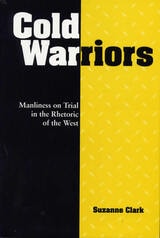
Cold Warriors
Manliness on Trial in the Rhetoric of the WestSuzanne Clark
Southern Illinois University Press, 2000
Cold Warriors: Manliness on Trial in the Rhetoric of the West returns to familiar cultural forces—the West, anticommunism, and manliness—to show how they combined to suppress dissent and dominate the unruliness of literature in the name of a national identity after World War II. Few realize how much the domination of a “white male” American literary canon was a product not of long history, but of the Cold War. Suzanne Clark describes here how the Cold War excluded women writers on several levels, together with others—African American, Native American, poor, men as well as women—who were ignored in the struggle over white male identity.
Clark first shows how defining national/individual/American identity in the Cold War involved a brand new configuration of cultural history. At the same time, it called upon the nostalgia for the old discourses of the West (the national manliness asserted by Theodore Roosevelt) to claim that there was and always had been only one real American identity.
By subverting the claims of a national identity, Clark finds, many male writers risked falling outside the boundaries not only of public rhetoric but also of the literary world: men as different from one another as the determinedly masculine Ernest Hemingway and the antiheroic storyteller of the everyday, Bernard Malamud. Equally vocal and contentious, Cold War women writers were unwilling to be silenced, as Clark demonstrates in her discussion of the work of Mari Sandoz and Ursula Le Guin.
The book concludes with a discussion of how the silencing of gender, race, and class in Cold War writing maintained its discipline until the eruptions of the sixties. By questioning the identity politics of manliness in the Cold War context of persecution and trial, Clark finds that the involvement of men in identity politics set the stage for our subsequent cultural history.
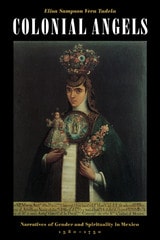
Colonial Angels
Narratives of Gender and Spirituality in Mexico, 1580-1750By Elisa Sampson Vera Tudela
University of Texas Press, 2000
Spain's attempt to establish a "New Spain" in Mexico never fully succeeded, for Spanish institutions and cultural practices inevitably mutated as they came in contact with indigenous American outlooks and ways of life. This original, interdisciplinary book explores how writing by and about colonial religious women participated in this transformation, as it illuminates the role that gender played in imposing the Spanish empire in Mexico.
The author argues that the New World context necessitated the creation of a new kind of writing. Drawing on previously unpublished writings by and about nuns in the convents of Mexico City, she investigates such topics as the relationship between hagiography and travel narratives, male visions of the feminine that emerge from the reworking of a nun's letters to her confessor into a hagiography, the discourse surrounding a convent's trial for heresy by the Inquisition, and the reports of Spanish priests who ministered to noble Indian women. This research rounds out colonial Mexican history by revealing how tensions between Spain and its colonies played out in the local, daily lives of women.

Commentary and Ideology
Dante in the RenaissanceDeborah Parker
Duke University Press, 1993
Parker begins by tracing the criticism of Dante commentaries from the nineteenth century to the present and then examines the tradition of commentary from the Middle Ages to the Renaissance. She shows how the civic, institutional, and social commitments of commentators shaped their response to the Comedy, and how commentators tried to use the poem as an authoritative source for various kinds of social legitimation. Parker discusses how different commentators dealt with a deeply political section of the poem: the damnation of Brutus and Cassius.
The scope and importance of Commentary and Ideology will command the attention of a broad group of scholars, including Italian specialists on Dante, late medievalists, students and professionals in early modern European literature, bibliographers, critical theorists, historians of literary criticism and theory, and cultural and intellectual historians.
Conditions of the Present
Selected EssaysLindon Barrett
Duke University Press, 2018
Contributors. Elizabeth Alexander, Jennifer DeVere Brody, Daphne A. Brooks, Linh U. Hua, Janet Neary, Marlon B. Ross, Robyn Wiegman
Confronting AIDS through Literature
The Responsibilities of RepresentationEdited by Judith Laurence Pastore
University of Illinois Press, 1993
Consuming Anxieties
Alcohol, Tobacco, and Trade in British Satire, 1660-1751Dayne C. Riley
Bucknell University Press, 2024
Contesting the Past, Reconstructing the Nation
American Literature and Culture in the Gilded Age, 1876-1893Benjamin A. Railton
University of Alabama Press, 2007
In this study of Gilded Age literature and culture, Ben Railton proposes that in the years after Reconstruction, America’s identity was often contested through distinct and competing conceptions of the nation’s history. He argues that the United States moved toward unifying and univocal historical narratives in the years between the Centennial and Columbian Expositions, that ongoing social conflict provided sites for complications of those narratives, and that works of historical literature offer some of the most revealing glimpses into the nature of those competing visions.
Gilded Age scholarship often connects the period to the 20th-century American future, but Railton argues that it is just as crucial to see how the era relates to the American past. He closely analyzes the 1876 and 1893 Expositions, finding that many of the period’s central trends, from technology to imperialism, were intimately connected to particular visions of the nation’s history. Railton’s concern is with four key social questions: race, Native Americans, women, and the South. He provides close readings of a number of texts for the ways they highlight these issues. He examines established classics (The Adventures of Huck Finn and The Bostonians); newer additions to the canon (The Conjure Woman, Life Among the Piutes, The Story of Avis); largely forgotten best-sellers (Uncle Remus, The Grandissimes); unrecovered gems (Ploughed Under, Where the Battle Was Fought); and autobiographical works by Douglass and Truth, poems by Harper and Piatt, and short stories by Woolson and Cook.
These readings, while illuminating the authors themselves, contribute to ongoing conversations over historical literature’s definition and value, and a greater understanding of not only American society in the Gilded Age, but also debates on our shared but contested history that remain very much alive in the present.
Corrupting Luxury in Ancient Greek Literature
Robert J. Gorman and Vanessa B. Gorman
University of Michigan Press, 2014
Countering the Counterculture
Rereading Postwar American Dissent from Jack Kerouac to Tomás RiveraManuel Luis Martinez
University of Wisconsin Press, 2003
Rebelling against bourgeois vacuity and taking their countercultural critique on the road, the Beat writers and artists have long symbolized a spirit of freedom and radical democracy. Manuel Martinez offers an eye-opening challenge to this characterization of the Beats, juxtaposing them against Chicano nationalists like Raul Salinas, Jose Montoya, Luis Valdez, and Oscar Acosta and Mexican migrant writers in the United States, like Tomas Rivera and Ernesto Galarza.
In an innovative rereading of American radical politics and culture of the 1950s and 1960s, Martinez uncovers reactionary, neoromantic, and sometimes racist strains in the Beats’ vision of freedom, and he brings to the fore the complex stances of Latinos on participant democracy and progressive culture. He analyzes the ways that Beats, Chicanos, and migrant writers conceived of and articulated social and political perspectives. He contends that both the Beats’ extreme individualism and the Chicano nationalists’ narrow vision of citizenship are betrayals of the democratic ideal, but that the migrant writers presented a distinctly radical and inclusive vision of democracy that was truly countercultural.
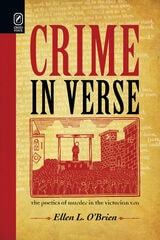
Crime in Verse
The Poetics of Murder in the Victorian EraEllen L. O’Brien
The Ohio State University Press, 2008
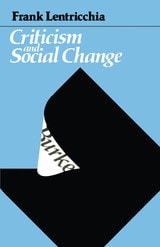
Criticism and Social Change
Frank Lentricchia
University of Chicago Press, 1984
"A profound meditation on relations obtaining among writing, political consciousness, and criticism—this last taken in its most general sense. It is written with passion and grace; it is shot through with learning, intimate knowledge of the critical tradition, and a deep (though by no means uncritical) understanding of the work (as well as social significance) of Kenneth Burke."—Hayden White
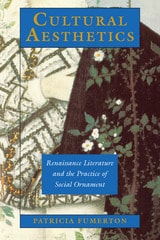
Cultural Aesthetics
Renaissance Literature and the Practice of Social OrnamentPatricia Fumerton
University of Chicago Press, 1991
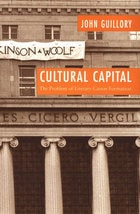
Cultural Capital
The Problem of Literary Canon FormationJohn Guillory
University of Chicago Press, 1993
Cultural Capital
The Problem of Literary Canon FormationJohn Guillory
University of Chicago Press, 2023
Since its publication in 1993, John Guillory’s Cultural Capital has been a signal text for understanding the codification and uses of the literary canon. Cultural Capital reconsiders the social basis for aesthetic judgment and exposes the unequal distribution of symbolic and linguistic knowledge on which culture has long been based. Drawing from Pierre Bourdieu’s sociology, Guillory argues that canon formation must be understood less as a question of the representation of social groups and more as a question of the distribution of cultural capital in schools, which regulate access to literacy, to the practices of reading and writing.
Now, as the crisis of the canon has evolved into the so-called crisis of the humanities, Guillory’s groundbreaking, incisive work has never been more urgent. As scholar and critic Merve Emre writes in her introduction to this enlarged edition: “Exclusion, selection, reflection, representation—these are the terms on which the canon wars of the last century were fought, and the terms that continue to inform debates about, for instance, decolonizing the curriculum and the rhetoric of antiracist pedagogy.”

Cultural Conservatism, Political Liberalism
From Criticism to Cultural StudiesJames Seaton
University of Michigan Press, 1996
Chapters on Lionel Trilling, H. L. Mencken and Irving Babbitt, Ralph Ellison, Dwight Macdonald, Diana Trilling, and Edmund Wilson affirm the continuing pertinence of their work to today's concerns. Seaton then turns to the careers of Leslie Fiedler and Susan Sontag to explore the impact of the cultural radicalism of the sixties on literary criticism. Subsequent chapters analyze the successes and failures of contemporary cultural studies through the writings of Richard Rorty, Edward Said, Stanley Fish and Fredric Jameson.
Separately, these chapters provide provocative readings of the individual critics; together they make a case for the tradition exemplified by these critics as an alternative to contemporary cultural studies. The issues the book discusses extend beyond literary criticism and the academic world to the political-religious- cultural conflicts of today's culture wars.
"These lively, closely argued essays explain very clearly what the issues are, how they arose, and why they are important." --Christopher Lasch
"A forceful argument about the relationship between literary studies and politics that will add something important to the vigorous, and often fierce, discussion of the canon, the politics of literature, and educational reform."--William Cain, Wellesley College
James Seaton is Professor of English, Michigan State University. He is co-editor, with William K. Buckley, of Beyond Cheering and Bashing: New Perspectives on the Closing of the American Mind.
Cultural Considerations
Essays on Readers, Writers, and Musicians in Postwar AmericaJoan Shelley Rubin
University of Massachusetts Press, 2013
Focusing on aspects of American literary and musical culture in the decades after World War II, Rubin examines the contests between critics and their readers over the authority to make aesthetic judgments; the effort of academics to extend the university outward by bringing the humanities to a wide public; the politics of setting poetic texts to music; the role of ideology in the practice of commissioning and performing choral works; and the uses of reading in the service of both individualism and community. Specific topics include the 1957 attack by the critic John Ciardi on the poetry of Anne Morrow Lindbergh in the Saturday Review; the radio broadcasts of the classicist Gilbert Highet; Dwight Macdonald's vitriolic depiction of the novelist James Gould Cozzens as a pernicious middlebrow; the composition and reception of Howard Hanson's "Song of Democracy"; the varied career of musician Gunther Schuller; the liberal humanism of America's foremost twentieth-century choral conductor, Robert Shaw; and the place of books in the student and women's movements of the 1960s.
What unites these essays is the author's ongoing concern with cultural boundaries, mediation, and ideology--and the contradictions they frequently entail.
Cultures of Letters
Scenes of Reading and Writing in Nineteenth-Century AmericaRichard H. Brodhead
University of Chicago Press, 1993
Curiosity
A Cultural History of Early Modern InquiryBarbara M. Benedict
University of Chicago Press, 2001
In this striking social history, Barbara M. Benedict draws on the texts of the early modern period to discover the era's attitudes toward curiosity, a trait we learn was often depicted as an unsavory form of transgression or cultural ambition.