Results by title
99 books match the query 'Local' and 9 start with c

Change and Continuity in Minangkabau
Local, Regional, and Historical Perspectives on West SumatraLynn L. Thomas
Ohio University Press, 1985
Focusing on Minangkabau proper, and treating several adjacent areas as well, this collection examines the resilience and adaptability of the Minangkabau in the face of outside political and economic pressures and of distortions in social science and legal theory. Individual studies address issues of kinship and other forms of social organization, ideology, and political and economic life. Together, they emphasize the integrity of Minangkabau social forms while revealing fascinating patterns of continuity and change in Minangkabau culture.
This collection will be of particular interest to anthropologists specializing in Southeast Asia, but it will also be important reading for those concerned with the issue of change and continuity in the third world generally.

Chicago Latina Trailblazers
Testimonios of Political ActivismEdited by Rita D. Hernández, Leticia Villarreal Sosa, Elena R. Gutiérrez
University of Illinois Press, 2024
Mexican American and Puerto Rican women have long taken up the challenge to improve the lives of Chicagoans in the city’s Latino/a/x communities. Rita D. Hernández, Leticia Villarreal Sosa, and Elena R. Gutiérrez present testimonies by Latina leaders who blazed new trails and shaped Latina Chicago history from the 1960s through today.
Taking a do-it-all attitude, these women advanced agendas, built institutions, forged alliances, and created essential resources that Latino/a/x communities lacked. Time and again, they found themselves the first Latina to hold their post or part of the first Latino/a/x institution of its kind. Just as often, early grassroots efforts to address issues affecting themselves, their families, and their neighborhoods grew into larger endeavors. Their experiences ranged from public schools to healthcare to politics to broadcast media, and each woman’s story shows how her work changed countless lives and still reverberates across the entire city.
An eyewitness view of an unknown history, Chicago Latina Trailblazers reveals the vision and passion that fueled a group of women in the vanguard of reform.
Contributors: Ana Castillo, Maria B. Cerda, Carmen Chico, Aracelis Flecha Figueroa, Aida Luz Maisonet Giachello, Mary Gonzales, Ada Nivia López, Emma Lozano, Virginia Martinez, Carmen Mendoza, Elena Mulcahy, Guadalupe Reyes, Luz Maria B. Solis, and Carmen Velasquez
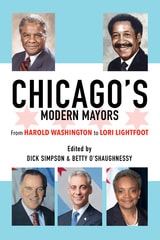
Chicago’s Modern Mayors
From Harold Washington to Lori LightfootEdited by Dick Simpson and Betty O'Shaughnessy
University of Illinois Press, 2024
Chicago’s transformation into a global city began at City Hall. Dick Simpson and Betty O’Shaughnessy edit in-depth analyses of the five mayors that guided the city through this transition beginning with Harold Washington’s 1983 election: Washington, Eugene Sawyer, Richard M. Daley, Rahm Emmanuel, and Lori Lightfoot. Though the respected political science, sociologist, and journalist contributors approach their subjects from distinct perspectives, each essay addresses three essential issues: how and why each mayor won the office; whether the City Council of their time acted as a rubber stamp or independent body; and the ways the unique qualities of each mayor’s administration and accomplishments influenced their legacy.
Filled with expert analysis and valuable insights, Chicago’s Modern Mayors illuminates a time of transition and change and considers the politicians who--for better and worse--shaped the Chicago of today.
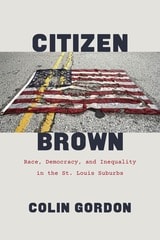
Citizen Brown
Race, Democracy, and Inequality in the St. Louis SuburbsColin Gordon
University of Chicago Press, 2019
Citizen Brown uncovers half a century of private practices and public policies that resulted in bitter inequality and sustained segregation in Ferguson and beyond. Gordon shows how municipal and school district boundaries were pointedly drawn to contain or exclude African Americans and how local policies and services—especially policing, education, and urban renewal—were weaponized to maintain civic separation. He also makes it clear that the outcry that arose in Ferguson was no impulsive outburst but rather an explosion of pent-up rage against long-standing systems of segregation and inequality—of which a police force that viewed citizens not as subjects to serve and protect but as sources of revenue was only the most immediate example. Worse, Citizen Brown illustrates the fact that though the greater St. Louis area provides some extraordinarily clear examples of fraught racial dynamics, in this it is hardly alone among American cities and regions.
Interactive maps and other companion resources to Citizen Brown are available at the book website.
Citizen Lobbyists
Local Efforts to Influence Public PolicyBrian Adams
Temple University Press, 2006
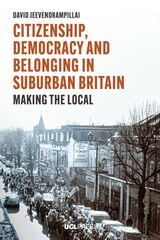
Citizenship, Democracy and Belonging in Suburban Britain
Making the LocalDavid Jeevendrampillai
University College London, 2021
An activist group in outer London’s Surbiton suburb, the Seething Villagers commemorate a fictional local history through tongue-in-cheek community festivals. These admittedly “stupid” gatherings celebrate a mythical village of Seething and its many adventures, including a run-in with a mountain-crushing giant. Citizenship, Democracy and Belonging in Suburban Britain explores how the Seething Villagers and other suburbanite fantasies fashion community in the face of neoliberal isolation. By taking the artists’ playfulness seriously, David Jeevendrampillai demonstrates how suburbanites develop fellow-feeling without access to traditional community centers.
City and Regime in the American Republic
Stephen L. Elkin
University of Chicago Press, 1987
The present workings of American urban political institutions are, Elkin maintains, characterized by a close relationship between politicians and businessmen, a relationship that promotes neither political equality nor effective social problem-solving. Elkin pays particular attention to the issue of land-use in his analysis of these failures of popular control in traditional city politics. Urban political institutions, however, are not just instruments for the dispensing of valued outcomes or devices for social problem-solving—they help to form the citizenry. Our present institutions largely define citizens as interest group adversaries and do little to encourage them to focus on the commercial public interest of the city. Elkin concludes by proposing new institutional arrangements that would be better able to harness the self-interested behavior of individuals for the common good of a commercial republic.
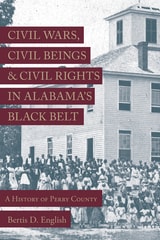
Civil Wars, Civil Beings, and Civil Rights in Alabama's Black Belt
A History of Perry CountyBertis D. English, Foreword by Wayne Flynt
University of Alabama Press, 2020
Reconstruction politics and race relations between freed blacks and the white establishment in Perry County, Alabama
In his fascinating, in-depth study, Bertis D. English analyzes why Perry County, situated in the heart of a violence-prone subregion of Alabama, enjoyed more peaceful race relations and less bloodshed than several neighboring counties. Choosing an atypical locality as central to his study, English raises questions about factors affecting ethnic disturbances in the Black Belt and elsewhere in Alabama. He also uses Perry County, which he deems an anomalous county, to caution against the tendency of some scholars to make sweeping generalizations about entire regions and subregions.
English contends Perry County was a relatively tranquil place with a set of extremely influential African American businessmen, clergy, politicians, and other leaders during Reconstruction. Together with egalitarian or opportunistic white citizens, they headed a successful campaign for black agency and biracial cooperation that few counties in Alabama matched. English also illustrates how a significant number of educational institutions, a high density of African American residents, and an unusually organized and informed African American population were essential factors in forming Perry County’s character. He likewise traces the development of religion in Perry, the nineteenth-century Baptist capital of Alabama, and the emergence of civil rights in Perry, an underemphasized center of activism during the twentieth century.
This well-researched and comprehensive volume illuminates Perry County’s history from the various perspectives of its black, interracial, and white inhabitants, amplifying their own voices in a novel way. The narrative includes rich personal details about ordinary and affluent people, both free and unfree, creating a distinctive resource that will be useful to scholars as well as a reference that will serve the needs of students and general readers.
Communities of Work
Rural Restructuring in Local and Global ContextsWilliam W. Falk
Ohio University Press, 2003
The image of rural America portrayed in this illuminating study is one that is vibrant, regionally varied, and sometimes heroic. Communities of Work focuses on the ways in which rural people and places are affected by political, social, and economic forces far outside their control and how they sustain themselves and their communities in response.
Bringing together the two fundamental concepts of community—where the relationships and practices of daily life occur—and work, in which an elementary exchange occurs, Communities of Work bridges several fields of study. Presented here is the contextual and embedded nature of social relations and the complexity involved in understanding them. Through the use of multiple case studies, the authors apply diverse theories and methods in seeking an integrated outcome, one captured by “communities of work.”
Beginning with a description of the broad changes in work and economic activities across the United States, ranging from the Ohio River Valley to a western boomtown, the book shifts its focus to the interplay of work, family, and local networks in time and place. Activities range from fishing in the Mississippi Delta to farming and family life in the Midwest. The authors then highlight how rural people and places respond to extra-local, increasingly global forces in settings as diverse as rural South Carolina and Wisconsin.
A certain communitarian theme runs through Communities of Work. It is about people and communities not merely reacting, but instead responding in ways that reflect their local culture, while being cognizant of the larger world within which they live.