Results by title
64 books match the query 'Military policy' and 5 start with c
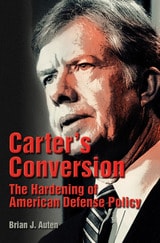
Carter's Conversion
The Hardening of American Defense PolicyBrian J. Auten
University of Missouri Press, 2008
When presidential candidate Jimmy Carter advocated defense budget cuts, he did so not only to save money but also with the hope of eventually abolishing nuclear weapons. Three yearslater, when President Carter announced his support of full-scale development of the MX missile and modernization of NATO’s Long-Range Theater Nuclear Force, it marked a dramatic policy shift for his administration.
In light of Carter’s cost-cutting in the first year of his administration, previous observers have attributed Carter’s subsequent shift either to the “shocks of 1979”—the Soviet Union’s move into Afghanistan and the seizure of power by Islamic revolutionaries in Iran—or to domestic political pressure, such as interest group activity, executive-legislative bargaining, or interbureaucratic conflict. Brian Auten now argues that these explanations only partially explain this midterm policy change.
In Carter’s Conversion, Auten reveals how strategic ideas and studies, allied relations, and arms control negotiations each worked to deflect Carter’s initial defense stance away from the policy path suggested by the prevailing international military environment. He also shows how the administration’s MX and Long-Range Theater Nuclear Force decisions subsequently hardened following significant adjustments to these three variables.
Employing the approach to international relations known as neoclassical realism, Auten demonstrates that Carter reassessed his strategic thinking and revised his policy stance accordingly. Integrating declassified documents, interviews, and private archives with a mountain of secondary sources, he provides a historical analysis of defense policy transformation over the first three years of the Carter administration and a detailed examination of how Carter and his national security team addressed challenges posed by the expansion of Soviet military power.
Full of rich history and cogent analysis, Carter’s Conversion presents a wealth of detailed arguments about how Carter adjusted his policy outlook, couched in a thorough understanding of weapons, arms control dynamics, and defense policy-making. As a revision ofcommon interpretations, it provides both an example of self-correcting policy change and a realist argument about the end of superpower détente and the start of the “Second Cold War.”
[more]
Civil Wars and Foreign Powers
Outside Intervention in Intrastate ConflictPatrick M. Regan
University of Michigan Press, 2002
We have seen recent massive intervention by the United States and its allies in Europe in internal conflict in Bosnia and Kosovo. In Civil Wars and Foreign Powers: Outside Intervention in Intrastate Conflict, Patrick Regan systematically answers the question about the conditions under which third parties intervene in civil conflicts to stop the fighting. It uses data on all civil conflicts since 1945 to identify those conflicts that are amenable to outside interventions and the types of interventions that are more likely to be successful. Civil Wars and Foreign Powers is a book about how governments can help facilitate the end of civil conflicts. In a time when internal conflicts appear to be increasing in number, and increasingly destabilizing, governments need to know what policies work and when. Interventions are generally of two sorts -- unilateral, or when one state takes action, and multilateral, such as UN or NATO action. This book examines the conditions under which each form of intervention is most likely and most effective. The analysis suggests that three conditions associated with multi-lateral interventions will increase the likelihood of success: mutual consent of the parties involved; impartiality on the part of the intervenors; and the existence of a coherent intervention strategy. The questions are posed from the perspective of the decision maker and the answers offered are framed in a language familiar to the decision-making community. The book mixes descriptive case material with systematic statistical analysis of a unique data set of all civil conflicts since World War II, providing contemporary examples to illustrate overall trends in the data. Beyond the policy implications this work is also rich in theoretical development about issues of conflict and conflict management. This book will appeal to students of international conflict, civil war, ethnic conflict, and those who are concerned with developing policy in the post-cold war world to deal with intrastate conflict.
[more]
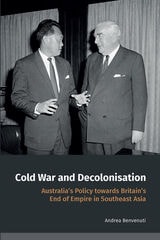
Cold War and Decolonisation
Australia's Policy towards Britain's End of Empire in Southeast AsiaAndrea Benvenuti
National University of Singapore Press, 2017
In this book, Andrea Benvenuti discusses the development of Australia’s foreign and defense policies toward Malaya and Singapore in light of the redefinition of Britain’s imperial role in Southeast Asia and the formation of new postcolonial states. Benvenuti sheds light on the impact of Britain on Australia’s political and strategic interests in Southeast Asia during the Cold War. It will be of interest to historians of Australia’s foreign relations, Southeast Asia, and the British Empire and decolonization.
[more]
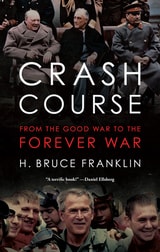
Crash Course
From the Good War to the Forever WarFranklin, H. Bruce
Rutgers University Press, 2024
Growing up during the Second World War, H. Bruce Franklin believed what he was told: that America’s victory would lead to a new era of world peace. Like most Americans, he was soon led to believe in a world-wide Communist conspiracy that menaced the United States, forcing the nation into a disastrous war in Korea. But once he joined the U.S. Air Force and began flying top-secret missions as a navigator and intelligence officer, what he learned was eye-opening. He saw that even as the U.S. preached about peace and freedom, it was engaging in an endless cycle of warfare, bringing devastation and oppression to fledgling democracies across the globe.
Now, after fifty years as a renowned cultural historian, Franklin offers a set of hard-learned lessons about modern American history. Crash Course is essential reading for anyone who wonders how America ended up where it is today: with a deeply divided and disillusioned populace, led by a dysfunctional government, and mired in unwinnable wars. It also finds startling parallels between America’s foreign military exploits and the equally brutal tactics used on the home front to crush organized labor, antiwar, and civil rights movements.
More than just a memoir or a history book, Crash Course gives readers a unique firsthand look at the building of the American empire and the damage it has wrought. Shocking and gripping as any thriller, it exposes the endless deception of the American public, and reveals from inside how and why many millions of Americans have been struggling for decades against our own government in a fight for peace and justice.
[more]
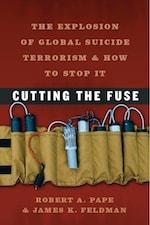
Cutting the Fuse
The Explosion of Global Suicide Terrorism and How to Stop ItRobert A. Pape and James K. Feldman
University of Chicago Press, 2012
Cutting the Fuse offers a wealth of new knowledge about the origins of suicide terrorism and strategies to stop it. Robert A. Pape and James K. Feldman have examined every suicide terrorist attack worldwide from 1980 to 2009, and the insights they have gleaned from that data fundamentally challenge how we understand the root causes of terrorist campaigns today—and reveal why the War on Terror has been ultimately counterproductive. Through a close analysis of suicide campaigns by Al Qaeda and other terrorist organizations in Iraq, Afghanistan, Pakistan, Lebanon, Israel, Chechnya, and Sri Lanka, the authors provide powerful new evidence that, contrary to popular and dangerously mistaken belief, only a tiny minority of these attacks are motivated solely by religion. Instead, the root cause is foreign military occupation, which triggers secular and religious people alike to carry out suicide attacks.
Cutting the Fuse calls for new, effective solutions that America and its allies can sustain for decades, relying less on ground troops in Muslim countries and more on offshore, over-the-horizon military forces along with political and economic strategies that empower local communities to stop terrorists in their midst.
[more]