126 books match the query 'New England' and 6 start with c
cover of Capitalism, Politics, and Railroads in Jacksonian New England

Capitalism, Politics, and Railroads in Jacksonian New England

Michael J. Connolly

University of Missouri Press, 2003
In this engaging new study, Michael J. Connolly seeks to understand the interrelationships among political change, economic interests, and railroad development in northern New England prior to the Civil War. He analyzes the political thought of the region as it involved the growth of party confrontations—among the Radical Democrats in New Hampshire, the Whigs and Conservative Democrats in New Hampshire, and the Whigs in Essex County, Massachusetts—and the rise of voting activity. An assortment of antebellum demographic data on the various railroad lines is made clear by the maps in the book.
New England was an older region with settled patterns of political economy, and innovations like the railroad forced antebellum citizens to alter their patterns of life. Jacksonian Democrats debated among themselves the wisdom of railroad technology, its influence on political power, and its effect on regional economies, remaining skeptical about how this invention would improve their lives. They voiced serious concern that railroads would shrink private rights and destroy the existing “liberal capitalist” economy, all the while making northern New Englanders the minions of business interests far away in Boston and Canada. These concerns separated them from the Whigs.
Whigs remained ebullient over how railroads would transform their political and economic lives, improve the lot of every New Englander in the long run, and rescue a dying region from social oblivion. They believed that danger came in not developing railroads. Whigs were willing to extend public power to a remarkable extent: bridges were destroyed, courthouses demolished, land and buildings taken to make way for railroads. Less sophisticated in economic understanding than the Jacksonians, Whigs never worried over “illiberal capitalism”; they welcomed it. The great consensus between Jacksonians and Whigs was capitalism. No one opposed markets.
The antebellum conflict was not about whether America should be a market society, but what shape those markets should take; not about whether government should have power over private rights, but to what extent states could impose on private citizens. At the center of this debate was the railroad.
Providing an excellent view of the economics of railroad development and how it affected the factory and farm world of northern New England, Capitalism, Politics, and Railroads in Jacksonian New England makes a major contribution to our full understanding of the coming of the Civil War.
[more]
cover of Conquering the American Wilderness: The Triumph of European Warfare in the Colonial Northeast

Conquering the American Wilderness

The Triumph of European Warfare in the Colonial Northeast

Guy Chet

University of Massachusetts Press, 2003

A study of military tactics and strategy before the War of Independence, this book reexamines the conquest of the North American wilderness and its native peoples by colonial settlers. Historians have long believed that the peculiar conditions of the New World, coupled with the success of Indians tactics, forced the colonists to abandon traditional European methods of warfare and to develop a new “American” style of combat. By combining firearms with guerrilla-like native tactics, colonial commanders were able not only to subdue their Indian adversaries but eventually to prevail against more conventionally trained British forces during the American Revolution. Yet upon closer scrutiny, this common understanding of early American warfare turns out to be more myth than reality. 

As Guy Chet reveals, clashes between colonial and Indian forces during the seventeenth and eighteenth centuries did not lead to a reevaluation and transformation of conventional military doctrine. On the contrary, the poor performance of the settlers during King Philip's War (1675–76) and King William's War (1689–1697) prompted colonial magistrates to address the shortcomings of their military forces through a greater reliance on British troops and imperial administrators. Thus, as the eighteenth century wore on, growing military success in the New England colonies reflected an increasing degree of British planning, administration, participation, and command. The colonies' military and political leadership, Chet argues, never rejected the time-tested principles of European warfare, and even during the American War of Independence, the republic's military leadership looked to Europe for guidance in the art of combat.
[more]
cover of Country Place: A Novel

Country Place

A Novel

Ann Petry, foreword by Farah Jasmine Griffin

Northwestern University Press, 1947
A 1947 novel by best-selling African American author Ann Petry, Country Place opens with a soldier returning from World War II and his effort to rescue his failing marriage.

 
[more]
cover of Creating New England, Defending the Northeast: Contested Algonquian and English Spatial Worlds, 1500–1700

Creating New England, Defending the Northeast

Contested Algonquian and English Spatial Worlds, 1500–1700

Nathan Braccio

University of Massachusetts Press, 2026

Examining maps and placemaking during negotiations between Indigenous people and colonial settlers
 
Between 1500 and 1700, Indigenous and English mapmakers across the North Atlantic depicted present-day New England in markedly distinct ways, highlighting how differently their communities understood the landscape. While English cartographers relied on new mathematics and other developing scientific knowledge from Europe, as well as an overhead perspective of the world, Algonquian mapmakers drew on deep knowledge of the landscape, derived from their communities’ long history upon it. Nathan Braccio refers to this phenomenon as “parallel landscapes.”

Creating New England, Defending the Northeast asserts that Algonquian knowledge of the landscape represented a powerful and persistent alternative to English surveying and mapmaking in the Northeast. When English colonists and explorers recognized the unsuitability of their techniques for understanding New England’s unfamiliar landscape, they attempted to appropriate Indigenous knowledge and maps. Algonquian sachems used this as an opportunity to control and benefit from their new English neighbors. Later, as the English became insecure in their dependence on Indigenous people, they began to remake and mark the landscape. Algonquians adapted, maintaining control of important spatial knowledge, even in a place no longer entirely of their making. This story complicates narratives of conquest and highlights the Indigenous spatial knowledge too often overlooked.
 
[more]
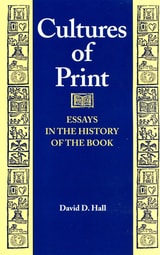
cover of Cultures of Print: Essays in the History of the Book

Cultures of Print

Essays in the History of the Book

David D. Hall

University of Massachusetts Press, 1996

How did people in early America understand the authority of print and how was this authority sustained and contested? These questions are at the heart of this set of pathbreaking essays in the history of the book by one of America's leading practitioners in this interdisciplinary field.

David D. Hall examines the interchange between popular and learned cultures and the practices of reading and writing. His writings deal with change and continuity, exploring the possibility of a reading revolution and arguing for the long duration of a Protestant vernacular tradition. A newly written essay on book culture in the early Chesapeake describes a system of scribal publication. The pieces reflect Hall's belief that the better we understand the production and consumption of books, the closer we come to a social history of culture.
[more]
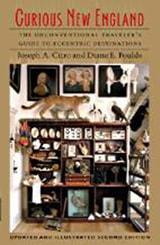
cover of Curious New England: The Unconventional Traveler’s Guide to Eccentric Destinations

Curious New England

The Unconventional Traveler’s Guide to Eccentric Destinations

Joseph E. Citro and Diane E. Foulds

University Press of New England, 2004

New England is truly a Cabinet of Curiosities, and this indispensable guide directs you to its most bizarre, off the wall, and unsettling exhibits. Some evoke hilarity, some horror. Discover singing sand, glowing tombstones, ghostly squirrels, and a musical instrument said to cause madness. Marvel at the most mysterious manuscript in the world. Visit a miniature replica of the Holy Land or climb carved stone steps leading . . . nowhere. Curious New England points the way to all the tantalizing treats and terrifying treasures that remain tucked away in overlooked museums, private collections, and forgotten recesses of this very special region. *A cursed statue in Maine *Ageless American Megaliths *A window embedded in Vermont earth *Titus’s Arch on a New Hampshire hilltop *Artwork made from insect parts With precise directions, hours, and contact information, these fascinating pages reveal each mystery, miracle, and marvel, from world-class weirdness, to minor curiosities, to entertaining distractions. There'll be no more boring Sunday drives when you can visit a spider farm, explore the laboratory of “mad” scientist Wilhelm Reich, view the Hobo Hotel, and observe houses made from paper, wooden crates, mounds of earth—even covered bridges. And New England’s wonders never cease: discover evidence of manned flight a century before the Wright Brothers; visible phantoms manifesting from marble columns; and automobiles emerging from tarmac like dinosaurs from pits of tar. This one-of-a-kind collection spotlights all six New England states, illuminating everything that’s wicked, weird, and wonderful in every hidden corner of a region that rivals Old England in mysteries, miracles, and marvels.
[more]