126 books match the query 'People with disabilities' and 13 start with c

cover of Care at the End of the World: Dreaming of Infrastructure in Crip-of-Color Writing

Care at the End of the World

Dreaming of Infrastructure in Crip-of-Color Writing

Jina B. Kim

Duke University Press, 2025
In Care at the End of the World, Jina B. Kim develops what she calls crip-of-color critique, bringing a disability lens to bear on feminist- and queer-of-color literature in the aftermath of 1996 US welfare reform and the subsequent evisceration of social safety nets. She examines literature by contemporary feminist, queer, and disabled writers of color such as Jesmyn Ward, Octavia Butler, Karen Tei Yamashita, Samuel Delany, and Aurora Levins Morales, who each bring disability and dependency to the forefront of their literary freedom dreaming. Kim shows that in their writing, liberation does not take the shape of the unfettered individual or hinge on achieving independence. Instead, liberation emerges by recuperating dependency, cultivating radical interdependency, and recognizing the numerous support systems upon which survival depends. At the same time, Kim demonstrates how theories and narratives of disability can intervene into state-authored myths of resource parasitism, such as the welfare queen. In so doing, she highlights the alternate structures of care these writers envision and their dreams of life organized around reciprocity and mutual support.
[more]
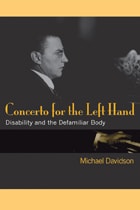
cover of Concerto for the Left Hand: Disability and the Defamiliar Body

Concerto for the Left Hand

Disability and the Defamiliar Body

Michael Davidson

University of Michigan Press, 2008

Concerto for the Left Hand is at the cutting edge of the expanding field of disability studies, offering a wide range of essays that investigate the impact of disability across various art forms---including literature, performance, photography, and film. Rather than simply focusing on the ways in which disabled persons are portrayed, Michael Davidson explores how the experience of disability shapes the work of artists and why disability serves as a vital lens through which to interpret modern culture. Covering an eclectic range of topics---from the phantom missing limb in film noir to the poetry of American Sign Language---this collection delivers a unique and engaging assessment of the interplay between disability and aesthetics. Written in a fluid, accessible style, Concerto for the Left Hand will appeal to both specialists and general audiences. With its interdisciplinary approach, this book should appeal not only to scholars of disability studies but to all those working in minority art, deaf studies, visual culture, and modernism.
[more]
cover of Confronting the "Good Death": Nazi Euthanasia on Trial, 1945-1953

Confronting the "Good Death"

Nazi Euthanasia on Trial, 1945-1953

Michael S. Bryant

University Press of Colorado, 2022

Years before Hitler unleashed the “Final Solution” to annihilate European Jews, he began a lesser-known campaign to eradicate the mentally ill, which facilitated the gassing and lethal injection of as many as 270,000 people and set a precedent for the mass murder of civilians. In Confronting the “Good Death” Michael Bryant analyzes the U.S. government and West German judiciary’s attempt to punish the euthanasia killers after the war.

The first author to address the impact of geopolitics on the courts’ representation of Nazi euthanasia, Bryant argues that international power relationships wreaked havoc on the prosecutions.

Drawing on primary sources, this provocative investigation of the Nazi campaign against the mentally ill and the postwar quest for justice will interest general readers and provide critical information for scholars of Holocaust studies, legal history, and human rights. Support for this publication was generously provided by the Eugene M. Kayden Fund at the University of Colorado.
[more]
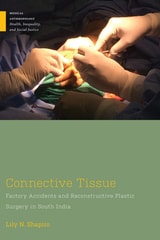
cover of Connective Tissue: Factory Accidents and Reconstructive Plastic Surgery in South India

Connective Tissue

Factory Accidents and Reconstructive Plastic Surgery in South India

Lily N. Shapiro

Rutgers University Press, 2025

An ethnography of factory accidents and their attendant reconstructive plastic surgeries in Coimbatore, Tamil Nadu, Connective Tissue explores notions of risk, work and labor practices, and the way meaning is made from experiences of trauma, care, and recovery. The book charts a rough chronology of the accident—from the workspace that preceded it, the transformation of the workspace by the accident, through journeys to and treatment in the hospital, and then the various and complex ways in which the accident reverberates into the future during recovery.
 
Connective Tissue revisits scholarship on factory labor by analyzing the accident as constitutive of the experience of work itself, and it refines existing conversations about the body, trauma, and care by introducing an analysis informed by theories of labor and production. Author Lily N. Shapiro argues that care does not happen in spite of or on the margins of capitalism, but rather that capitalism happens in and through care and caring relations. These experiences are intersected by identities of caste, class, and gender, and entangled in state discourse about labor rights, welfare, and industrial law.
 
[more]
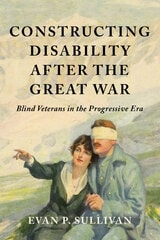
cover of Constructing Disability after the Great War: Blind Veterans in the Progressive Era

Constructing Disability after the Great War

Blind Veterans in the Progressive Era

Evan P. Sullivan

University of Illinois Press, 2024

As Americans--both civilians and veterans--worked to determine the meanings of identity for blind veterans of World War I, they bound cultural constructs of blindness to all the emotions and contingencies of mobilizing and fighting the war, and healing from its traumas. Sighted Americans’ wartime rehabilitation culture centered blind soldiers and veterans in a mix of inspirational stories. Veterans worked to become productive members of society even as ableism confined their unique life experiences to a collection of cultural tropes that suggested they were either downcast wrecks of their former selves or were morally superior and relatively flawless as they overcame their disabilities and triumphantly journeyed toward successful citizenship. Sullivan investigates the rich lives of blind soldiers and veterans and their families to reveal how they confronted barriers, gained an education, earned a living, and managed their self-image while continually exposed to the public’s scrutiny of their success and failures.
[more]
cover of Crip Authority: Disability and the Art of Consolation  in the Renaissance

Crip Authority

Disability and the Art of Consolation in the Renaissance

Elizabeth B. Bearden

University of Michigan Press, 2025

Crip Authority explores how Renaissance writers and artists with disabilities drew on consolatory literature to enhance their authority and create a sense of disability community across the centuries. Elizabeth B. Bearden considers how Renaissance writers and artists understood their lived experiences of disability by drawing on the ancient genre of consolation, which aims to comfort people for a variety of hardships, including mental and physical disability. Renaissance writers used the art of consolation to resignify the mental and physical disabilities that their society frequently scorned into an expression of their military, spiritual, political, and most importantly for this study, writerly authority. Bearden names this kind of defiant authorial self-representation crip authority, thereby transgressively cripping our society’s ableist notions of who has the ability and authority to write.  

Disabled authors include Francesco Petrarca, Teresa de Cartagena, Giovani Paolo Lomazzo, Miguel de Cervantes Saavedra, Robert Burton, and John Milton. They all explore their experiences of disability, but their work has rarely or never been considered from a disability studies perspective. Bearden thus brings today’s models of disability studies and crip theory together with early modern articulations of disability based on ancient and Renaissance models of military, political, biblical, and literary authority. In sum, Crip Authority makes a significant contribution to the growing field of early modern disability studies and invites us to rethink the extent of crip history and the endurance of disability gain.

[more]
cover of Crip Genealogies

Crip Genealogies

Mel Y. Chen, Alison Kafer, Eunjung Kim, and Julie A. Minich, editors

Duke University Press, 2023

The contributors to Crip Genealogies reorient the field of disability studies by centering the work of transnational feminism, queer of color critique, and trans scholarship and activism. They challenge the white, Western, and Northern rights-based genealogy of disability studies, showing how a single coherent narrative of the field is a mode of exclusion that relies on logics of whiteness and imperialism. The contributors examine how disability justice activists work in concert with other social justice projects, explore crip environments, create alternate disciplinary genealogies, and reject notions of the model minority. Throughout, they demonstrate how the mandate for a single genealogy of the discipline whitewashes disability and continues forms of violence. By cripping disability studies, the contributors allow for divergent histories, the coexistence of anti-ableist and antiracist theorizing, and a radically just and capacious understanding of disability.

Contributors. Suzanne Bost, Mel Y. Chen, Sony Coráñez Bolton, Natalia Duong, Lezlie Frye, Magda García, Alison Kafer, Eunjung Kim, Yoo-suk Kim, Kateřina Kolářová, James Kyung-Jin Lee, Stacey Park Milbern, Julie Avril Minich, Tari Young-Jung Na, Therí A. Pickens, Leah Lakshmi Piepzna-Samarasinha, Jasbir K. Puar, Sami Schalk, Faith Njahîra Wangarî

[more]
cover of Crip Love Onscreen: Representations of Love, Sex, and Disability

Crip Love Onscreen

Representations of Love, Sex, and Disability

Sarah Rainey-Smithback

The Ohio State University Press, 2026

Crip Love Onscreen: Representations of Love, Sex, and Disability examines how disabled people’s sexual lives—including pleasure/sex, love, pregnancy, and sexual violence—are represented in popular film and television. Analyzing a variety of films and TV shows from the United States, Canada, and the United Kingdom, Sarah Rainey-Smithback traces patterns in disability representation that ignore or distort many of the realities of crip sexuality. These patterns of sexual representation tend to uphold compulsory able-bodiedness, heteronormativity, and privacy norms—what Rainey-Smithback terms “neoliberal love values,” or standards that celebrate normative forms of sexual desire, bodies, and intimacy practices.

As disability representation increases, though, new possibilities are emerging. Crip Love Onscreen also draws attention to the exceptional through a close reading of screen narratives (such as 50 First Dates,Love and Other Drugs,American Horror Story: Freak Show, and more) that push against neoliberal, heteronormative, and ableist values. Drawing on the work of queer/crip scholars and activists, Rainey-Smithback uncovers glimpses of what Tobin Siebers calls a “sexual culture for disabled people”—a space and way of being that expands sexual access and sexual experience.

[more]
cover of Crip Spacetime: Access, Failure, and Accountability in Academic Life

Crip Spacetime

Access, Failure, and Accountability in Academic Life

Margaret Price

Duke University Press, 2024
In Crip Spacetime, Margaret Price intervenes in the competitive, productivity-focused realm of academia by sharing the everyday experiences of disabled academics. Drawing on more than three hundred interviews and survey responses, Price demonstrates that individual accommodations—the primary way universities address accessibility—actually impede access rather than enhance it. She argues that the pains and injustices encountered by academia’s disabled workers result in their living and working in realities different from nondisabled colleagues: a unique experience of space, time, and being that Price theorizes as “crip spacetime.” She explores how disability factors into the exclusionary practices found in universities, with multiply marginalized academics facing the greatest harms. Highlighting the knowledge that disabled academics already possess about how to achieve sustainable forms of access, Price boldly calls for the university to move away from individualized models of accommodation and toward a new system of collective accountability and care.
[more]
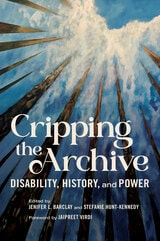
cover of Cripping the Archive: Disability, History, and Power

Cripping the Archive

Disability, History, and Power

Edited by Jenifer L. Barclay and Stefanie Hunt-Kennedy Foreword by Jaipreet Virdi

University of Illinois Press, 2025

How do we explain the conspicuous absence of disability from the histories we write? What forces and factors create this dynamic? How can disability be everywhere and nowhere, present and absent, and obvious and overlooked in both the historical record and historians’ interpretations of the past?

Jenifer L. Barclay and Stefanie Hunt-Kennedy edit a collection of interdisciplinary essays that consider how and why physical, sensory, intellectual, and psychological disabilities are underrepresented, erased, or distorted in the historical record. The contributors draw on the methodology and practice of cripping to uncover disability in contested archives and explore ways to build inclusive archives accountable to, and centered on, disabled people and disability justice. Throughout, they show ableness informing the politics of the archive as a physical space, a discriminatory record, and a collection of silences.

An essential contribution to research methods and disability justice, Cripping the Archive offers a blueprint for intersectional and interdisciplinary approaches that bridge disability studies, history, and archival studies.
[more]
cover of Crippled Justice: The History of Modern Disability Policy in the Workplace

Crippled Justice

The History of Modern Disability Policy in the Workplace

Ruth O'Brien

University of Chicago Press, 2001

Crippled Justice, the first comprehensive intellectual history of disability policy in the workplace from World War II to the present, explains why American employers and judges, despite the Americans with Disabilities Act, have been so resistant to accommodating the disabled in the workplace. Ruth O'Brien traces the origins of this resistance to the postwar disability policies inspired by physicians and psychoanalysts that were based on the notion that disabled people should accommodate society rather than having society accommodate them.

O'Brien shows how the remnants of postwar cultural values bogged down the rights-oriented policy in the 1970s and how they continue to permeate judicial interpretations of provisions under the Americans with Disabilities Act. In effect, O'Brien argues, these decisions have created a lose/lose situation for the very people the act was meant to protect. Covering developments up to the present, Crippled Justice is an eye-opening story of government officials and influential experts, and how our legislative and judicial institutions have responded to them.
[more]
cover of Cultural Locations of Disability

Cultural Locations of Disability

Sharon L. Snyder and David T. Mitchell

University of Chicago Press, 2006

In Cultural Locations of Disability, Sharon L. Snyder and David T. Mitchell trace how disabled people came to be viewed as biologically deviant. The eugenics era pioneered techniques that managed "defectives" through the application of therapies, invasive case histories, and acute surveillance techniques, turning disabled persons into subjects for a readily available research pool. In its pursuit of normalization, eugenics implemented disability regulations that included charity systems, marriage laws, sterilization, institutionalization, and even extermination. Enacted in enclosed disability locations, these practices ultimately resulted in expectations of segregation from the mainstream, leaving today's disability politics to focus on reintegration, visibility, inclusion, and the right of meaningful public participation.

Snyder and Mitchell reveal cracks in the social production of human variation as aberrancy. From our modern obsessions with tidiness and cleanliness to our desire to attain perfect bodies, notions of disabilities as examples of human insufficiency proliferate. These disability practices infuse more general modes of social obedience at work today. Consequently, this important study explains how disabled people are instrumental to charting the passage from a disciplinary society to one based upon regulation of the self.
[more]
cover of Curative Violence: Rehabilitating Disability, Gender, and Sexuality in Modern Korea

Curative Violence

Rehabilitating Disability, Gender, and Sexuality in Modern Korea

Eunjung Kim

Duke University Press, 2017

In Curative Violence Eunjung Kim examines what the social and material investment in curing illnesses and disabilities tells us about the relationship between disability and Korean nationalism. Kim uses the concept of curative violence to question the representation of cure as a universal good and to understand how nonmedical and medical cures come with violent effects that are not only symbolic but also physical. Writing disability theory in a transnational context, Kim tracks the shifts from the 1930s to the present in the ways that disabled bodies and narratives of cure have been represented in Korean folktales, novels, visual culture, media accounts, policies, and activism. Whether analyzing eugenics, the management of Hansen's disease, discourses on disabled people's sexuality, violence against disabled women, or rethinking the use of disabled people as a metaphor for life under Japanese colonial rule or under the U.S. military occupation, Kim shows how the possibility of life with disability that is free from violence depends on the creation of a space and time where cure is seen as a negotiation rather than a necessity.
[more]