117 books match the query 'Philippines' and 9 start with c
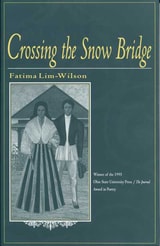
cover of CROSSING THE SNOW BRIDGE

CROSSING THE SNOW BRIDGE

Fatima Lim-Wilson

The Ohio State University Press, 1995

The manananggal, a supernatural character in Filipino folklore, flies at night seeking prey, her winged upper torso casting shadows from the moonlit sky while the lower part of her body waits patiently below. In this fascinating new collection, Crossing the Snow Bridge, Fatima Lim-Wilson explores the similarly split experience of the immigrant in the United States.

An inhabitant of this country for five years, Lim-Wilson’s legal status is that of “resident alien,” a disturbing but apt description given the clash of cultures the immigrant encounters daily. Although she still dreams in her native Tagalog, Lim-Wilson writes in her borrowed language, and it is through attempting to understand the cleaving of her own tongue that she works to redefine her place and that of other immigrants here.

How can memories of green mangoes, miniature fish, and the landscape of seven thousand islands fit in with, let alone contribute to, a North American cultural identity? Yet a great part of that cultural identity is built upon the immigrant experience. In telling stories of the Philippines and of the United States, these poems build a metaphorical bridge over which we can cross between cultures.
[more]
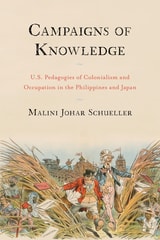
cover of Campaigns of Knowledge: U.S. Pedagogies of Colonialism and Occupation in the Philippines and Japan

Campaigns of Knowledge

U.S. Pedagogies of Colonialism and Occupation in the Philippines and Japan

Malini Johar Schueller

Temple University Press, 2019

The creation of a new school system in the Philippines in 1898 and educational reforms in occupied Japan, both with stated goals of democratization, speaks to a singular vision of America as savior, following its politics of violence with benevolent recuperation. The pedagogy of recovery—in which schooling was central and natives were forced to accept empire through education—might have shown how Americans could be good occupiers, but it also created projects of Orientalist racial management: Filipinos had to be educated and civilized, while the Japanese had to be reeducated and “de-civilized.” 

In Campaigns of Knowledge, Malini Schueller contrapuntally reads state-sanctioned proclamations, educational agendas, and school textbooks alongside political cartoons, novels, short stories, and films to demonstrate how the U.S. tutelary project was rerouted, appropriated, reinterpreted, and resisted. In doing so, she highlights how schooling was conceived as a process of subjectification, creating particular modes of thought, behaviors, aspirations, and desires that would render the natives docile subjects amenable to American-style colonialism in the Philippines and occupation in Japan.
[more]
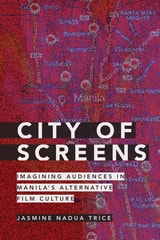
cover of City of Screens: Imagining Audiences in Manila's Alternative Film Culture

City of Screens

Imagining Audiences in Manila's Alternative Film Culture

Jasmine Nadua Trice

Duke University Press, 2021
In City of Screens Jasmine Nadua Trice examines the politics of cinema circulation in early-2000s Manila. She traces Manila's cinema landscape by focusing on the primary locations of film exhibition and distribution: the pirated DVD district, mall multiplexes, art-house cinemas, the university film institute, and state-sponsored cinematheques. In the wake of digital media piracy and the decline of the local commercial film industry, the rising independent cinema movement has been a site of contestation between filmmakers and the state, each constructing different notions of a prospective, national public film audience. Discourses around audiences become more salient given that films by independent Philippine filmmakers are seldom screened to domestic audiences, despite their international success. City of Screens provides a deeper understanding of the debates about the competing roles of the film industry, the public, and the state in national culture in the Philippines and beyond.
[more]
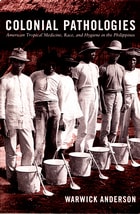
cover of Colonial Pathologies: American Tropical Medicine, Race, and Hygiene in the Philippines

Colonial Pathologies

American Tropical Medicine, Race, and Hygiene in the Philippines

Warwick Anderson

Duke University Press, 2006

Colonial Pathologies is a groundbreaking history of the role of science and medicine in the American colonization of the Philippines from 1898 through the 1930s. Warwick Anderson describes how American colonizers sought to maintain their own health and stamina in a foreign environment while exerting control over and “civilizing” a population of seven million people spread out over seven thousand islands. In the process, he traces a significant transformation in the thinking of colonial doctors and scientists about what was most threatening to the health of white colonists. During the late nineteenth century, they understood the tropical environment as the greatest danger, and they sought to help their fellow colonizers to acclimate. Later, as their attention shifted to the role of microbial pathogens, colonial scientists came to view the Filipino people as a contaminated race, and they launched public health initiatives to reform Filipinos’ personal hygiene practices and social conduct.

A vivid sense of a colonial culture characterized by an anxious and assertive white masculinity emerges from Anderson’s description of American efforts to treat and discipline allegedly errant Filipinos. His narrative encompasses a colonial obsession with native excrement, a leper colony intended to transform those considered most unclean and least socialized, and the hookworm and malaria programs implemented by the Rockefeller Foundation in the 1920s and 1930s. Throughout, Anderson is attentive to the circulation of intertwined ideas about race, science, and medicine. He points to colonial public health in the Philippines as a key influence on the subsequent development of military medicine and industrial hygiene, U.S. urban health services, and racialized development regimes in other parts of the world.
[more]
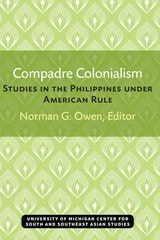
cover of Compadre Colonialism: Studies in the Philippines under American Rule

Compadre Colonialism

Studies in the Philippines under American Rule

Norman G. Owen, Editor

University of Michigan Press, 1971
This volume is a manifestation of the continuing interest of scholars at the University of Michigan in Philippine studies. Written by a generation of post-colonial scholars, it attempts to unravel some of the historical problems of the colonial era. Again and again the authors focus on the relationship of the ilustrados and the Americans, on the problems of continuity and discontinuity, and on the meaning of “modernization” in the Philippine context. As part of the Vietnam generation, these authors have looked at American imperialism with a new perspective, and yet their analysis is tempered, not strident, and reflective, not dogmatic. Perhaps the most central theme to emerge is the depth of the contradiction inherent in the American colonial experiment. [vi-vii]
[more]
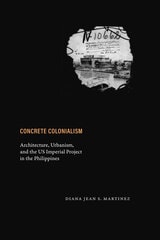
cover of Concrete Colonialism: Architecture, Urbanism, and the US Imperial Project in the Philippines

Concrete Colonialism

Architecture, Urbanism, and the US Imperial Project in the Philippines

Diana Jean S. Martinez

Duke University Press, 2025
During US colonial rule in the Philippines, reinforced concrete was used to the near exclusion of all other building materials. In Concrete Colonialism, Diana Jean S. Martinez examines the motivations for and lasting effects of this forgotten colonial policy. Arguing that the pervasive use of reinforced concrete technologies revolutionized techniques of imperial conquest, Martinez shows how concrete reshaped colonialism as a project that sought durable change through the reformation of environments, colonial society, and racialized biologies. Martinez locates the origins of this material revolution in the development of Chicago, highlighting how building this urban center atop exceptionally challenging geology made it possible to transform diverse global ecologies. She details how the material’s stability, plasticity, strength, and other qualities served the shifting imperatives of the US colonial regime, playing a central role in defending territory, controlling disease, and constructing monuments to nation and empire. By describing a world irreversibly remade, Martinez urges readers to consider how colonialism persists—in concrete forms—despite claims of its conclusion.
[more]
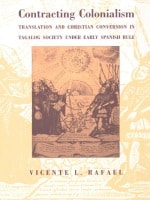
cover of Contracting Colonialism: Translation and Christian Conversion in Tagalog Society Under Early Spanish Rule

Contracting Colonialism

Translation and Christian Conversion in Tagalog Society Under Early Spanish Rule

Vicente L. Rafael

Duke University Press, 1993
In an innovative mix of history, anthropology, and post-colonial theory, Vicente L. Rafael examines the role of language in the religious conversion of the Tagalogs to Catholicism and their subsequent colonization during the early period (1580–1705) of Spanish rule in the Philippines. By tracing this history of communication between Spaniards and Tagalogs, Rafael maps the conditions that made possible both the emergence of a colonial regime and resistance to it. Originally published in 1988, this new paperback edition contains an updated preface that places the book in theoretical relation to other recent works in cultural studies and comparative colonialism.
[more]
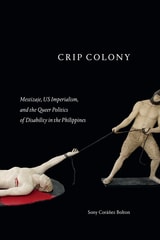
cover of Crip Colony: Mestizaje, US Imperialism, and the Queer Politics of Disability in the Philippines

Crip Colony

Mestizaje, US Imperialism, and the Queer Politics of Disability in the Philippines

Sony Coráñez Bolton

Duke University Press, 2023
In Crip Colony, Sony Coráñez Bolton examines the racial politics of disability, mestizaje, and sexuality in the Philippines. Drawing on literature, poetry, colonial records, political essays, travel narratives, and visual culture, Coráñez Bolton traces how disability politics colluded with notions of Philippine mestizaje. He demonstrates that Filipino mestizo writers in the late nineteenth and early twentieth centuries used mestizaje as a racial ideology of ability that marked Indigenous inhabitants of the Philippines as lacking in civilization and in need of uplift and rehabilitation. Heteronormative, able-bodied, and able-minded mixed-race Filipinos offered a model and path for assimilation into the US empire. In this way, mestizaje allowed for supposedly superior mixed-race subjects to govern the archipelago in collusion with American imperialism. By bringing disability studies together with studies of colonialism and queer-of-color critique, Coráñez Bolton extends theorizations of mestizaje beyond the United States and Latin America while considering how Filipinx and Filipinx American thought fundamentally enhances understandings of the colonial body and the racial histories of disability.
[more]
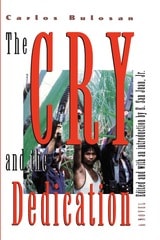
cover of Cry And Dedication

Cry And Dedication

Carlos Bulosan

Temple University Press, 1995

[more]