Results by title
142 books match the query 'Political Advocacy' and 11 start with c
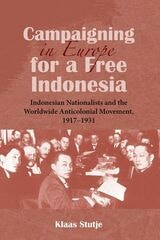
Campaigning in Europe for a Free Indonesia
Indonesian Nationalists and the Worldwide Anticolonial Movement, 1917–1932Klaas Stutje
National University of Singapore Press, 2019
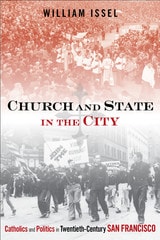
Church and State in the City
Catholics and Politics in Twentieth-Century San FranciscoWilliam Issel
Temple University Press, 2012
Church and State in the City provides the first comprehensive analysis of the city’s long debate about the public interest. Historian William Issel explores the complex ways that the San Francisco Catholic Church—and its lay men and women—developed relationships with the local businesses, unions, other community groups, and city government to shape debates about how to define and implement the common good. Issel’s deeply researched narrative also sheds new light on the city’s socialists, including Communist Party activists—the most important transnational challengers of both capitalism and Catholicism during the twentieth century.
Moreover, Church and State in the City is revisionist in challenging the notion that the history of urban politics and policy can best be understood as the unfolding of a progressive, secular modernization of urban political culture. Issel shows how tussles over the public interest in San Francisco were both distinctive to the city and shaped by its American character.
In the series Urban Life, Landscape, and Policy, edited by Zane L. Miller, David Stradling, and Larry Bennett
Citizen Power
A Citizen Leadership Manual Introducing the Art of No-Blame Problem SolvingHarry S. Pozycki
Rutgers University Press, 2020
Citizen Power
A Citizen Leadership Manual, New Jersey EditionHarry S. Pozycki
Rutgers University Press, 2021
Citizen Power portal (https://thecitizenscampaign.org/register/).
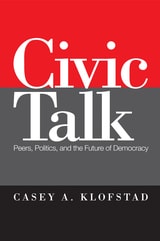
Civic Talk
Peers, Politics, and the Future of DemocracyAuthored by Casey A. Klofstad
Temple University Press, 2011
Does talking about civic issues encourage civic participation? In his innovative book, Civic Talk, Casey Klofstad shows that our discussions about politics and current events with our friends, colleagues, and relatives—"civic talk"—has the ability to turn thought into action—from voting to volunteering in civic organizations.
Klofstad’s path breaking research is the first to find evidence of a causal relationship between the casual chatting and civic participation. He employs survey information and focus groups consisting of randomly assigned college freshman roommates to show this behavior in action. Klofstad also illustrates how civic talk varies under different circumstances and how the effects can last years into the future. Based on these findings, Klofstad contends that social context plays a central role in maintaining the strength of democracy. This conclusion cuts against the grain of previous research, which primarily focuses on individual-level determinants of civic participation, and negates social-level explanations.
Civil Society Elites
Field Studies from Cambodia and IndonesiaEdited by Astrid Norén-Nilsson, Amalinda Savirani, and Anders Uhlin
National University of Singapore Press, 2023
Collaborating for Change
A Participatory Action Research CasebookSusan D. Greenbaum
Rutgers University Press, 2020
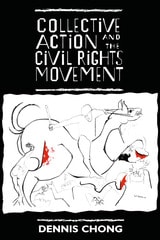
Collective Action and the Civil Rights Movement
Dennis Chong
University of Chicago Press, 1991

Coming of Political Age
American Schools and the Civic Development of Immigrant YouthRebecca M. Callahan
Russell Sage Foundation, 2013

Comrade or Brother?
A History of the British Labour MovementMary Davis
Pluto Press, 2009
Critical and iconoclastic, Comrade or Brother? traces the history of the British Labour Movement from its beginnings at the onset of industrialisation through its development within a capitalist society, up to the end of the twentieth-century. Written by a leading activist in the labour movement, the book redresses the balance in much labour history writing. It examines the place of women and the influence of racism and sexism as well as providing a critical analysis of the rival ideologies which played a role in the uneven development of the labour movement.
Crack Capitalism
John Holloway
Pluto Press, 2010
Crack Capitalism, argues that radical change can only come about through the creation, expansion and multiplication of 'cracks' in the capitalist system. These cracks are ordinary moments or spaces of rebellion in which we assert a different type of doing.
John Holloway's previous book, Change the World Without Taking Power, sparked a world-wide debate among activists and scholars about the most effective methods of going beyond capitalism. Now Holloway rejects the idea of a disconnected array of struggles and finds a unifying contradiction - the opposition between the capitalist labour we undertake in our jobs and the drive towards doing what we consider necessary or desirable.
Clearly and accessibly presented in the form of 33 theses, Crack Capitalism is set to reopen the debate among radical scholars and activists seeking to break capitalism now.