Results by title
93 books match the query 'Political violence' and 6 start with c
Captured Peace
Elites and Peacebuilding in El SalvadorChristine J. Wade
Ohio University Press, 2015
El Salvador is widely considered one of the most successful United Nations peacebuilding efforts, but record homicide rates, political polarization, socioeconomic exclusion, and corruption have diminished the quality of peace for many of its citizens. In Captured Peace: Elites and Peacebuilding in El Salvador, Christine J. Wade adapts the concept of elite capture to expand on the idea of “captured peace,” explaining how local elites commandeered political, social, and economic affairs before war’s end and then used the peace accords to deepen their control in these spheres.
While much scholarship has focused on the role of gangs in Salvadoran unrest, Wade draws on an exhaustive range of sources to demonstrate how day-to-day violence is inextricable from the economic and political dimensions. In this in-depth analysis of postwar politics in El Salvador, she highlights the local actors’ primary role in peacebuilding and demonstrates the political advantage an incumbent party—in this case, the Nationalist Republican Alliance (ARENA—has throughout the peace process and the consequences of this to the quality of peace that results.
Citizens’ Media against Armed Conflict
Disrupting Violence in ColombiaClemencia Rodríguez
University of Minnesota Press, 2011
For two years, Clemencia Rodríguez did fieldwork in regions of Colombia where leftist guerillas, right-wing paramilitary groups, the army, and drug traffickers made their presence felt in the lives of unarmed civilians. Here, Rodríguez tells the story of the ways in which people living in the shadow of these armed intruders use community radio, television, video, digital photography, and the Internet to shield their communities from armed violence’s negative impacts.
Citizens’ media are most effective, Rodríguez posits, when they understand communication as performance rather than simply as persuasion or the transmission of information. Grassroots media that are deeply embedded in the communities they serve and responsive to local needs strengthen the ability of community members to productively react to violent incursions. Rodríguez demonstrates how citizens’ media privilege aspects of community life not hijacked by violence, providing people with the tools and the platform to forge lives for themselves and their families that are not entirely colonized by armed conflict and its effects.
Ultimately, Rodríguez shows that unarmed civilian communities that have been cornered by armed conflict can use community media to repair torn social fabrics, reconstruct eroded bonds, reclaim public spaces, resolve conflict, and sow the seeds of peace and stability.
Composing Violence
The Limits of Exposure and the Making of MinoritiesMoyukh Chatterjee
Duke University Press, 2023
Conflicted Memory
Military Cultural Interventions and the Human Rights Era in PeruCynthia E. Milton
University of Wisconsin Press, 2018
Milton calls attention to fabrications of our post-truth era but goes further to deeply explore the ways members of the Peruvian military see their past, how they actively commemorate and curate it in the present, and why they do so. Her nuanced approach upends frameworks of memory studies that reduce military and ex-military to a predictable role of outright denial.
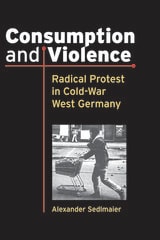
Consumption and Violence
Radical Protest in Cold-War West GermanyAlexander Sedlmaier
University of Michigan Press, 2014
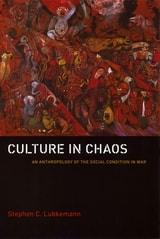
Culture in Chaos
An Anthropology of the Social Condition in WarStephen C. Lubkemann
University of Chicago Press, 2007
Lubkemann focuses on how Ndau social networks were fragmented by wartime displacement and the profound effect this had on gender relations. Demonstrating how wartime migration and post-conflict return were shaped by social struggles and interests that had little to do with the larger political reasons for the war, Lubkemann contests the assumption that wartime migration is always involuntary. His critical reexamination of displacement and his engagement with broader theories of agency and social change will be of interest to anthropologists, political scientists, historians, and demographers, and to anyone who works in a war zone or with refugees and migrants.