176 books match the query 'Prevention' and 18 start with c
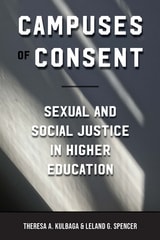
cover of Campuses of Consent: Sexual and Social Justice in Higher Education

Campuses of Consent

Sexual and Social Justice in Higher Education

Theresa A. Kulbaga and Leland G. Spencer

University of Massachusetts Press, 2019

Winner of the 2020 OSCLG Outstanding Book Award
This new book for scholars and university administrators offers a provocative critique of sexual justice language and policy in higher education around the concept of consent. Complicating the idea that consent is plain common sense, Campuses of Consent shows how normative and inaccurate concepts about gender, gender identity, and sexuality erase queer or trans students' experiences and perpetuate narrow, regressive gender norms and individualist frameworks for understanding violence.

Theresa A. Kulbaga and Leland G. Spencer prove that consent in higher education cannot be meaningfully separated from larger issues of institutional and structural power and oppression. While sexual assault advocacy campaigns, such as It's On Us, federal legislation from Title IX to the Clery Act, and more recent affirmative-consent measures tend to construct consent in individualist terms, as something “given” or “received” by individuals, the authors imagine consent as something that can be constructed systemically and institutionally: in classrooms, campus communication, and shared campus spaces.
[more]
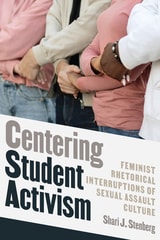
cover of Centering Student Activism: Feminist Rhetorical Interruptions of Sexual Assault Culture

Centering Student Activism

Feminist Rhetorical Interruptions of Sexual Assault Culture

Shari J. Stenberg

Utah State University Press, 2026

Centering Student Activism is a deep exploration of institutional responses to sexual assault. It addresses critical issues facing campuses today, examining how students navigate institutional dynamics and utilize the power of new and traditional rhetorical strategies to effect change. In doing so, it provides a profound understanding of the mechanisms by which coalitions can transform educational environments.

Centering Student Activism features a national interview-based study of contemporary student activists who deploy rhetorical strategies and tactics—old and new, embodied and digital—with agility and awareness. They aim their strategies and tactics of “intersectional rhetorical feminism” to interrupt and transform a sedimented culture. The students’ activism highlights not only the harms experienced by survivors in the aftermath of their assaults but also how their efforts to communicate those harms are often stymied or silenced by official responses and practices. These student activists pair interruption with rhetorical transformation as they seek to create a survivor-centric culture. In so doing they spotlight the systemic roots of sexual violence and respond to sexual assault through intersectional, coalition-based work.

Through detailed analysis and compelling narratives, Shari J. Stenberg underscores the importance of community care and mutual support in advocacy efforts. Centering Student Activism is an essential work for navigating institutional dynamics, providing an important resource to students, educators, and administrators who seek to understand how universities silence survivors and how students create ways to speak back and transform institutional culture.
[more]
cover of Changing Lives: Delinquency Prevention as Crime-Control Policy

Changing Lives

Delinquency Prevention as Crime-Control Policy

Peter W. Greenwood

University of Chicago Press, 2005

One of the most astonishing aspects of juvenile crime is how little is known about the impact of the policies and programs put in place to fight it. The most commonly used strategies and programs for combating juvenile delinquency problems primarily rely on intuition and fads. Fortunately, as a result of the promising new research documented in Changing Lives, these deficiencies in our juvenile justice system might quickly be remedied.

Peter W. Greenwood here demonstrates here that as crimes rates have fallen, researchers have identified more connections between specific risk factors and criminal behavior, while program developers have discovered a wide array of innovative interventions. The result of all this activity, he reveals, has been the revelation of a few prevention models that reduce crime much more cost-effectively than popular approaches such as tougher sentencing, D.A.R.E., boot camps, and "scared straight" programs. Changing Lives expertly presents the most promising of these prevention programs, their histories, the quality of evidence to support their effectiveness, the public policy programs involved in bringing them into wider use, and the potential for investments and developmental research to increase the range and quality of programs.
[more]
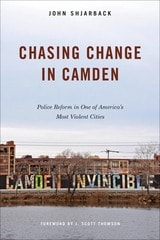
cover of Chasing Change in Camden: Police Reform in One of America's Most Violent Cities

Chasing Change in Camden

Police Reform in One of America's Most Violent Cities

John Shjarback

Temple University Press, 2025

In the 1990s and 2000s, Camden, NJ, across the river from Philadelphia, was perennially designated one of America’s most dangerous cities. The functionally bankrupt city dissolved the Camden Police Department (CPD) and created the Camden County Police Department (CCPD) in 2013, refocusing its priorities and officer performance standards to engage with the community and build trust. The change was significant, with notable drops in violent crime and murder. However, concerns about the use of force and other aggressive practices continued.

In Chasing Change in Camden, John Shjarback investigates how Camden’s police department re-formed and questions whether it can serve as a model for other cities. He analyzes successful policies—from innovative police training to advancements in technology—and evidence-based policing strategies. 

Shjarback explains how the changes were implemented and then adjusted in response to community backlash. Chasing Change in Camden concludes with a discussion of threats to the reform and accountability efforts in both the CCPD and American policing more broadly. Ultimately, Camden’s case study offers valuable lessons for cities seeking effective police reform.

[more]
cover of Chris Gets Ear Tubes

Chris Gets Ear Tubes

Betty Pace

Gallaudet University Press, 1987

Chris Gets Ear Tubes explains what happens before, during, and after the surgery in language a child understands. It takes away the child’s natural fear of the unknown. The charming full-color illustrations familiarize the child with the hosptial procedures.
[more]
cover of Code of Practice for Electrical Safety Management

Code of Practice for Electrical Safety Management

The Institution of Engineering and Technology

The Institution of Engineering and Technology, 2013

The aim of the Code of Practice for Electrical Safety Management is to provide good practice guidance to enable individuals and their organisations to have a level of knowledge and understanding to manage the risks associated with an electrical system. There are many technical publications that provide guidance on certain aspects of electrical safety but not in a way that provides a process for managing electrical safety.
[more]
cover of Code of Practice for Electrical Safety Management

Code of Practice for Electrical Safety Management

The Institution of Engineering and Technology

The Institution of Engineering and Technology, 2023

The aim of this Code of Practice is to provide good practice guidance to enable individuals and their organisations to have a level of knowledge and understanding to manage the risks associated with an electrical system. There are many technical publications that provide guidance on certain aspects of electrical safety but not in a way that provides a process for managing electrical safety.
[more]
cover of Combating Jihadism: American Hegemony and Interstate Cooperation in the War on Terrorism

Combating Jihadism

American Hegemony and Interstate Cooperation in the War on Terrorism

Barak Mendelsohn

University of Chicago Press, 2009

Although terrorism is an age-old phenomenon, jihadi ideology is distinctive in its ambition to abandon the principle of state sovereignty, overthrow the modern state system, and replace it with an extremely radical interpretation of an Islamic world order. These characteristics reflect a radical break from traditional objectives promoted by terrorist groups. In Combating Jihadism Barak Mendelsohn argues that the distinctiveness of the al-Qaeda threat led the international community to change its approach to counterterrorism. Contrary to common yet erroneous conceptions, the United States, in its role as a hegemon, was critical for the formulation of a multilateral response.
While most analyses of hegemony have focused on power, Mendelsohn firmly grounds the phenomenon in a web of shared norms and rules relating to the hegemon’s freedom of action. Consequently, he explains why US leadership in counterterrorism efforts was in some spheres successful, when in others it failed or did not even seek to establish multilateral collaborative frameworks. Tracing the ways in which international cooperation has stopped terrorist efforts, Combating Jihadism provides a nuanced, innovative, and timely reinterpretation of the war on terrorism and the role of the United States in leading the fight against al-Qaeda and its affiliates.
[more]
cover of Combating Teen Smoking: Research and Policy Strategies

Combating Teen Smoking

Research and Policy Strategies

Peter D. Jacobson, Paula M. Lantz, Kenneth E. Warner, Jeffrey Wasserman, Harold A. Pollack, and Alexis K. Ahlstrom

University of Michigan Press, 2001

Every year, more than 400,000 Americans die prematurely because of tobacco use. Most began smoking during their teen years. Adolescent tobacco use remains our nation's most preventable threat to life and health. This public health crisis has generated widespread debate over how best to prevent young people from initiating smoking or using other tobacco products. Combating Teen Smoking is an invaluable guide for policymakers and communities on the front lines of this prevention effort. Synthesizing recent research regarding the prevention and control of adolescent smoking, this book offers the reader a convenient compendium of what is known about adolescents and tobacco use; it also highlights areas where additional research is needed. Based on their assessment of the considerable amount of information presented, the authors recommend various ways to help slow--or even reverse--the recent rise in teenage smoking. A comprehensive antitobacco program might include, for example, antismoking media campaigns based on social marketing strategies, clean indoor air laws, and the increase of cigarette prices. Combating Teen Smoking will appeal to a broad spectrum of readers concerned about the problem of adolescent tobacco use, including policymakers who are actively seeking ways to help reduce teen smoking.
[more]
cover of Combating Terrorism: Strategies of Ten Countries

Combating Terrorism

Strategies of Ten Countries

Yonah Alexander, Editor

University of Michigan Press, 2002

The tragic events of September 11, 2001, and the consequent "war on terrorism" have made the question of effective counterterrorism policy a growing public concern. The original essays in Combating Terrorism offer a unique overview and evaluation of the counterterrorism policies of ten countries: the United States, Argentina, Peru, Colombia, the United Kingdom, Spain, Israel, Turkey, India, and Japan. Postscripts for each of the country chapters provide post-September 11 assessments of current counterterrorism practices. Most of the contributors to this volume have served in official governmental capacities and many continue to serve as consultants to governmental policy and decision makers.
All of the essays address the same set of questions to allow for cross-national comparison of strategies and an assessment of counterterrorism practices:
What is the governmental and public perception of the sources of terrorism? How successful have the policies of governments been in combating both domestic and international terrorism? What factors influence a government's willingness and ability to cooperate with other countries in combating terrorism? To what degree are the terrorist realities and the concerns of governments interconnected with global terrorism? To what degree are certain countries "natural hosts" of either terrorist groups or propensities that target Western or closely allied interests? To what degree are terrorist organizations mainly concerned about winning political participation in their target countries? Which counterterrorism strategies work, and which do not? What are the lessons of past experiences for future counterterrorism responses at the national, regional, and global levels?
The conclusion to the volume summarizes the lessons that may be learned from the experiences of the ten countries and discusses a list of best practices in counterterrorism.
This book will be of interest to policymakers, scholars, and other individuals with professional responsibilities in the area of terrorism and security studies. Written in clear, accessible prose, this book will also appeal to the general reader who is interested in gaining insight into the array of issues facing governments that endeavor to combat terrorism, and into the possible solutions to one of the foremost threats to world peace in our time.
Yonah Alexander is Professor and Director, Inter-University Center for Terrorism Studies; Senior Fellow and Director, International Center for Terrorism Studies, Potomac Institute for Policy Studies; and Co-Director, Inter-University Center for Legal Studies, International Law Institute.

[more]
cover of Commodities of Care: The Business of HIV Testing in China

Commodities of Care

The Business of HIV Testing in China

Elsa L. Fan

University of Minnesota Press, 2021

How global health practices can end up reorganizing practices of care for the people and communities they seek to serve 

Commodities of Care examines the unanticipated effects of global health interventions, ideas, and practices as they unfold in communities of men who have sex with men (MSM) in China. Targeted for the scaling-up of HIV testing, Elsa L. Fan examines how the impact of this initiative has transformed these men from subjects of care into commodities of care: through the use of performance-based financing tied to HIV testing, MSM have become a source of economic and political capital. 

In ethnographic detail, Fan shows how this particular program, ushered in by global health donors, became the prevailing strategy to control the epidemic in China in the late 2000s. Fan examines the implementation of MSM testing and its effects among these men, arguing that the intervention produced new markets of men, driven by the push to meet testing metrics. 

Fan shows how men who have sex with men in China came to see themselves as part of a global “MSM” category, adopting new selfhoods and socialities inextricably tied to HIV and to testing. Wider trends in global health programming have shaped national public health responses in China and, this book reveals, have radically altered the ways health, disease, and care are addressed. 

[more]
cover of Complaint!

Complaint!

Sara Ahmed

Duke University Press, 2021
In Complaint! Sara Ahmed examines what we can learn about power from those who complain about abuses of power. Drawing on oral and written testimonies from academics and students who have made complaints about harassment, bullying, and unequal working conditions at universities, Ahmed explores the gap between what is supposed to happen when complaints are made and what actually happens. To make complaints within institutions is to learn how they work and for whom they work: complaint as feminist pedagogy. Ahmed explores how complaints are made behind closed doors and how doors are often closed on those who complain. To open these doors---to get complaints through, keep them going, or keep them alive---Ahmed emphasizes, requires forming new kinds of collectives. This book offers a systematic analysis of the methods used to stop complaints and a powerful and poetic meditation on what complaints can be used to do. Following a long lineage of Black feminist and feminist of color critiques of the university, Ahmed delivers a timely consideration of how institutional change becomes possible and why it is necessary.
[more]
cover of Completing College: Rethinking Institutional Action

Completing College

Rethinking Institutional Action

Vincent Tinto

University of Chicago Press, 2012

Even as the number of students attending college has more than doubled in the past forty years, it is still the case that nearly half of all college students in the United States will not complete their degree within six years. It is clear that much remains to be done toward improving student success. For more than twenty years, Vincent Tinto’s pathbreaking book Leaving College has been recognized as the definitive resource on student retention in higher education. Now, with Completing College, Tinto offers administrators a coherent framework with which to develop and implement programs to promote completion.

Deftly distilling an enormous amount of research, Tinto identifies the essential conditions enabling students to succeed and continue on within institutions. Especially during the early years, he shows that students thrive in settings that pair high expectations for success with structured academic, social, and financial support, provide frequent feedback and assessments of their performance, and promote their active involvement with other students and faculty. And while these conditions may be worked on and met at different institutional levels, Tinto points to the classroom as the center of student education and life, and therefore the primary target for institutional action.

Improving retention rates continues to be among the most widely studied fields in higher education, and Completing College carefully synthesizes the latest research and, most importantly, translates it into practical steps that administrators can take to enhance student success.
[more]
cover of Coronavirus Politics: The Comparative Politics and Policy of COVID-19

Coronavirus Politics

The Comparative Politics and Policy of COVID-19

Scott L. Greer, Elizabeth J. King, Elize Massard da Fonseca, André Peralta-Santos, Editors

University of Michigan Press, 2021

COVID-19 is the most significant global crisis of any of our lifetimes. The numbers have been stupefying, whether of infection and mortality, the scale of public health measures, or the economic consequences of shutdown. Coronavirus Politics identifies key threads in the global comparative discussion that continue to shed light on COVID-19 and shape debates about what it means for scholarship in health and comparative politics. Editors Scott L. Greer, Elizabeth J. King, Elize Massard da Fonseca, and André Peralta-Santos bring together over 30 authors versed in politics and the health issues in order to understand the health policy decisions, the public health interventions, the social policy decisions, their interactions, and the reasons. The book’s coverage is global, with a wide range of key and exemplary countries, and contains a mixture of comparative, thematic, and templated country studies. All go beyond reporting and monitoring to develop explanations that draw on the authors' expertise while engaging in structured conversations across the book.
[more]
cover of Corruption and Reform: Lessons from America's Economic History

Corruption and Reform

Lessons from America's Economic History

Edited by Edward L. Glaeser and Claudia Goldin

University of Chicago Press, 2006

Despite recent corporate scandals, the United States is among the world’s least corrupt nations. But in the nineteenth century, the degree of fraud and corruption in America approached that of today’s most corrupt developing nations, as municipal governments and robber barons alike found new ways to steal from taxpayers and swindle investors. In Corruption and Reform, contributors explore this shadowy period of United States history in search of better methods to fight corruption worldwide today.

Contributors to this volume address the measurement and consequences of fraud and corruption and the forces that ultimately led to their decline within the United States. They show that various approaches to reducing corruption have met with success, such as deregulation, particularly “free banking,” in the 1830s. In the 1930s, corruption was kept in check when new federal bureaucracies replaced local administrations in doling out relief.  Another deterrent to corruption was the independent press, which kept a watchful eye over government and business. These and other facets of American history analyzed in this volume make it indispensable as background for anyone interested in corruption today.

[more]
cover of Crime and Family: Selected Essays of Joan McCord

Crime and Family

Selected Essays of Joan McCord

Joan McCord, introduction by David Farrington, foreword by Geoffrey Sayre-McCord

Temple University Press, 2007
Joan McCord (1930-2004) was one of the most famous, most-respected, and best-loved criminologists of her generation. A brilliant pioneer, Dr. McCord was best known for her work on the Cambridge-Somerville Youth Study, the first large-scale, longitudinal experimental study in the field of criminology. The study was among the first to demonstrate unintended harmful effects of a well-meaning prevention program. Dr. McCord's most important essays from this groundbreaking research project are among those included in this volume.McCord also co-wrote, edited, or co-edited twelve volumes and authored or co-authored 127 journal articles and book chapters. She wrote across a broad array of subjects, including delinquency, alcoholism, violence, crime prevention, and criminal theory. This book brings her most important and lasting work together in one place for the first time.
[more]
cover of Crime and Justice, Volume 19: Strategic Approaches to Crime Prevention

Crime and Justice, Volume 19

Strategic Approaches to Crime Prevention

Edited by Michael Tonry and David Farrington

University of Chicago Press Journals, 1995

We elect officials in hopes that they will make our communities safer, yet their widely-endorsed law enforcement strategies have little effect on crime rates. Active crime prevention must take into account the diversity of crimes and criminals. High-quality evaluation research designs are needed to convince scholars, policy makers, and practitioners about the effectiveness of crime prevention techniques. Building a Safer Society, the most comprehensive exposition of research and experience concerning crime prevention ever published, offers a new conceptualization of the subject incorporating developmental, community, situational and law enforcement approaches. This timely collection will especially interest scholars in law, criminal justice, public policy and public administration.
[more]
cover of Cutting the Fuse: The Explosion of Global Suicide Terrorism and How to Stop It

Cutting the Fuse

The Explosion of Global Suicide Terrorism and How to Stop It

Robert A. Pape and James K. Feldman

University of Chicago Press, 2012

 
Cutting the Fuse offers a wealth of new knowledge about the origins of suicide terrorism and strategies to stop it. Robert A. Pape and James K. Feldman have examined every suicide terrorist attack worldwide from 1980 to 2009, and the insights they have gleaned from that data fundamentally challenge how we understand the root causes of terrorist campaigns today—and reveal why the War on Terror has been ultimately counterproductive. Through a close analysis of suicide campaigns by Al Qaeda and other terrorist organizations in Iraq, Afghanistan, Pakistan, Lebanon, Israel, Chechnya, and Sri Lanka, the authors provide powerful new evidence that, contrary to popular and dangerously mistaken belief, only a tiny minority of these attacks are motivated solely by religion. Instead, the root cause is foreign military occupation, which triggers secular and religious people alike to carry out suicide attacks.
Cutting the Fuse calls for new, effective solutions that America and its allies can sustain for decades, relying less on ground troops in Muslim countries and more on offshore, over-the-horizon military forces along with political and economic strategies that empower local communities to stop terrorists in their midst. 
[more]