Results by title
56 books match the query 'Public schools' and 7 start with c
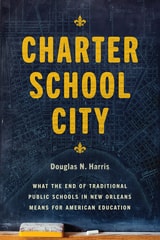
Charter School City
What the End of Traditional Public Schools in New Orleans Means for American EducationDouglas N. Harris
University of Chicago Press, 2020
New Orleans became the first US city ever to adopt a school system based on the principles of markets and economics. When the state took over all of the city’s public schools, it turned them over to non-profit charter school managers accountable under performance-based contracts. Students were no longer obligated to attend a specific school based upon their address, allowing families to act like consumers and choose schools in any neighborhood. The teacher union contract, tenure, and certification rules were eliminated, giving schools autonomy and control to hire and fire as they pleased.
In Charter School City, Douglas N. Harris provides an inside look at how and why these reform decisions were made and offers many surprising findings from one of the most extensive and rigorous evaluations of a district school reform ever conducted. Through close examination of the results, Harris finds that this unprecedented experiment was a noteworthy success on almost every measurable student outcome. But, as Harris shows, New Orleans was uniquely situated for these reforms to work well and that this market-based reform still required some specific and active roles for government. Letting free markets rule on their own without government involvement will not generate the kinds of changes their advocates suggest.
Combining the evidence from New Orleans with that from other cities, Harris draws out the broader lessons of this unprecedented reform effort. At a time when charter school debates are more based on ideology than data, this book is a powerful, evidence-based, and in-depth look at how we can rethink the roles for governments, markets, and nonprofit organizations in education to ensure that America’s schools fulfill their potential for all students.
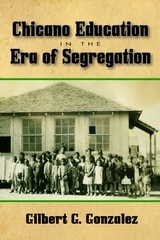
Chicano Education in the Era of Segregation
Gilbert G. Gonzalez
University of North Texas Press, 2013
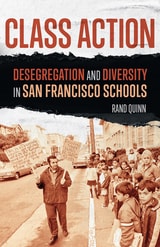
Class Action
Desegregation and Diversity in San Francisco SchoolsRand Quinn
University of Minnesota Press, 2020
A compelling history of school desegregation and activism in San Francisco
The picture of school desegregation in the United States is often painted with broad strokes of generalization and insulated anecdotes. Its true history, however, is remarkably wide ranging. Class Action tells the story of San Francisco’s long struggle over school desegregation in the wake of the 1954 U.S. Supreme Court decision Brown v. Board of Education.
San Francisco’s story provides a critical chapter in the history of American school discrimination and the complicated racial politics that emerged. It was among the first large cities outside the South to face court-ordered desegregation following the Brown rulings, and it experienced the same demographic shifts that transformed other cities throughout the urban West. Rand Quinn argues that the district’s student assignment policies—including busing and other desegregative mechanisms—began as a remedy for state discrimination but transformed into a tool intended to create diversity. Drawing on extensive archival research—from court docket files to school district records—Quinn describes how this transformation was facilitated by the rise of school choice, persistent demand for neighborhood schools, evolving social and legal landscapes, and local community advocacy and activism.
Class Action is the first book to present a comprehensive political history of post-Brown school desegregation in San Francisco. Quinn illuminates the evolving relationship between jurisprudence and community-based activism and brings a deeper understanding to the multiracial politics of urban education reform. He responds to recent calls by scholars to address the connections between ideas and policy change and ultimately provides a fascinating look at race and educational opportunity, school choice, and neighborhood schools in the aftermath of Brown v. Board of Education.
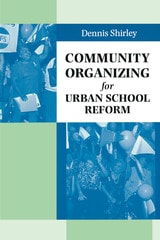
Community Organizing for Urban School Reform
By Dennis Shirley
University of Texas Press, 1997
Observers of all political persuasions agree that our urban schools are in a state of crisis. Yet most efforts at school reform treat schools as isolated institutions, disconnected from the communities in which they are embedded and insulated from the political realities which surround them.
Community Organizing for Urban School Reform tells the story of a radically different approach to educational change. Using a case study approach, Dennis Shirley describes how working-class parents, public school teachers, clergy, social workers, business partners, and a host of other engaged citizens have worked to improve education in inner-city schools. Their combined efforts are linked through the community organizations of the Industrial Areas Foundation, which have developed a network of over seventy "Alliance Schools" in poor and working-class neighborhoods throughout Texas. This deeply democratic struggle for school reform contains important lessons for all of the nation's urban areas. It provides a striking point of contrast to orthodox models of change and places the political empowerment of low-income parents at the heart of genuine school improvement and civic renewal.

Compelling Belief
The Culture of American SchoolingStephen Arons
University of Massachusetts Press, 1986
Critical Perspectives on Latino Education in Massachusetts
Lorna Rivera and Melissa Colón, editors
University of Massachusetts Press, 2025
In Massachusetts, the Latino population increased by 475 percent between 1980 and 2017, marking a dramatic growth. This diverse ethnic community of Puerto Ricans, Dominicans, Salvadoreans, Colombians, Brazilians, and more also contains a wide range of cultures, immigration and migration experiences, languages, and socio-political backgrounds. However, there are numerous commonalities involving education. Recent research at the Mauricio Gastón Institute for Latino Community Development and Policy reveals that Latino students in Massachusetts are more likely to attend public schools, in communities with significant academic achievement and opportunity gaps as well as other challenges, from food scarcity to higher rates of unemployment. At the same time, the state-wide shift to standards-based education has had a disproportionately negative impact on Latino students, who already feel the effects of politically motivated anti-immigrant policies and laws that limit bilingual education.
This collection of essays, from those working inside the classroom as well as researchers taking a broader look at policy, addresses the array of issues facing Latino students in Massachusetts. These perspectives paint a complex picture of the educational experience for Latinos, and offer expert suggestions for improving classrooms, school environments, and ultimate educational outcomes for an important growing demographic in the Commonwealth.
In addition to editors Lorna Rivera and Melissa Colón, this volume’s contributors include Almudena G. Abeyta, Nasteho Ali, Cristina Araujo Brinkerhoff, Michael Berardino, Alex Briesacher, Thomas Conroy, Judenie Dabel, Liya Escalera, Luis Enrique Esquivel, Deyja Enriquez, Isahiah Erilus, Nyal Fuentes, Jazmin Rubi Flete Gomez, Manuel Frau-Ramos, Kimberly A. S. Howard, Patricia Krueger-Henney, Steven Lue, Mary Jo Marion, Timothy E. Murphy, Cecilia Nardi, Laurie Occhipinti, Alexandra Oliver-Davila, Chong Myung Park, Angelica Rodriquez, Marta T. Rosa, Diana Santiago, Melissa Sargent, Ester Shapiro, V. Scott H. Solberg, Fabián Torres-Ardila, Ashley Torres Carrasquillo, Paul Trunfio, Carmen N. Veloria, and Heilam Xie.
Crossing Segregated Boundaries
Remembering Chicago School DesegregationDionne Danns
Rutgers University Press, 2021