140 books match the query 'Queer theory' and 10 start with c

cover of California Futures: Haunted Ecologies, Decolonial Relations

California Futures

Haunted Ecologies, Decolonial Relations

Daniel Lanza Rivers

Duke University Press, 2026

California Futures is a critical study of California as a site of liberatory dreaming—one that takes up the history, politics, and afterlives of the region’s colonial imaginings as well as archives of resistance and world-making which strive toward Indigenous, decolonial, Black, queer, feminist, and anti-white supremacist futures. Attending carefully to the colonial, commercial, and environmental entanglements of the region, Daniel Lanza Rivers offers an account of the processes of speculation that worlded California into being. Rivers examines case studies such as the colonial cultures of grizzly bear eradication and reintroduction; the convergence of drought, industrial agriculture, and environmental toxicity in California's Central Valley; utopianism in the Klamath Mountains, from the Black Bear Ranch commune to Octavia Butler’s Parable series; dam removal and Native climate adaptation on the Klamath watershed; and the policing of unhoused people around Oakland's Lake Merritt. Through these case studies, Rivers interrogates the long histories of settler conquest, extractive and racial capitalism, and heteropatriarchy that have shaped California. They chart strategies for thinking beyond the colonial Anthropocene and toward the post-extractive and liberatory futures that emerge from and with decolonial land relations.
[more]
cover of Care at the End of the World: Dreaming of Infrastructure in Crip-of-Color Writing

Care at the End of the World

Dreaming of Infrastructure in Crip-of-Color Writing

Jina B. Kim

Duke University Press, 2025
In Care at the End of the World, Jina B. Kim develops what she calls crip-of-color critique, bringing a disability lens to bear on feminist- and queer-of-color literature in the aftermath of 1996 US welfare reform and the subsequent evisceration of social safety nets. She examines literature by contemporary feminist, queer, and disabled writers of color such as Jesmyn Ward, Octavia Butler, Karen Tei Yamashita, Samuel Delany, and Aurora Levins Morales, who each bring disability and dependency to the forefront of their literary freedom dreaming. Kim shows that in their writing, liberation does not take the shape of the unfettered individual or hinge on achieving independence. Instead, liberation emerges by recuperating dependency, cultivating radical interdependency, and recognizing the numerous support systems upon which survival depends. At the same time, Kim demonstrates how theories and narratives of disability can intervene into state-authored myths of resource parasitism, such as the welfare queen. In so doing, she highlights the alternate structures of care these writers envision and their dreams of life organized around reciprocity and mutual support.
[more]
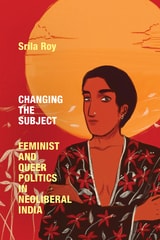
cover of Changing the Subject: Feminist and Queer Politics in Neoliberal India

Changing the Subject

Feminist and Queer Politics in Neoliberal India

Srila Roy

Duke University Press, 2022

In Changing the Subject Srila Roy maps the rapidly transforming terrain of gender and sexual politics in India under the conditions of global neoliberalism. The consequences of India’s liberalization were paradoxical: the influx of global funds for social development and NGOs signaled the co-optation and depoliticization of struggles for women’s rights, even as they amplified the visibility and vitalization of queer activism. Roy reveals the specificity of activist and NGO work around issues of gender and sexuality through a decade-long ethnography of two West Bengal organizations, one working on lesbian, bisexual, and transgender issues and the other on rural women’s empowerment. Tracing changes in feminist governmentality that were entangled in transnational neoliberalism, Roy shows how historical and highly local feminist currents shaped contemporary queer and nonqueer neoliberal feminisms. The interplay between historic techniques of activist governance and queer feminist governmentality’s focus on changing the self offers a new way of knowing feminism—both as always already co-opted and as a transformative force in the world.
[more]
cover of Circuits of the Sacred: A Faggotology in the Black Latinx Caribbean

Circuits of the Sacred

A Faggotology in the Black Latinx Caribbean

Carlos Ulises Decena

Duke University Press, 2023
In Circuits of the Sacred Carlos Ulises Decena examines transnational black Latinx Caribbean immigrant queer life and spirit. Decena models what he calls a faggotology—the erotic in the divine as found in the disreputable and the excessive—as foundational to queer black critical and expressive praxis of the future. Drawing on theoretical analysis, memoir, creative writing, and ethnography of Santería/Lucumí in Santo Domingo, Havana, and New Jersey, Decena moves between languages, locations, pronouns, and genres to map the itineraries of blackness as a “circuit,” a multipronged and multisensorial field. A feminist pilgrimage and extended conversation with the dead, Decena’s study is a provocative work that transforms the academic monograph into a gathering of stories, theoretical innovation, and expressive praxis to channel voices, ancestors, deities, theorists, artists, and spirits from the vantage point of radical feminism and queer-of-color thinking.
[more]
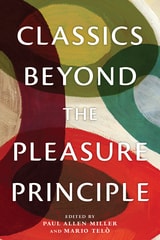
cover of Classics Beyond the Pleasure Principle

Classics Beyond the Pleasure Principle

Edited by Paul Allen Miller and Mario Telò

The Ohio State University Press, 2026

Classics Beyond the Pleasure Principle explores the concept of the Freudian death drive to interrogate both the ancient past and the present, highlighting how destruction and its remnants resist erasure and shape historical memory. Using Gaza’s rubble as a metaphor for the indestructibility of violence’s material traces, the text connects ancient Greco-Roman culture—from Homer and Sophocles to Ovid and Seneca—with modern figures and events, from Elena Ferrante to the war in Israel and Palestine. The volume engages psychoanalytic theory, queer theory, and feminism to challenge the boundaries of classical studies, arguing that only by confronting the discipline’s entanglement with the pleasure principle and its repressions can classics contribute to understanding the crises of the present and imagining a future distinct from the past.

Contributors:
Karen Bassi, Martin Devecka, Micaela Janan, Hagi Kenaan, Vered Lev Kenaan, Sara Lindheim, Paul Allen Miller, Helen Morales, Jay Oliver, Victoria Rimell, Mario Telò

[more]
cover of Close Writing: Kathy Acker, Cookie Mueller, and Love-in-Pieces

Close Writing

Kathy Acker, Cookie Mueller, and Love-in-Pieces

Alice Butler

Duke University Press, 2026
In Close Writing, Alice Butler reflects on the diaries, letters, publications, performances, lives, and afterlives of her most beloved queer feminist writers: Kathy Acker and Cookie Mueller. While the transgressive avant-garde writer Kathy Acker has developed a cult following in the decades since her death in the late-90s, the actress and writer Cookie Mueller has remained relatively obscure. In this creative-critical study, Butler participates and responds to the lives and writings of her shared “beloved," reimagining the scene of the archive as a scene of triangulated and bittersweet love that traverses the boundaries of life and death. She draws on the autofictional strategies that Acker and Mueller pioneered in their own experimental writings and performances, encountering the women in intimate theoretical spaces of sensuality, sexuality, and sickness that slip between life and text. By encountering Acker and Mueller as transgressors and innovators, but also as beloved figures in her writing life whom she addresses in love letters, Butler brings readers to new, reparative textures of understanding, embodiment, and affection through close writing.
[more]
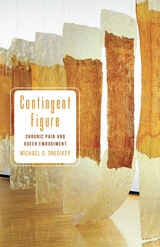
cover of Contingent Figure: Chronic Pain and Queer Embodiment

Contingent Figure

Chronic Pain and Queer Embodiment

Michael D. Snediker

University of Minnesota Press, 2021

A masterful synthesis of literary readings and poetic reflections, making profound contributions to our understanding of chronic pain

At the intersection of queer theory and disability studies, acclaimed theorist Michael D. Snediker locates something unexpected: chronic pain. Starting from this paradigm-shifting insight, Snediker elaborates a bracing examination of the phenomenological peculiarity of disability, articulating a complex idiom of figuration as the lived substance of pain’s quotidian. This lexicon helps us differently inhabit both the theoretical and phenomenal dimensions of chronic pain and suffering by illuminating where these modes are least distinguishable. 

Suffused with fastidious close readings, and girded by a remarkably complex understanding of phenomenal experience, Contingent Figure resides in the overlap between literary theory and lyric experiment. Snediker grounds his exploration of disability and chronic pain in dazzling close readings of Herman Melville, Emily Dickinson, Henry James, and many others. Its juxtaposition of these readings with candid autobiographical accounts makes Contingent Figure an exemplary instance of literary theory as a practice of lyric attention.

Thoroughly rigorous and anything but predictable, this stirring inquiry leaves the reader with a rich critical vocabulary indebted to the likes of Maurice Blanchot, Gilles Deleuze, D. O. Winnicott, and Eve Kosofsky Sedgwick. A master class in close reading’s inseparability from the urgency of lived experience, this book is essential for students and scholars of disability studies, queer theory, formalism, aesthetics, and the radical challenge of Emersonian poetics across the long American nineteenth century.

[more]
cover of Courtly and Queer: Deconstruction, Desire, and Medieval French Literature

Courtly and Queer

Deconstruction, Desire, and Medieval French Literature

Charlie Samuelson

The Ohio State University Press, 2022
In Courtly and Queer, Charlie Samuelson casts queerness in medieval French texts about courtly love in a new light by bringing together for the first time two exemplary genres: high medieval verse romance, associated with the towering figure of Chrétien de Troyes, and late medieval dits, primarily associated with Guillaume de Machaut. In close readings informed by deconstruction and queer theory, Samuelson argues that the genres’ juxtaposition opens up radical new perspectives on the deviant poetics and gender and sexual politics of both. Contrary to a critical tradition that locates the queer Middle Ages at the margins of these courtly genres, Courtly and Queer emphasizes an unflagging queerness that is inseparable from poetic indeterminacy and that inhabits the core of a literary tradition usually assumed to be conservative and patriarchal. Ultimately, Courtly and Queer contends that one facet of texts commonly referred to as their “courtliness”—namely, their literary sophistication—powerfully overlaps with modern conceptions of queerness.
[more]
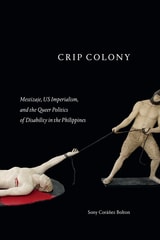
cover of Crip Colony: Mestizaje, US Imperialism, and the Queer Politics of Disability in the Philippines

Crip Colony

Mestizaje, US Imperialism, and the Queer Politics of Disability in the Philippines

Sony Coráñez Bolton

Duke University Press, 2023

In Crip Colony, Sony Coráñez Bolton examines the racial politics of disability, mestizaje, and sexuality in the Philippines. Drawing on literature, poetry, colonial records, political essays, travel narratives, and visual culture, Coráñez Bolton traces how disability politics colluded with notions of Philippine mestizaje. He demonstrates that Filipino mestizo writers in the late nineteenth and early twentieth centuries used mestizaje as a racial ideology of ability that marked Indigenous inhabitants of the Philippines as lacking in civilization and in need of uplift and rehabilitation. Heteronormative, able-bodied, and able-minded mixed-race Filipinos offered a model and path for assimilation into the US empire. In this way, mestizaje allowed for supposedly superior mixed-race subjects to govern the archipelago in collusion with American imperialism. By bringing disability studies together with studies of colonialism and queer-of-color critique, Coráñez Bolton extends theorizations of mestizaje beyond the United States and Latin America while considering how Filipinx and Filipinx American thought fundamentally enhances understandings of the colonial body and the racial histories of disability.
[more]
cover of Critically Sovereign: Indigenous Gender, Sexuality, and Feminist Studies

Critically Sovereign

Indigenous Gender, Sexuality, and Feminist Studies

Joanne Barker, editor

Duke University Press, 2017

Critically Sovereign traces the ways in which gender is inextricably a part of Indigenous politics and U.S. and Canadian imperialism and colonialism. The contributors show how gender, sexuality, and feminism work as co-productive forces of Native American and Indigenous sovereignty, self-determination, and epistemology. Several essays use a range of literary and legal texts to analyze the production of colonial space, the biopolitics of “Indianness,” and the collisions and collusions between queer theory and colonialism within Indigenous studies. Others address the U.S. government’s criminalization of traditional forms of Diné marriage and sexuality, the Iñupiat people's changing conceptions of masculinity as they embrace the processes of globalization, Hawai‘i’s same-sex marriage bill, and stories of Indigenous women falling in love with non-human beings such as animals, plants, and stars. Following the politics of gender, sexuality, and feminism across these diverse historical and cultural contexts, the contributors question and reframe the thinking about Indigenous knowledge, nationhood, citizenship, history, identity, belonging, and the possibilities for a decolonial future.

Contributors. Jodi A. Byrd, Joanne Barker, Jennifer Nez Denetdale, Mishuana Goeman,  J. Kēhaulani Kauanui, Melissa K. Nelson, Jessica Bissett Perea, Mark Rifkin
[more]