Results by title
53 books match the query 'Rap & Hip Hop' and 3 start with c
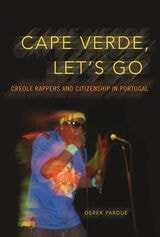
Cape Verde, Let's Go
Creole Rappers and Citizenship in PortugalDerek Pardue
University of Illinois Press, 2015
Drawing on fieldwork and archival research in Portugal and Cape Verde, Derek Pardue introduces Lisbon's kriolu rap scene and its role in challenging metropolitan Portuguese identities. Pardue demonstrates that Cape Verde, while relatively small within the Portuguese diaspora, offers valuable lessons about the politics of experience and social agency within a postcolonial context that remains poorly understood. As he argues, knowing more about both Cape Verdeans and the Portuguese invites clearer assessments of the relationship between the experience and policies of migration. That in turn allows us to better gauge citizenship as a balance of individual achievement and cultural ascription.
Deftly shifting from domestic to public spaces and from social media to ethnographic theory, Pardue describes an overlooked phenomenon transforming Portugal, one sure to have parallels in former colonial powers across twenty-first-century Europe.
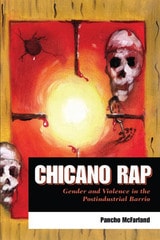
Chicano Rap
Gender and Violence in the Postindustrial BarrioBy Pancho McFarland
University of Texas Press, 2008
Powered by a driving beat, clever lyrics, and assertive attitudes, rap music and hip hop culture have engrossed American youth since the mid-1980s. Although the first rappers were African Americans, rap and hip hop culture quickly spread to other ethnic groups who have added their own cultural elements to the music. Chicano Rap offers the first in-depth look at how Chicano/a youth have adopted and adapted rap music and hip hop culture to express their views on gender and violence, as well as on how Chicano/a youth fit into a globalizing world.
Pancho McFarland examines over five hundred songs and seventy rap artists from all the major Chicano rap regions—San Diego, San Francisco and Northern California, Texas, and Chicago and the Midwest. He discusses the cultural, political, historical, and economic contexts in which Chicano rap has emerged and how these have shaped the violence and misogyny often expressed in Chicano rap and hip hop. In particular, he argues that the misogyny and violence of Chicano rap are direct outcomes of the "patriarchal dominance paradigm" that governs human relations in the United States. McFarland also explains how globalization, economic restructuring, and the conservative shift in national politics have affected Chicano/a youth and Chicano rap. He concludes with a look at how Xicana feminists, some Chicano rappers, and other cultural workers are striving to reach Chicano/a youth with a democratic, peaceful, empowering, and liberating message.
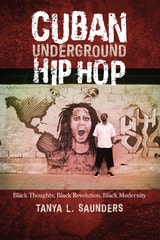
Cuban Underground Hip Hop
Black Thoughts, Black Revolution, Black ModernityBy Tanya L. Saunders
University of Texas Press, 2015
Honorable Mention, Barbara T. Christian Literary Award, Caribbean Studies Association, 2017
In the wake of the 1959 Cuban Revolution, a key state ideology developed: racism was a systemic cultural issue that ceased to exist after the Revolution, and any racism that did persist was a result of contained cases of individual prejudice perpetuated by US influence. Even after the state officially pronounced the end of racism within its borders, social inequalities tied to racism, sexism, and homophobia endured, and, during the economic liberalization of the 1990s, widespread economic disparities began to reemerge.
Cuban Underground Hip Hop focuses on a group of self-described antiracist, revolutionary youth who initiated a social movement (1996–2006) to educate and fight against these inequalities through the use of arts-based political activism intended to spur debate and enact social change. Their “revolution” was manifest in altering individual and collective consciousness by critiquing nearly all aspects of social and economic life tied to colonial legacies. Using over a decade of research and interviews with those directly involved, Tanya L. Saunders traces the history of the movement from its inception and the national and international debates that it spawned to the exodus of these activists/artists from Cuba and the creative vacuum they left behind. Shedding light on identity politics, race, sexuality, and gender in Cuba and the Americas, Cuban Underground Hip Hop is a valuable case study of a social movement that is a part of Cuba’s longer historical process of decolonization.