160 books match the query 'Reflections' and 5 start with c
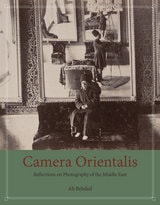
cover of Camera Orientalis: Reflections on Photography of the Middle East

Camera Orientalis

Reflections on Photography of the Middle East

Ali Behdad

University of Chicago Press, 2016

In the decades after its invention in 1839, photography was inextricably linked to the Middle East. Introduced as a crucial tool for Egyptologists and Orientalists who needed to document their archaeological findings, the photograph was easier and faster to produce in intense Middle Eastern light—making the region one of the original sites for the practice of photography. A pioneering study of this intertwined history, Camera Orientalis traces the Middle East’s influences on photography’s evolution, as well as photography’s effect on Europe’s view of “the Orient.”

Considering a range of Western and Middle Eastern archival material from the late nineteenth and early twentieth centuries, Ali Behdad offers a rich account of how photography transformed Europe’s distinctly Orientalist vision into what seemed objective fact, a transformation that proved central to the project of European colonialism. At the same time, Orientalism was useful for photographers from both regions, as it gave them a set of conventions by which to frame exotic Middle Eastern cultures for Western audiences. Behdad also shows how Middle Eastern audiences embraced photography as a way to foreground status and patriarchal values while also exoticizing other social classes.

An important examination of previously overlooked European and Middle Eastern photographers and studios, Camera Orientalis demonstrates that, far from being a one-sided European development, Orientalist photography was the product of rich cultural contact between the East and the West.
 
[more]
cover of Class Not Dismissed: Reflections on Undergraduate Education and Teaching the Liberal Arts

Class Not Dismissed

Reflections on Undergraduate Education and Teaching the Liberal Arts

Anthony Aveni

University Press of Colorado, 2014

In Class Not Dismissed, award-winning professor Anthony Aveni tells the personal story of his six decades in college classrooms and some of the 10,000 students who have filled them. Through anecdotes of his own triumphs and tribulations—some amusing, others heartrending—Aveni reveals his teaching story and thoughts on the future of higher education.

Although in recent years the lecture has come under fire as a pedagogical method, Aveni ardently defends lecturing to students. He shares his secrets on crafting an engaging lecture and creating productive dialogue in class discussions. He lays out his rules on classroom discipline and tells how he promotes the lost art of listening. He is a passionate proponent of the liberal arts and core course requirements as well as a believer in sound teaching promoted by active scholarship.

Aveni is known to his students as a consummate storyteller. In Class Not Dismissed he shares real stories about everyday college life that shed light on serious educational issues. The result is a humorous, reflective, inviting, and powerful inquiry into higher education that will be of interest to anyone invested in the current and future state of college and university education.

[more]
cover of Complex Sorrow: Reflections on Cancer and an Abbreviated Life

Complex Sorrow

Reflections on Cancer and an Abbreviated Life

Marianne Paget

Temple University Press, 1993
"The author's multiple voices--scholar, sociologist, victim--provide an academic, yet personal, professional, yet poignant, story....Readers face...the 'contradictory meanings' that an especially articulate woman brings to the final chapter of her life." --Women and Health In 1988, Marianne Paget published the Unity of Mistakes: A Phenomenological Interpretation of Medical Work (Temple) in which she argued that error is an intrinsic feature in medicine--an experimental and uncertain activity. Her subsequent research focused on medical negligence and on miscommunication and silence a as cause and product of error in medicine. While pursuing her research on negligence, she found out that she was an example of it. Chronic back pain that had been misdiagnosed as muscle spasms turned out to be a symptom of a rare and fatal cancer that claimed Paget's life in December 1989. This collection of her personal and professional writings on the phenomenon of error in medicine chronicles a young scholar's courageous struggle to make sense of a tragic coincidence. Discovering that she was living the charges and painful topic that she had studied so deeply, Paget write poignantly and analytically until the last week of her life about this uncanny parallel. "It is very tricky to come to terms with the reality of death without becoming trapped in that reality," wrote "Tracy" Paget to her friends. In this book, she describes "the odd way my life began to mirror my work"; her search for "life rites" when face with tasks involving wills, last rites, and farewells; and her indomitable and forthright attempt to remain intensely alive in the face of death. A Complex Sorrow, her final project, comprises essays, letters, and a journal recording her last year. Ever critical of the distanced and dispassionate stance taken in much social analysis, Paget had experimented with performance as a form for enlivening social science research. The script for her play, "The Work of Talk," about communication problems between a physician and his cancer patient, is also included. Her compelling life-text speaks to those living with illness and those who care for and about them, as the investigation and representation of lived experience. Excerpt Excerpt available at www.temple.edu/tempress "Strangely, my knowledge of error has helped me deal with the errors in my care. Had I not known about the prevalence of error in medicine I would not have been able to process what has happened to me without bitterness. But I had thought these matters through already, and more than once. I now live out the complex sorrow I have before described." --Marianne A. Paget Reviews "Paget's book is stunning. It's a tribute to the invulnerable human spirit. The woman burned like a flame; obviously she died well, because she lived well; she was loved because she was loving. The book is tremendously sad, but it isn't depressing; somehow, one is left with a sense of human possibility." --Joan Cassell, author of Expected Miracles: Surgeons at Work
[more]
cover of Contested Terrain: Reflections with Afghan Women Leaders

Contested Terrain

Reflections with Afghan Women Leaders

Sally L Kitch

University of Illinois Press, 2014
Sally L. Kitch explores the crisis in contemporary Afghan women’s lives by focusing on two remarkable Afghan professional women working on behalf of their Afghan sisters. Kitch's compelling narrative follows the stories of Judge Marzia Basel and Jamila Afghani from 2005 through 2013, providing an oft-ignored perspective on the personal and professional lives of Afghanistan's women. Contending with the complex dynamics of a society both undergoing and resisting change, Basel and Afghani speak candidly--and critically--of matters like international intervention and patriarchal Afghan culture, capturing the ways in which immense possibility alternates and vies with utter hopelessness. Strongly rooted in feminist theory and interdisciplinary historical and geopolitical analysis, Contested Terrain sheds new light on the struggle against the powerful forces that affect Afghan women's education, health, political participation, livelihoods, and quality of life. The book also suggests how a new dialogue might be started--in which women from across geopolitical boundaries might find common cause for change and rewrite their collective stories.
[more]
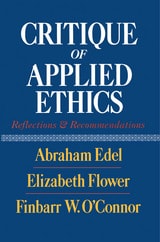
cover of Critique Of Applied Ethics: Reflections and Recommendations

Critique Of Applied Ethics

Reflections and Recommendations

Abraham Edel

Temple University Press, 1994

"Part One is historically rich and analytically sophisticated. It is unquestionably the best treatment of the applied ethics landscape. In Part Two, the authors have an uncanny sense of the issues and a remarkable ability to demythologize the jargon temple of doom, such that controversial philosophical positions are rendered clear.... I look forward to teaching from this book." --John J. McDermott, Distinguished Professor of Philosophy and Humanities, Professor and Head of Humanities in Medicine, Texas A&M University Over the past two decades, applied ethics has turned increasingly toward theories that explore ethical questions faced by a variety of professions and away from classic moral concerns. Abraham Edel, Elizabeth Flower, and Finbarr O'Connor utilize examples of professional, public policy, and personal decision making to illustrate the strengths and limitations of the application of ethics in a rapidly changing world. They first discuss the emergence of applied ethics and how it functions within a philosophical tradition. They are not concerned, however, with solving the problems they expose, but with employing them as a means to critique applied ethics. Using human rights and health and welfare issues, the authors examine the subsequent ethical stumbling blocks that surround the "moral order" of these social concerns. Through a historical discussion of the abundant ethical theories posited since the Enlightenment, they suggest ways to decide which can serve as intellectual tools for applied ethics and consider how knowledge and experience enter into any moral decision. Turning to the factors pertinent in the analysis and solution of moral problems, they dissect the underlying influences on the practice of ethics, the way in which a moral problem is diagnosed and its relevant contexts established, the ensuing conflicts between the concerns of the individual and of society, and the degree of inventiveness in issues of morality. The authors suggest that, instead of viewing theory as a set consequence derived from prior applications, relating theory to practice will engage a process of mutual aid, from which each element will learn, refining and improving the other.
[more]