Results by title
70 books match the query 'Rehabilitation' and 10 start with c
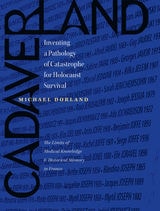
Cadaverland
Inventing a Pathology of Catastrophe for Holocaust Survival [The Limits of Medical Knowledge and Historical Memory in France]Michael Dorland
Brandeis University Press, 2009
Changing Lives
Delinquency Prevention as Crime-Control PolicyPeter W. Greenwood
University of Chicago Press, 2005
Peter W. Greenwood here demonstrates here that as crimes rates have fallen, researchers have identified more connections between specific risk factors and criminal behavior, while program developers have discovered a wide array of innovative interventions. The result of all this activity, he reveals, has been the revelation of a few prevention models that reduce crime much more cost-effectively than popular approaches such as tougher sentencing, D.A.R.E., boot camps, and "scared straight" programs. Changing Lives expertly presents the most promising of these prevention programs, their histories, the quality of evidence to support their effectiveness, the public policy programs involved in bringing them into wider use, and the potential for investments and developmental research to increase the range and quality of programs.
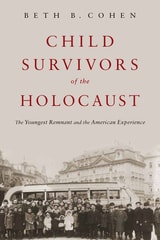
Child Survivors of the Holocaust
The Youngest Remnant and the American ExperienceCohen, Beth B
Rutgers University Press, 2018
The majority of European Jewish children alive in 1939 were murdered during the Holocaust. Of 1.5 million children, only an estimated 150,000 survived. In the aftermath of the Shoah, efforts by American Jews brought several thousand of these child survivors to the United States. In Child Survivors of the Holocaust, historian Beth B. Cohen weaves together survivor testimonies and archival documents to bring their story to light. She reveals that even as child survivors were resettled and “saved,” they struggled to adapt to new lives as members of adoptive families, previously unknown American Jewish kin networks, or their own survivor relatives. Nonetheless, the youngsters moved ahead. As Cohen demonstrates, the experiences both during and after the war shadowed their lives and relationships through adulthood, yet an identity as “survivors” eluded them for decades. Now, as the last living link to the Holocaust, the voices of Child Survivors are finally being heard.
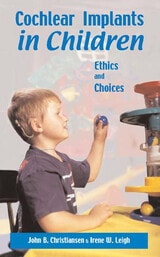
Cochlear Implants in Children
Ethics and ChoicesJohn B. Christiansen
Gallaudet University Press, 2002
Cochlear Implants in Children: Ethics and Choices addresses every facet of the ongoing controversy about implanting cochlear hearing devices in children as young as 12 months old and in some cases, younger. Authors John B. Christiansen and Irene W. Leigh and contributors Jay Lucker and Patricia Elizabeth Spencer analyzed the sensitive issues connected with the procedure by reviewing 439 responses to a survey of parents with children who have cochlear implants. They followed up with interviews of the parents of children who have had a year's experience using their implants, and also the children themselves. Their findings shape the core of this useful and telling study.
Cochlear Implants begins with a history of their development and an explanation of how implants convert sound into electric impulses that stimulate the brain. The second section focuses on pediatric implants, starting with the ways parents coped with the discovery that their child was deaf. Parents share how they learned about cochlear implants and how they chose an implant center. They also detail their children's experiences with the implants after surgery, and their progress with language acquisition and in school.
The final part treats the controversy associated with cochlear implants, particularly the reaction of the Deaf community and the ethics of implanting young children without their consent. Cochlear Implants concludes with sage observations and recommendations for parents and professionals that complete it as the essential book on the pros and cons of this burgeoning technology.
Communication Therapy
An Integrated Approach to Aural RehabilitationMary June Moseley
Gallaudet University Press, 1996
This new book for students and professionals emphasizes a functional approach to aural rehabilitation refined during the past several years. It details the use of an integrated therapy strategy designed to meet a variety of needs for each client while simultaneously working on multiple communication skill areas. Particular care has been taken to address the different requirements of deaf and hard of hearing adolescents and adults, including information about the unique needs of the culturally Deaf population. Throughout this practical text, clinicians receive encouragement to learn American Sign Language to enhance communication with Deaf clients.
Communication Therapy calls upon the expertise of various authorities well-versed in integrated therapy. They explain fully the state-of-the-art practices for all therapy areas, from global areas in communication therapy, to technology for aural rehabilitation, auditory skills, speechreading, speech and voice, pronunciation, and language skills, and telephone communication training. Case studies demonstrate the effectiveness of the integrated approach, making this book a significant advancement in communication therapy.
Connective Tissue
Factory Accidents and Reconstructive Plastic Surgery in South IndiaLily N. Shapiro
Rutgers University Press, 2025
Connective Tissue revisits scholarship on factory labor by analyzing the accident as constitutive of the experience of work itself, and it refines existing conversations about the body, trauma, and care by introducing an analysis informed by theories of labor and production. Author Lily N. Shapiro argues that care does not happen in spite of or on the margins of capitalism, but rather that capitalism happens in and through care and caring relations. These experiences are intersected by identities of caste, class, and gender, and entangled in state discourse about labor rights, welfare, and industrial law.
Constructing Disability after the Great War
Blind Veterans in the Progressive EraEvan P. Sullivan
University of Illinois Press, 2024
Coping with Blindness
Personal Tales of Blindness RehabilitationAlvin Roberts
Southern Illinois University Press, 1998
Currently, 1.7 million Americans are either blind or are in the process of losing their vision. Sightless himself and a veteran of four decades of helping people cope with blindness as well as with the possibility of blindness, Alvin Roberts decided that telling stories drawn from the community of the blind and from his fellow rehabilitation workers was the best way to reassure others—especially the elderly, who are most at risk of becoming visually impaired—that "blindness need not be the end of active life, but rather the beginning of a life in which [people] will depend on their residual senses to continue full, active living."
Through good stories well told, then, Roberts offers reassurance that competent help exists for the visually impaired. He chooses stories that demonstrate to those facing blindness that they, too, can learn to cope because others have done so. Yet that is only part of his message. Seeing humor as a great facilitator for successfully reentering mainstream society, Roberts also dispels the commonly held belief that blind people are a somber lot and that those who help them encounter little humor. Many of these stories are frankly funny, and blind people and those in the rehabilitation field certainly are not above practical jokes.
Roberts’s personal experiences and conversations with colleagues have provided a wealth of incidents on which to base stories of rehabilitation workers with the blind going about their daily tasks. He paints a positive picture of what it is like to be blind, replacing fear, dread, and myth with reality.
Cruel Attachments
The Ritual Rehab of Child Molesters in GermanyJohn Borneman
University of Chicago Press, 2015
Carefully exploring different cases of the attempt to rehabilitate child sex offenders, Borneman details a secular ritual process aimed not only at preventing future acts of molestation but also at fundamentally transforming the offender, who is ultimately charged with creating an almost entirely new self. Acknowledging the powerful repulsion felt by a public that is often extremely skeptical about the success of rehabilitation, he challenges readers to confront the contemporary contexts and conundrums that lie at the heart of regulating intimacy between children and adults.
Curative Violence
Rehabilitating Disability, Gender, and Sexuality in Modern KoreaEunjung Kim
Duke University Press, 2017